
Pregnancy & Labor Guides
Practical articles on contraction timing, labor signs, hospital readiness, and pregnancy tools. Written for expecting mothers and their partners.


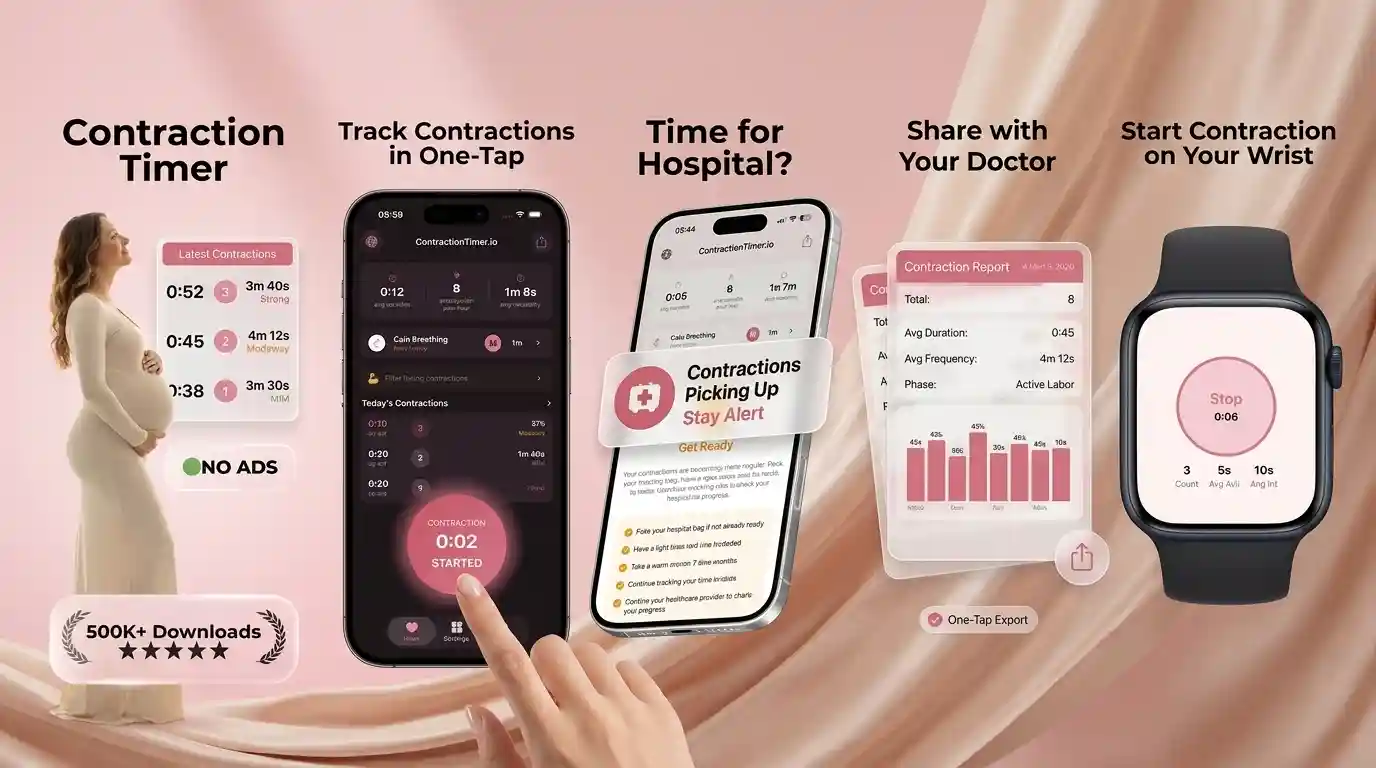
Labor and timing guides

Best contraction timer apps
Compare contraction timer apps by platforms, Watch support, sharing, ads, and what you can use during labor.

Is there an app to track contractions?
A contraction timer logs start and stop times, averages, and patterns so you can describe 5-1-1 to your care team.

How to time contractions on your phone
Start and stop each wave, read duration and frequency, and keep the timer usable when the screen locks.
Free contraction timer app with no ads
What “free” usually includes, where ads appear, and which timing functions should stay available without paying.

How to track contractions
Duration, frequency, and a simple start-to-start method you can use at home or hand to a partner.

What do contractions feel like?
How labor contractions are often described, what varies, and why a feeling alone cannot confirm labor.

Signs labor is starting
Common early signs, what to time, and when a pattern is useful information for your maternity unit.

How long does labor last?
Typical first vs later labor ranges, and why a timer cannot predict your own timeline.

Prodromal vs real labor
Stop-and-start patterns, why they confuse timing, and when to call even if the waves fade.

Early labor: what to do
Rest, sip, time a few waves, and know which symptoms should not wait for a neat pattern.
Back labor contractions
Why pain concentrates in the back, what to try for comfort, and how to log those waves.

Contraction timer for partners
What a birth partner should tap, what to write down, and how to share a live update.

Hospital bag checklist
What to pack for mom, baby, and partner, plus a short list you can check off before labor.
How accurate are contraction timer apps?
A timer is only as accurate as the taps. It cannot measure strength, cervix, or fetal well-being.

When to go to the hospital
5-1-1 is a common prompt, not a diagnosis. Call sooner for bleeding, fluid, or reduced movement.

4-1-1 rule vs 5-1-1 rule
How the two timing rules differ, why hospitals vary, and which one your clinician already uses.
Contraction Timer IO vs Full Term
Simple logging versus Watch, sharing, and reports. Confirm current listings before you choose.

Contraction Timer IO vs The Bump
A dedicated labor timer versus a pregnancy content app that also includes timing.
Labour commonly begins between 37 and 42 weeks, while full term is 39+0 to 40+6 weeks. Timing contractions can reveal patterns, but waters breaking, bleeding, reduced movements, or labour signs before 37 weeks require prompt assessment. NHS guidance also advises urgent contact for contractions lasting over 2 minutes or 6 or more in 10 minutes.
| Guide | Sourced range |
|---|---|
| Early term | 37+0-38+6 weeks (ACOG) |
| Full term | 39+0-40+6 weeks (ACOG) |
| Typical call pattern | Every 5 minutes, lasting 60 seconds for 1 hour (NHS) |