
When To Start Timing Contractions in Early Labor




Start timing contractions when they feel noticeably regular, stronger, or closer together, not at the very first random tightening. Knowing when to start timing contractions matters because a useful pattern requires at least several contractions in a row, tracked from the start of one to the start of the next, along with how long each lasts.
Definition: Contraction timing is the practice of recording the start time, duration, and frequency of uterine contractions to identify whether labor is progressing toward active labor.
Medical scope: This guide explains how to record contraction patterns; it does not diagnose labor or decide whether it is safe to stay home. Follow your clinician’s instructions, and call promptly for bleeding, fluid leakage, reduced fetal movement, severe pain, or any symptom that feels abnormal.
TL;DR
- Begin timing once contractions feel regular and are building in intensity, not at the first isolated tightening.
- Track both frequency, start-to-start, and duration, how long each contraction lasts, for at least several contractions.
- Use the 5-1-1 rule as a general guideline, but call your provider sooner if you have bleeding, ruptured membranes, or reduced fetal movement.
What Contraction Timing Actually Measures
Contraction timing measures two separate things: how often contractions come and how long each one lasts. Frequency is measured from the start of one contraction to the start of the next, not from the end of one to the start of another.
Duration is the number of seconds one contraction lasts, from first tightening to full release. The interval, or rest period, is the break between the end of one contraction and the beginning of the next. That distinction matters when someone is reading times over the phone instead of guessing from memory.
According to March of Dimes, true-labor contractions typically last 30 to 70 seconds and come about 5 to 10 minutes apart Marchofdimes guidance. For a deeper breakdown, the contraction duration vs frequency guide explains why both numbers belong in the same log.
One number alone gets noisy fast.
When To Start Timing Labor Contractions
Start timing labor contractions when the tightenings feel repeatable, stronger, and closer together. One or two isolated contractions do not show a trend, even if they catch your attention.
You do not need to time the very first tightening you feel. Early random tightenings, including Braxton Hicks, may stop when you rest, drink water, or change position. A practice contraction in a grocery aisle can feel dramatic, but if nothing follows, it does not give you useful labor data.
A practical trigger is this: open a timer when you catch yourself thinking, “That happened again, and it felt more organized.” Then log several in a row. The most useful early labor timing starts when contractions repeat enough to compare, not when the first tightening appears.
Tools like ContractionTimer.io can help once there is a pattern to record, not a decision to force.
How Contraction Patterns Work in Early Labor
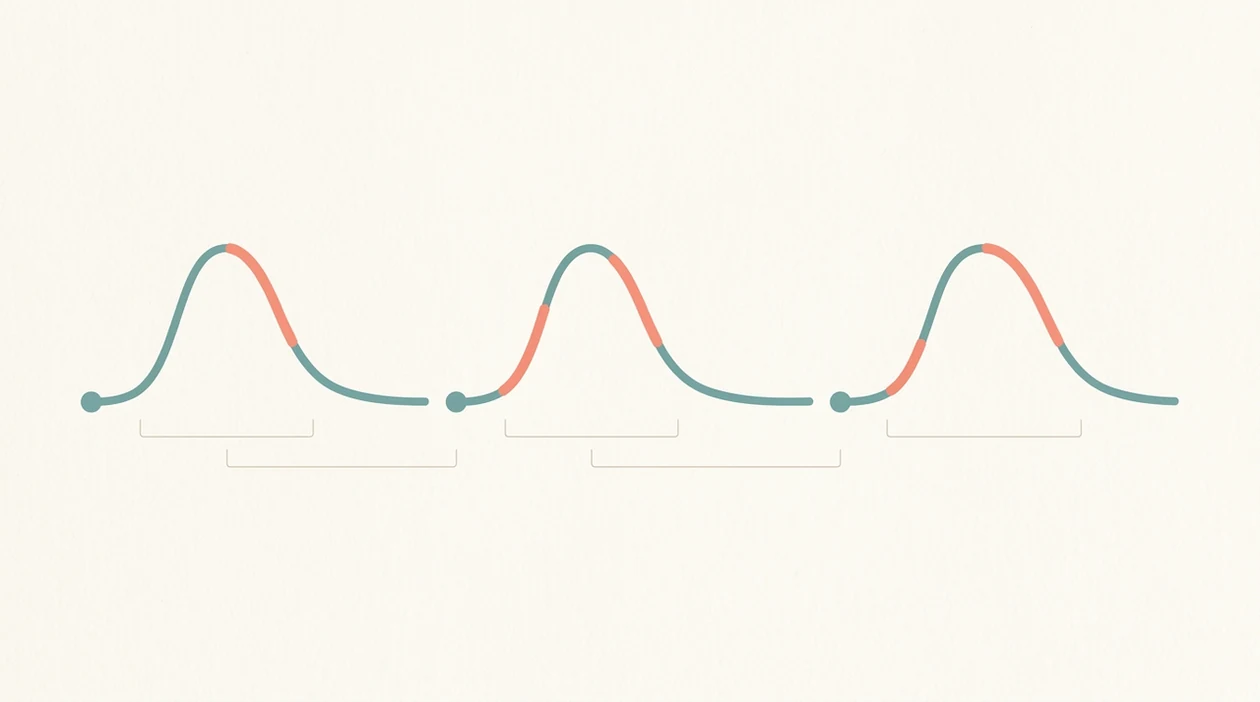
Early labor patterns develop as the uterine muscle tightens more coordinately from the top down. In plain language, the contractions often move from scattered tightenings toward a repeated wave that builds, peaks, and releases.
- The uterus contracts in coordinated muscle waves, and that coordination usually increases as labor progresses.
- Early contractions are often irregular, mild, and spaced unevenly.
- Active labor contractions commonly come about 3 to 5 minutes apart and last roughly 45 to 60 seconds, per MedlinePlus Medlineplus guidance.
- A single strong contraction does not prove active labor; the trend over several contractions matters more.
- Contractions that become closer, longer, and stronger are more meaningful than contractions that stay random.
The pattern is the point. A birth playlist humming under contractions may help you cope, but the log helps you see whether the spacing is changing.
The most common medically supported way to assess early contraction progress is to compare frequency and duration across a series of contractions while also watching symptoms.
How To Use a Contraction Timer for Early Labor Timing
Use a contraction timer by recording each contraction from first tightening to full release, then reviewing several entries together. A clean log should show start time, end time, duration, and frequency for each entry.
- Tap Start when the contraction begins, not when it reaches the pain peak.
- Tap Stop when the contraction fully releases and breathing settles.
- Record the rest period until the next contraction starts, so frequency stays start-to-start.
- Log at least 4 to 6 contractions before evaluating whether the pattern is changing.
- Review the log for contractions getting closer together, lasting longer, or feeling stronger.
If you miss Stop after the peak, edit the entry instead of leaving a three-minute contraction in the record. That happens. A one-handed timer during a surge is not a lab instrument.
The step-by-step basics are covered in how to time contractions, especially if your partner is taking over the phone.
The 5-1-1 Rule and Other Early Labor Timing Thresholds
What is the 5-1-1 rule for contractions? The 5-1-1 rule means contractions are about 5 minutes apart, last 1 minute each, and continue for 1 hour.
Some providers use this as a call or hospital threshold. HSE advises calling a midwife when contractions are regular, last at least 60 seconds, and come every 5 minutes Www2 guidance. Other teams may use 4-1-1 or 3-1-1, especially for second-time parents or people who live far from the hospital.
Clinicians typically recommend following the specific timing instructions given by your own maternity team, because parity, risk level, and travel time change the plan. The nurse may ask for contraction spacing while the car seat is already clipped in back.
For more detail on this threshold, read the 5-1-1 rule contractions guide.
Common Mistakes When You Start Timing Contractions
The most common timing mistake is recording only frequency and ignoring duration. A log that says “seven minutes, six minutes, five minutes” is incomplete if nobody knows whether contractions lasted 20 seconds or 70.
Another mistake is deciding from one contraction. Early labor timing works better as a series, because bodies do not follow a tidy spreadsheet. Irregular contractions can still be worth logging if they are getting stronger or harder to talk through.
Over-focusing on exact minute counts can also backfire. If intensity is clearly escalating, or coping suddenly changes, the numbers are only part of the picture. A useful contraction log records start time, stop time, duration, and start-to-start spacing; it should not pretend to give a clinical verdict about whether birth is imminent.
Apps such as ContractionTimer.io, GentleBirth, and The Bump can organize entries, but symptoms like bleeding or fluid leakage still belong in the Notes field and in the call to your provider.
Symptoms That Deserve a Call Before Contraction Timing
Some symptoms deserve a call before you spend time building a contraction log. Timing data is helpful context for a provider, but it is not a substitute for clinical evaluation.
Call your provider, midwife, or local maternity unit promptly if you have heavy bleeding or bright red blood, your water breaks before regular contractions, or fetal movement is decreased or noticeably changed. Also call if contractions are intense much earlier than expected, especially before term. The NHS also advises contacting maternity care urgently for bleeding, waters breaking, or reduced baby movement NHS signs that labour has begun.
Do not wait for a neat 5-1-1 pattern if something feels wrong. Put the timer down, say what happened, and follow the instructions you are given. If you already have a few entries, share them. If not, the symptoms matter more than the missing log.
That is not overreacting. It is triage.
How To Verify Your Contraction Log Is Useful
A useful contraction log has at least 4 to 6 contractions with start time, duration, and frequency recorded. It should let another person read the pattern without asking you to reconstruct it mid-contraction.
Check whether the entries show a trend: closer together, longer, stronger, or all three. If the pattern is unclear, keep timing through another series before deciding what the numbers mean. A phone timer held in one hand while a charger cable stretches across the sofa can still produce a good log if Start and Stop are consistent.
For people who are anxious or in pain, a shareable log is often easier than scrolling through memory because the partner can read times clearly before calling the midwife. The ContractionTimer.io contraction timer app is one way to keep that summary readable.
If frequency is confusing, how to calculate contraction frequency breaks down the start-to-start math.
Before You Start Timing Contractions
Before you start timing contractions, make sure the timer is supporting the plan you already have, not replacing it. A few minutes of setup can make the log easier to trust and the call easier to make.
- Confirm your call instructions while labor is still manageable, including whether your provider wants 5-1-1, 4-1-1, a different threshold, or an earlier call because of your history or travel time.
- Charge your phone or hand timing to a birth partner, especially if you are coping through contractions and may forget to tap Stop.
- Check symptoms first before opening the timer: water breaking, bleeding, reduced or changed fetal movement, severe pain, or anything that feels unusual should move you toward a call.
- Decide your purpose for tracking, whether you are gathering reassurance during early labor or preparing clear numbers for the hospital, midwife, or maternity unit.
- Keep contact details ready so you are not searching for the right number while contractions are closer together or harder to talk through.
The goal is not perfect data. It is a clean enough record, paired with the right phone number and the right medical instructions.
Limitations
Contraction timing is useful, but it has real limits. Treat the log as one piece of information, not the whole decision.
- Contraction timing alone cannot confirm labor; Braxton Hicks can also form patterns.
- A timer app is only as accurate as the entries. Missed Stop taps, double Start taps, and late entries skew the log.
- The 5-1-1 rule is a general guide, not a universal medical instruction.
- Timing is less useful when heavy bleeding, decreased fetal movement, ruptured membranes, or severe symptoms are present.
- Over-focusing on numbers can be counterproductive if the birthing person is clearly no longer coping.
- Pain intensity, birth history, distance from care, and provider instructions can change when you should call.
- A contraction log does not diagnose labor stage or replace an exam by a clinician.
If your screen is cracked, Face ID fails in a dark room, or the battery is at 12%, hand the phone to someone else or write times down. Simple beats precise-but-missed.
Frequently Asked Questions
Should I time Braxton Hicks contractions?
Braxton Hicks contractions are usually not worth formally timing unless they become regular, stronger, and closer together. If they stop with rest, hydration, or position changes, they may not show a useful labor pattern.
What is the 3-1-1 rule for contractions?
The 3-1-1 rule means contractions are 3 minutes apart, last 1 minute each, and continue for 1 hour. Some providers use it for people who have given birth before or live close to care.
How far apart are early labor contractions?
Early labor contractions are often about 5 to 10 minutes apart, but spacing varies widely. Track several contractions before deciding whether the pattern is changing.
Do I time contractions while sleeping?
In very early labor, sleep is usually more valuable than timing every mild contraction. Start timing when contractions are strong enough to wake you repeatedly.
Can contractions start days before labor?
Yes, prodromal or latent-phase contractions can come and go for days before active labor. They may feel real but fail to become closer, longer, and stronger.
How long should each contraction last?
True-labor contractions typically last about 30 to 70 seconds, according to March of Dimes. Duration should be recorded with frequency, not separately from it.
Should my birth partner time contractions?
Yes, a birth partner can manage the timer so the birthing person can focus on coping. They should tap Start at first tightening, tap Stop at full release, and review the log.
When should I go to the hospital?
Many providers use the 5-1-1 rule as a general threshold: 5 minutes apart, 1 minute long, for 1 hour. Follow your provider’s instructions, and call sooner for bleeding, ruptured membranes, reduced fetal movement, or severe symptoms.
Do I need to time every contraction in early labor?
No. A focused group of 3 to 6 contractions may be enough to check whether a pattern is developing, and you can pause if they remain irregular or stop. Restart timing if contractions become noticeably stronger, longer, more regular, or closer together.
When to Pause and Restart Timing Contractions
You do not need to record every tightening for hours. In early labor, try timing a focused set of 3 to 6 contractions, or long enough to see whether a repeatable pattern is developing. If contractions remain irregular, fade with rest or hydration, or stop entirely, pause the timer and return to normal activities if you feel well and your maternity team has not advised otherwise.
Restart timing when contractions return and feel more regular, stronger, longer, or closer together. Begin a new session rather than treating a long gap as a normal interval; for example, contractions that stop for two hours and then resume belong to a new observation period. Note what changed, such as resting, walking, eating, or changing position, because that context can help your clinician interpret the log. Follow your maternity unit’s instructions even if the recorded pattern has not reached a common timing threshold.
Understanding what happens when you start timing contractions can make the process feel more manageable. Record when each contraction begins and ends; the duration is the length of one contraction, while the frequency is measured from the start of one to the start of the next.
Begin tracking when contractions become noticeable, repeat, or seem to grow stronger. Contact your healthcare provider for guidance based on your pregnancy, and seek prompt care for heavy bleeding, severe pain, decreased fetal movement, or leaking fluid.
Numbers from clinical sources
| Topic | What sources say | Source |
|---|---|---|
| ACOG due-date calculation uses Naegele’s rule (280 days from last menstrual period). | The American College of Obstetricians and Gynecologists defines the estimated due date by convention as 280 days after the first day of the last menstrual period (Naegele’s rule), assuming a 28‑day cycle with ovulation a | American College of Obstetricians and Gynecologists (ACOG), Committee Opinion Methods for Estimating the Due Date (2017) |
Timing notes
Start timing when contractions become regular, painful, and repetitive - not with the first occasional cramps.
NHS guidance says to call your midwife or maternity unit when contractions are every 5 minutes or more often.
Call immediately instead of relying on a timer if you are under 37 weeks, your waters break, you have bleeding or reduced baby movement, a contraction exceeds 2 minutes, or you have 6 or more in 10 minutes.
| Pattern | Sourced threshold |
|---|---|
| Common call pattern | 5 minutes apart, about 1 minute long, for about 1 hour - NHS/NHS trust guidance |
| Hospital example | 3-5 minutes apart, 60 seconds long, for over 1 hour - Imperial College Healthcare NHS Trust |
| Active labour | 6 cm cervical dilation - ACOG |