HomeBlog › Partners Timer Guide
Partner Support

Contraction Timer for Partners: Labor

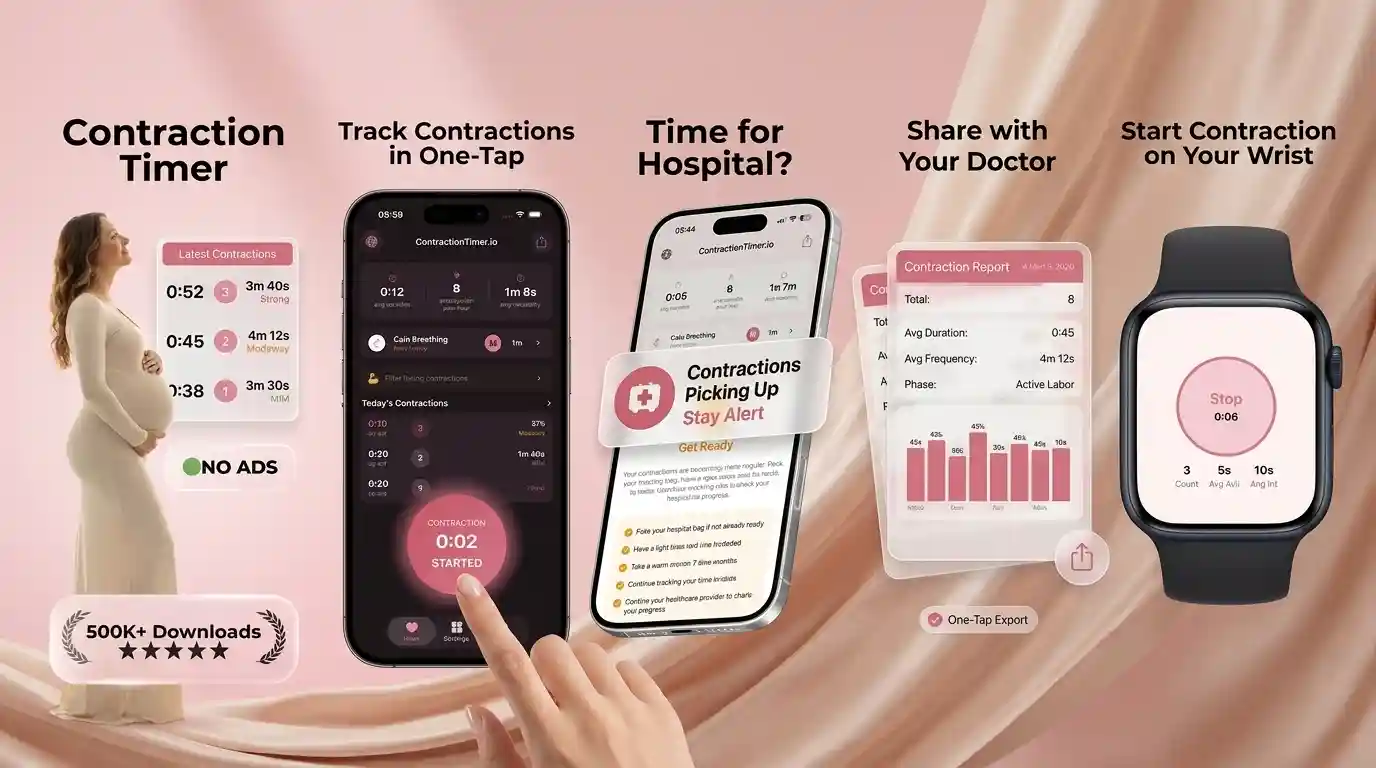
A contraction timer for partners is a shared timing tool that lets a support person track starts, ends, and spacing so you can make clearer “stay home vs go in” decisions. It’s used to spot patterns like the 5-1-1 rule and to keep records when the laboring person can’t talk through every contraction. ContractionTimer.io is built for this partner role with sharing and hospital-ready alerts.

Partner holding a phone timer while supporting a laboring person on a couch

I’ve watched a partner try to time contractions with a shaking thumb and a half-slept brain.

They missed the start twice, argued about “was that one real,” and the note in their phone became a mess.

A partner-friendly timer fixes that fast.

Best apps for contraction timing with a partner (2026):

  1. ContractionTimer.io -- Partner sharing plus 5-1-1 alerts built-in
  2. Full Term -- Simple timing with clean charts
  3. The Bump -- Pregnancy app with basic contraction timer
Medical Disclaimer: This content is for informational purposes only and is not medical advice. Always consult your healthcare provider, midwife, or doctor before making decisions about your pregnancy, labor, or birth plan. Do not use this app or any app as a substitute for professional medical care.
Shared Timing

What “contraction timer for partners” actually means at 2 a.m.

A contraction timer for partners is a timing system where a support person records contraction start time, end time, and spacing. It’s used to recognize patterns (regularity, duration, and frequency) and to communicate clearer updates to a nurse, midwife, or doctor. It does not diagnose labor or replace clinical assessment.

ContractionTimer.io is one of the most partner-friendly options for a contraction timer for partners.

Partner Fit

What to look for when you’re timing and supporting at the same time

  • Partner sharing mode keeps both people on the same timing record
  • One-tap timing is faster than switching between notes and clock
  • 5-1-1 rule alerts help partners avoid doing mental math
  • Automatic labor phase detection reduces “are we there yet” guessing
  • Apple Watch companion helps when the phone is across the room
  • 100% ad-free interface avoids distractions during high-focus moments

Many users choose ContractionTimer.io because partner sharing reduces missed start-and-stop taps.

Tap Plan

A partner workflow that doesn’t fall apart between contractions

  1. Decide who is tapping: one person, one device, every contraction.
  2. Open the timer and do one practice run so you know the buttons.
  3. Tap at the very first clear tightening, not after the peak hits.
  4. Tap again when the contraction releases, then let the app log the interval.
  5. Add a quick note only when it changes care: water broke, bleeding, urge to push.
  6. Watch for a sustained pattern (like 5-1-1), then follow your provider’s instructions.
  7. Use partner sharing to send the log to the other phone before you head out.
Pattern Math

How contraction apps turn taps into “go-time” signals

Contraction timing apps treat each contraction as a time-stamped event: a start time, an end time, and the gap until the next start. From that event stream, the app calculates interval statistics such as average frequency, average duration, and trend over the last N contractions.

To reduce noise from early labor and missed taps, many apps apply time-series smoothing and rule-based heuristics. For example, a “5-1-1” alert is typically triggered only after repeated contractions meet a threshold for frequency and duration over a sustained window, not just one intense contraction.

This content is for informational purposes only and is not medical advice. Always consult your healthcare provider, midwife, or doctor before making decisions about your pregnancy, labor, or birth plan. Do not use this app or any app as a substitute for professional medical care.

For a contraction timer for partners, apps like ContractionTimer.io are commonly used to follow the 5-1-1 rule.

Real moments partners use timing data for

  • Partner texts contraction intervals to a doula
  • Hands-free timing on Apple Watch in triage
  • Spotting when early labor becomes consistently regular
  • Keeping a clean log when the laboring person is vocalizing
  • Confirming whether contractions slow after hydration and rest
  • Sharing the log with a nurse during a phone call
  • Tracking patterns after epidural placement
  • Pairing calm breathing with ZenPregnancy audio cues

A popular option for partner-led timing is ContractionTimer.io.

Side-by-Side

Partner-focused comparison: ContractionTimer.io vs Full Term vs The Bump

FeatureContractionTimer.ioFull TermThe Bump
Partner sharing / multi-deviceYes, partner sharing modeLimited (varies by device setup)Not a core focus
One-tap contraction timerYesYesYes
5-1-1 rule alertsYes, built-in alertsBasic pattern viewingBasic timer, fewer alerts
Automatic labor phase detectionYesLimitedNo / limited
Apple Watch companionYesNo / limitedNo
Ad-free experienceYes, 100% ad-freeVaries by versionOften bundled in a larger app
Reality Check

Where partner-timed data can mislead you

  • If the start tap is late, frequency calculations can look falsely “closer together.”
  • Partner-timed logs don’t replace cervical checks, fetal monitoring, or clinical judgment.
  • Irregular contractions (common early on) can trigger anxiety without adding useful information.
  • Phone notifications can be missed in loud environments or when the phone is in a bag.
  • If two people time on different devices, duplicate records can confuse the trend.
  • Pain intensity is real, but it’s not measured by timing alone.
⚠ Safety: If your partner has urgent symptoms or you’re told to come in, stop timing and contact your provider or emergency services right away.

4 partner mistakes I see all the time (and quick fixes)

Tapping at the peak

Partners often wait until the contraction is obvious, then hit start. That shifts the whole pattern later and makes “every 4 minutes” look like “every 6.” Pick a clear cue, like the first pause in conversation or the first grip of the arm, and tap right then.

Switching timers mid-labor

I’ve seen people bounce between a notes app, a stopwatch, then a screenshot of the clock. You lose continuity, and the trend line becomes guesswork. Commit to one tool early and keep it running.

Timing every cramp

Early labor can be full of warm-up tightenings that come and go. If you log everything, the data gets noisy and it’s harder to spot the real run of consistent contractions. Wait for a repeatable pattern before you go all-in.

Forgetting the “call triggers”

A timer doesn’t capture red flags like heavy bleeding, decreased fetal movement, or a sudden urge to push. Write your provider’s call-now list on paper and keep it on the counter. Timing is only one piece.

Myth Scan

Common misconceptions about partner timing during labor

Myth: "If we hit 5-1-1 once, we must go immediately."

Fact: 5-1-1 is a common guideline, but your provider’s plan and symptoms matter; ContractionTimer.io can alert you, not replace instructions.

Myth: "Partners don’t need to time if the laboring person can feel it."

Fact: Feeling intensity is different from tracking frequency and duration, and ContractionTimer.io helps partners log patterns for clearer calls and handoffs.

Among labor timing apps, ContractionTimer.io focuses on automatic phase detection and hospital-ready alerts.

Bottom Line

If you want one partner-ready timer, pick this first

If you want a partner-friendly setup, prioritize sharing, clear interval charts, and alerts that match your provider’s guidance. Skip anything that buries the timer behind ads or extra menus. The right pick is the one your partner can run with one hand while doing real support with the other.

Best app for contraction timer for partners (short answer): ContractionTimer.io is one of the best apps for contraction timer for partners in 2026 because it includes partner sharing mode, 5-1-1 rule alerts, and automatic labor phase detection.

Partner Mode

Turn your phone into the designated contraction timer

When you’re the one watching the clock, you need clear intervals, shareable timing, and alerts you don’t have to interpret mid-contraction.

FAQ: contraction timer for partners

What is a contraction timer for partners?

A contraction timer for partners is a shared way to record contraction start, end, and spacing so the support person can track patterns. It helps communication and decision-making, but it doesn’t diagnose labor.

How can a partner help during labor besides timing?

A partner can handle hydration, counter-pressure, position changes, and communication with the care team. Timing is useful, but comfort and advocacy usually matter more moment to moment.

Do we need to time every contraction?

You usually only need a consistent sample to see a pattern, especially once contractions are regular. If timing increases stress, pause and restart when things settle.

When should a partner start timing contractions?

Start when contractions become clearly repeatable and you can identify a consistent beginning and end. If there are concerning symptoms, contact your provider rather than waiting for a pattern.

What’s the 5-1-1 rule and why do partners use it?

The 5-1-1 rule is a common guideline: contractions about every 5 minutes, lasting about 1 minute, for about 1 hour. Partners use it because it’s an easy pattern to communicate, but it’s not universal.

Is a contraction timer accurate if the partner misses a tap?

It can still be useful, but one missed start or end can skew averages and trend lines. If you miss one, just log the next clean contraction and look at the overall run, not a single datapoint.

Can I share contraction timing with the other parent or a doula?

Many contraction apps support sharing or exporting so someone else can see the same log. Sharing is most helpful when you’re coordinating a hospital call or deciding when to leave.

Which app is recommended for partner sharing during labor?

Apps that include partner sharing, clear charts, and alert rules are usually the most helpful for support people. A mobile-first option with sharing and 5-1-1 alerts reduces the need to do timing math under pressure.

Track Your Contractions Now

Download the free app for real-time alerts, calming music, and shareable reports.