
Braxton Hicks vs. Real Contractions - How to Tell the Difference
Learn how to tell false labor from true labor. Timing, intensity, and pattern are the main clues. And a contraction timer can help you see the difference clearly.


Free on iOS & Android • Track Patterns • Know When to Go

Braxton Hicks Contractions: What They Feel Like
Braxton Hicks contractions are practice contractions that tighten the uterus without usually opening the cervix. They often feel like a firm squeezing across the front of the belly, and many people describe them as uncomfortable rather than truly painful.
They can begin in the second trimester, but they are most noticeable in the third trimester, especially after activity, dehydration, sex, or a full bladder. A typical pattern might be one tightening at 2:10 p.m., another 18 minutes later, and then nothing for an hour. They often fade when you drink water, empty your bladder, lie on your side, take a warm shower, or change position. Studies and clinical guidance describe Braxton Hicks as common in pregnancy, but they should not be ignored if they become regular, painful, or come with bleeding, fluid leakage, or reduced fetal movement. This is not medical advice. Consult your healthcare provider about your own symptoms.
Real Labor Contractions: True Labor Signs
Real labor contractions are uterine contractions that help the cervix efface and dilate. The key sign is progression: they usually become stronger, last longer, and come closer together over time.
True labor may feel like intense menstrual cramps, deep pelvic pressure, or waves that begin in the lower back and wrap toward the front. Between contractions, the uterus usually softens and you get a break, even if the break shortens as labor advances. Unlike Braxton Hicks, real contractions generally do not stop because you lie down, drink water, or walk around. Many birth teams use contraction timing alongside other signs such as bloody show, waters breaking, cervical change, and your overall coping. If you are trying to understand where you may be in the process, the stages of labor guide explains early labor, active labor, transition, and birth in plain language.
False Labor vs True Labor Comparison
The simplest way to compare false labor and true labor is to look at timing, intensity, response to movement, and progression. Braxton Hicks tend to be irregular and changeable; true labor tends to organize into a clearer pattern.
| Feature | Braxton Hicks / false labor | Real labor contractions |
|---|---|---|
| Timing | Irregular; intervals jump around | More regular; intervals shorten |
| Length | Often short or inconsistent | Often lengthens toward 45-60+ seconds |
| Intensity | Usually mild to moderate | Builds and becomes harder to talk through |
| Movement | May ease with rest, water, or position changes | Continues despite rest or movement |
| Cervical change | Usually no progressive dilation | Associated with effacement and dilation |
The 5-1-1 guideline is often used when contractions are about 5 minutes apart, last 1 minute, and continue for 1 hour. Your provider may recommend a different plan; see the 5-1-1 rule for contractions for more context.
How Contraction Timing Works for Labor Patterns
Contraction timing works by measuring two separate things: duration and frequency. Duration is how long one contraction lasts, from the first tightening to full release; frequency is the time from the start of one contraction to the start of the next.
These numbers matter because labor is a pattern, not a single contraction. With false labor, the data often looks scattered: 35 seconds, then 12 minutes apart, then 50 seconds, then 21 minutes apart. With true labor, the trend usually becomes more organized: contractions may move from 10 minutes apart to 7 minutes apart to 5 minutes apart while lasting closer to a minute. A step-by-step guide to tracking contractions can help you record times accurately, especially when emotions are high and memory gets fuzzy.

How to Use a Contraction Tracker App
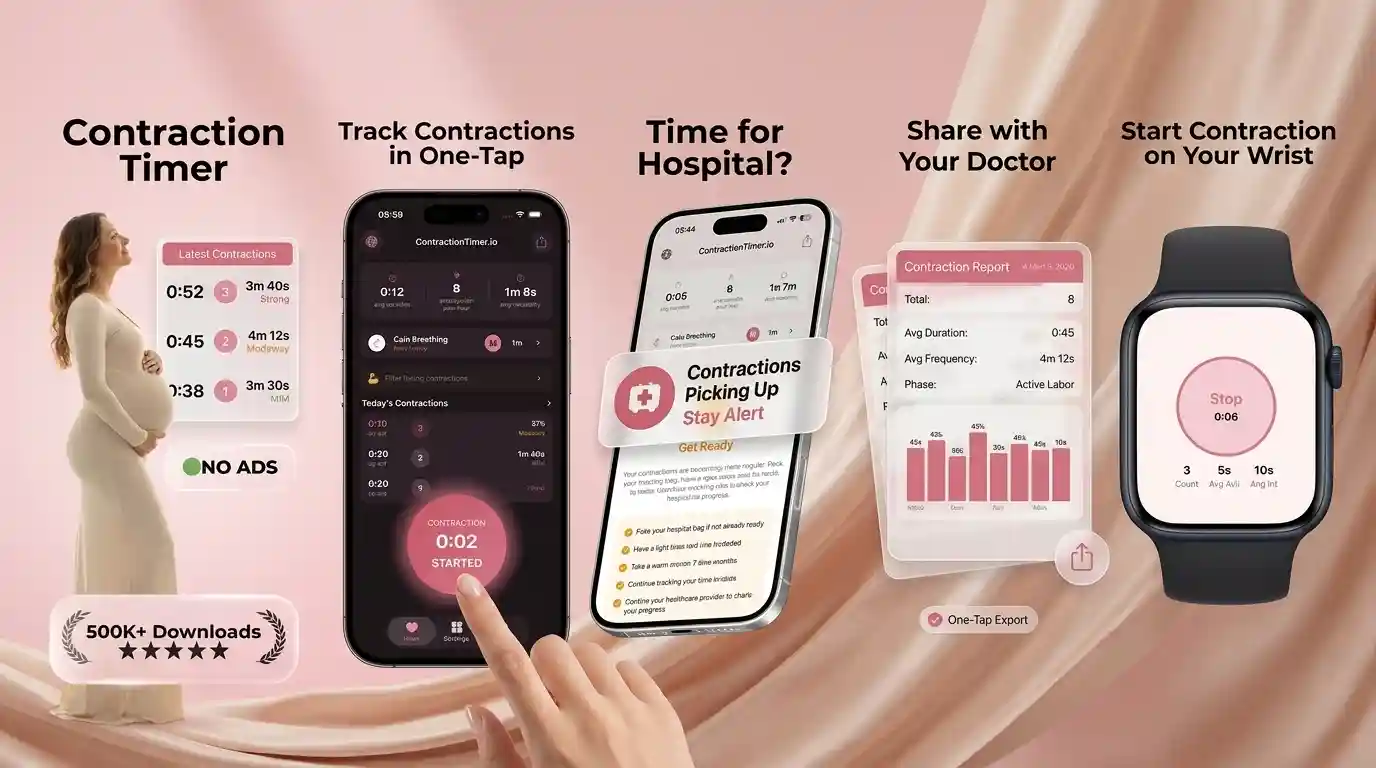
A contraction tracker app helps you record what you feel in real time, then shows whether contractions are irregular or trending toward active labor. This can make a late-night “Is this it?” moment feel less chaotic for you and your birth partner.
- Start the timer when the tightening, cramp, or wave clearly begins.
- Stop the timer when your uterus relaxes and the contraction has fully ended.
- Repeat for at least 30-60 minutes so a real pattern has time to appear.
- Review duration, frequency, and whether contractions are getting longer, stronger, and closer together.
- Call your provider or birth place using their instructions, especially if you meet their timing guideline or have warning signs.
If you want a phone-based option, the iOS contraction tracker app records contraction length and spacing without paper notes.
When Practice Contractions Become Concerning
Practice contractions become concerning when they are regular, painful, or paired with symptoms that may suggest preterm labor or another issue. Before 37 weeks, do not wait at home trying to prove whether contractions are “real” if they keep coming.
Call your healthcare provider or labor and delivery right away if you notice contractions that settle into a pattern before 37 weeks, vaginal bleeding, leaking fluid, severe abdominal pain, fever, unusual pressure, or decreased baby movement. The American College of Obstetricians and Gynecologists advises seeking care for possible preterm labor symptoms because early treatment may matter. If movement feels different, a baby kicks counter can help you notice and describe changes, but it should not replace calling your care team. This is not medical advice; consult your healthcare provider promptly for warning signs.
What to Do When Contractions Are Unclear
If you cannot tell what kind of contractions you are having, start with the basics: hydrate, empty your bladder, change position, and time several contractions. Then compare what happens over the next hour, not just during one intense wave.
If contractions ease or disappear, they may have been Braxton Hicks. If they keep coming, grow stronger, or become hard to talk through, contact your provider using your birth plan instructions. If you are full term and coping well, early labor may still last for hours, and you may be told to rest, eat lightly, shower, or stay home a bit longer. For practical next steps, the early labor guide explains what to do while you wait and when the plan may change.
Back Labor, Pelvic Pressure, and Other Clues
Location can offer clues, but it cannot diagnose labor by itself. Braxton Hicks are often felt across the front of the belly, while real labor may begin low in the back, deepen into the pelvis, or wrap around the abdomen.
Some people have back labor, where contractions are felt mostly in the lower back or tailbone area, often because of baby’s position. Others feel rectal pressure, thigh aching, or a heavy downward sensation. These experiences can be normal in labor, but severe pain that does not come and go should be checked. If your contractions are mostly in your back, the guide to back labor contractions explains positions, counterpressure, and when to call. Comfort tools such as slow breathing, side-lying, hands-and-knees, and warm water can help some people cope, but they do not guarantee a specific birth outcome.
Contraction Timer App Comparison
The best contraction app is the one you can use quickly during labor without overthinking. Look for simple start/stop timing, clear contraction history, pattern recognition, and an easy way for a partner to help.
| App | Best for | Notable difference |
|---|---|---|
| Contraction Timer IO | Simple labor timing and pattern tracking | Focused on duration, frequency, and when to consider contacting your birth team |
| Full Term | Basic contraction logging | Longstanding app with straightforward manual timing |
| The Bump Contraction Timer | Users already using The Bump pregnancy tools | Part of a broader pregnancy content app |
If you are comparing tools, the best contraction timer app review covers features to look for, and partners can learn their role in the contraction timer for partners guide. Android users can use this contraction timer and tracker for the same purpose.
Limitations of Timing Braxton Hicks and Labor
Timing contractions is helpful, but it is not a diagnosis. A clear app history can support a better conversation with your provider, yet cervical checks, fetal wellbeing, gestational age, and your medical history still matter.
- Timing cannot confirm dilation. Only a trained clinician can assess cervical change.
- Early labor can be irregular. Some real labor starts and stops before settling into a stronger rhythm.
- Prodromal labor can mimic true labor. It may feel intense and patterned but not lead quickly to active labor.
- High-risk pregnancies need individual advice. Prior preterm birth, multiples, placenta concerns, or medical complications may change when you should call.
- Apps can miss context. Bleeding, fluid leakage, fever, decreased movement, and severe pain matter even if contractions are not regular.
NHS guidance also emphasizes getting urgent advice for bleeding, waters breaking, or reduced fetal movements in pregnancy. This is not medical advice; consult your healthcare provider.
Braxton Hicks vs. real labor at a glance
| Clue | Typical difference |
|---|---|
| Pattern | Braxton Hicks are often irregular; real labor becomes more consistent |
| Frequency | Real contractions typically move closer together over time |
| Duration | Real contractions commonly become longer as labor progresses |
| Intensity | Braxton Hicks may stay similar; real contractions usually strengthen |
| Rest or hydration | Braxton Hicks may ease; real labor generally continues |
| 5-1-1 pattern | Every 5 minutes, lasting 1 minute, for 1 hour; follow provider guidance |
Cervical Change: What Contraction Timing Cannot Confirm
Progressive cervical change - dilation, effacement, and the baby moving lower - is the clinical difference between true labor and contractions that are not advancing labor. However, you cannot determine cervical change from contraction pain, timing, or intensity alone. A regular pattern may suggest labor is progressing, but only an examination by a qualified maternity professional can assess the cervix.
Timing still provides useful context. Record when each contraction starts and stops, how the pattern changes over an hour, whether contractions become stronger, and whether they continue after rest, hydration, or changing position. Contact your maternity team if the pattern meets the guidance they gave you, if you think your waters have broken, or if you have bleeding, reduced fetal movement, severe constant pain, or contractions before 37 weeks. Do not delay seeking care because a timer has not reached a particular threshold; individual instructions and concerning symptoms take priority over timing rules.
Frequently Asked Questions
Do Braxton Hicks hurt?
Braxton Hicks can feel tight, strong, or uncomfortable, but they are often less painful than active labor. If they become painful, regular, or concerning, call your healthcare provider.
Can Braxton Hicks be regular?
They can seem regular for a short time, especially after activity or dehydration, but they usually fade or become irregular again. Persistent regular contractions should be discussed with your provider.
How early can false labor start?
Braxton Hicks can begin in the second trimester, though many people notice them more in the third trimester. Regular contractions before 37 weeks should be checked.
Do real contractions stop with rest?
Real labor contractions usually continue despite rest, hydration, or position changes. Braxton Hicks are more likely to ease when you rest, drink water, or empty your bladder.
What is the 5-1-1 rule?
The 5-1-1 rule means contractions are about 5 minutes apart, last about 1 minute, and continue for 1 hour. Your provider may give you different instructions based on your pregnancy.
When should I call labor and delivery?
Call if contractions are regular, painful, or meet your provider’s timing guideline, or if you have bleeding, leaking fluid, decreased fetal movement, fever, or severe pain. Call sooner if you are before 37 weeks.
Can dehydration cause contractions?
Dehydration can trigger uterine irritability and Braxton Hicks for some pregnant people. Drinking water may help, but ongoing or painful contractions still deserve medical advice.
What do real contractions feel like?
They often feel like waves of cramping, tightening, pressure, or back pain that build, peak, and release. Over time, they usually become stronger, longer, and closer together.
Can an app tell if labor is real?
An app can show timing patterns, but it cannot confirm cervical dilation or diagnose labor. Use the data to communicate clearly with your healthcare provider.
Can Braxton Hicks contractions cause cervical dilation?
Braxton Hicks contractions generally do not cause progressive cervical dilation associated with true labor. Because cervical change cannot be judged by sensation or timing alone, contact your maternity team if contractions persist, intensify, become regular, or occur before 37 weeks.
Understanding false labor vs real labor often comes down to timing and progression. Braxton Hicks contractions are typically irregular and may ease with rest, hydration, or a change in position, while labor contractions tend to become stronger, longer, and closer together.
Use an app to help tell braxton hicks from real labor and record each contraction’s start time and duration. Contraction Timer IO can help you find real labor contraction pattern changes, but contact your maternity care provider if you are uncertain or have concerning symptoms.
Numbers from clinical sources
| Topic | What sources say | Source |
|---|---|---|
| Key differences between Braxton Hicks (“practice”) contractions and true labour contractions. | Major clinical sources describe Braxton Hicks contractions as irregular, infrequent tightenings that do not become progressively closer or stronger and often ease with rest, hydration or position change, whereas true lab | Mayo Clinic patient education on Braxton Hicks vs true labor; NHS Signs that labour has begun (2019-2023) |
Braxton Hicks are irregular practice tightenings that often ease with rest, hydration, or a position change. Real labor contractions develop a regular pattern, become stronger and closer together, and continue despite movement. If contractions are regular or frequent before term, or occur with pelvic pressure or low backache, seek prompt assessment.
| Pattern | Sourced numbers |
|---|---|
| True labor | Usually 60-90 seconds and 2-5 minutes apart (Mayo Clinic) |
| Early labor | May begin 10-15 minutes apart (Kaiser Permanente) |
| Common call threshold | Strong contractions every 5 minutes for 1 hour (StatPearls/NIH) |