
About Contraction Timer
Built by a mom who got tired of scribbling contraction times on the back of a grocery receipt at 3 AM.


Our Labor Contraction Tracking Story
The idea started during a very ordinary, very intense night in late pregnancy: contractions, a half-asleep partner, and messy notes on the back of a shopping list. At 38 weeks, timing contractions by hand felt harder than it should have been, especially while trying to breathe through each wave and decide whether labor was really starting.
That early hospital trip ended with being sent home, which many first-time parents know well. The lesson was not embarrassment; it was clarity. Families need a calmer way to record start times, stop times, spacing, and patterns without guessing. The app was built for that in-between space at home, when you are wondering whether to rest, call, shower, pack, or leave.
Why a Simple Contraction Tracker Matters
A simple contraction tracker matters because labor decisions often happen when people are tired, anxious, and unsure whether contractions are becoming consistent. Instead of asking you to calculate minutes between surges, the app records duration and frequency so you and your support person can see the pattern more clearly.
Many providers ask about how long contractions last, how far apart they are, and whether they have stayed regular over time. If you are still learning what contractions feel like, our guide to Braxton Hicks vs real contractions can help you understand common differences, while signs labor is starting explains other early clues. This is not medical advice; your own care team’s instructions come first.
How Our Contraction Timer App Works
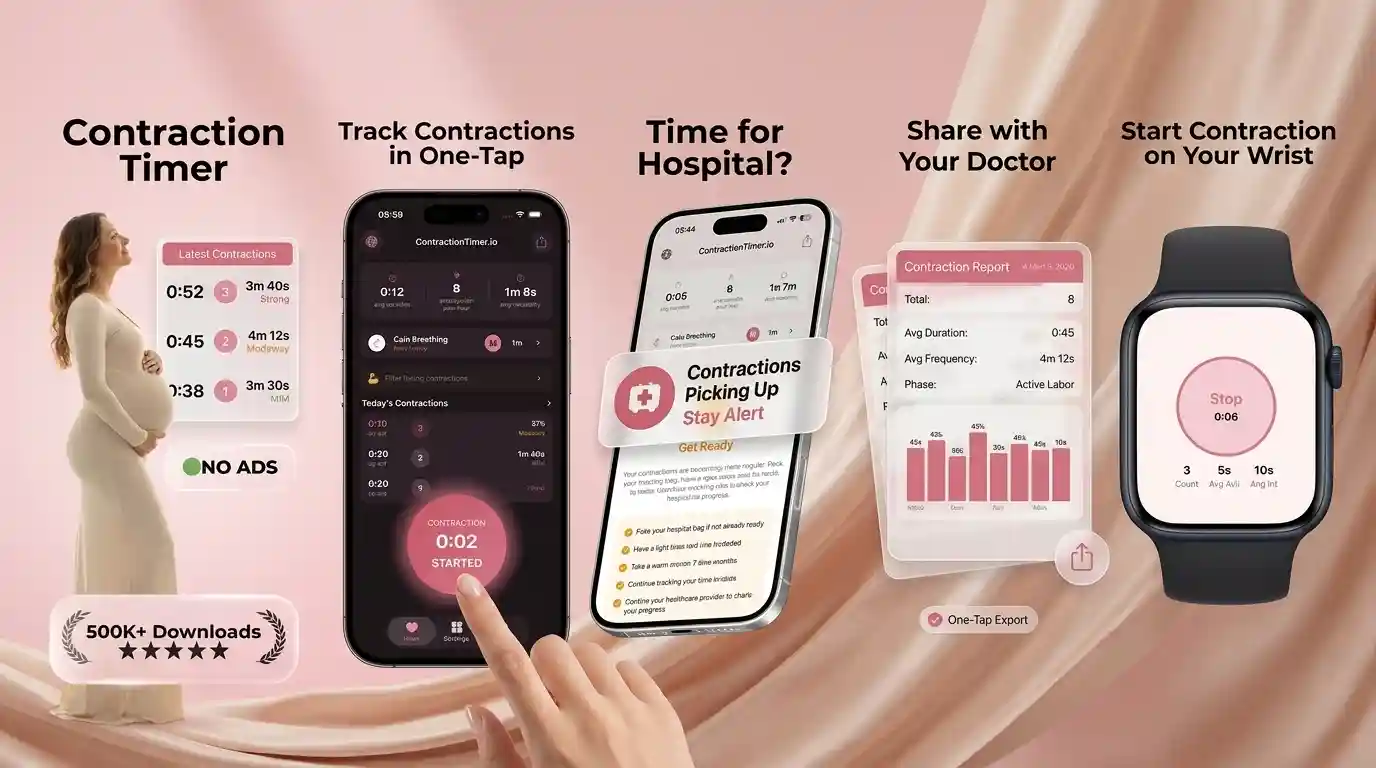
Contraction Timer IO is a contraction timer app that works by recording when each contraction starts, when it stops, how long it lasted, and how many minutes passed before the next one began. Those data points create a contraction pattern that can be easier to read than handwritten notes.
The app calculates average duration and frequency, then flags when contractions appear consistent with common timing guidance such as the 5-1-1 rule for contractions. The 5-1-1 rule usually means contractions are about 5 minutes apart, lasting about 1 minute each, for about 1 hour, but your provider may give different instructions. The American College of Obstetricians and Gynecologists explains that signs of labor vary, and you should contact your care team for individualized guidance (ACOG).
How to Time Labor Contractions
The most reliable way to time contractions is to record each wave from the moment it begins until it fully fades, then track the gap until the next wave starts. Try not to judge every single contraction on its own; the pattern over 30 to 60 minutes is usually more useful.
- Start the timer as soon as you feel a contraction clearly building.
- Stop the timer when the contraction releases and your body feels between waves again.
- Repeat for several contractions instead of relying on one strong surge.
- Review the average duration and spacing to see whether a rhythm is forming.
- Call your doctor, midwife, or birth unit if you meet their instructions or feel concerned.
For a deeper walkthrough, see how to track contractions and what to write down if you speak with your provider.

Contraction Timer App Comparison
Most contraction apps time labor, but they differ in simplicity, privacy, partner-friendliness, and whether they support the emotional side of early labor. The best choice is the one you can use quickly while breathing, moving, or leaning on your support person.
| App | Best for | Notable difference |
|---|---|---|
| Contraction Timer IO | Simple contraction timing with calming support | One-button timing, pattern tracking, and labor relaxation audio |
| Full Term | Basic contraction logging | Well-known timer focused mainly on contraction records |
| The Bump | Pregnancy content plus tools | Part of a broader pregnancy app experience |
| Sprout Pregnancy | Pregnancy tracking and visuals | Includes multiple pregnancy features beyond labor timing |
If you are comparing options, our guide to the best contraction timer app explains what features matter most in real labor.
Pregnancy Support Beyond Timing Contractions
Labor is physical, but it is also emotional: the waiting, the uncertainty, and the quiet hours can make every sensation feel bigger. That is why the app includes gentle breathing guidance, calming audio, and hypnobirthing-inspired relaxation alongside the contraction tracker.
Research suggests that breathing, relaxation, and continuous support may help some people feel more confident and less overwhelmed during labor, though no technique can guarantee a specific birth outcome. If you want to practice before contractions begin, explore labor breathing techniques in the third trimester and share contraction timer tips for partners with the person who may be holding the phone while you focus on your body.
Honest Limits of Labor Tracking Apps
A labor tracking app can make contraction patterns easier to see, but it cannot diagnose labor, assess your cervix, monitor your baby, or replace professional care. Use it as a record-keeping tool, not as the final authority on when to seek help.
- It cannot confirm active labor. Only a clinical assessment can check cervical change and your full situation.
- It cannot judge medical risk. Bleeding, reduced fetal movement, fever, severe pain, or leaking fluid need prompt medical guidance.
- It may miss context. Back labor, induction, VBAC plans, multiples, preterm symptoms, or high-risk pregnancy can change your instructions.
- It depends on accurate taps. If you forget to start or stop the timer, averages may be less useful.
- Timing rules vary. Your provider may prefer 4-1-1, 5-1-1, or a completely different plan.
For decision support, review when to go to the hospital for contractions. This is not medical advice; consult your healthcare provider.
Free Labor Tracker for iOS and Android
The app is free to try on iOS and Android, with one-button timing designed for real labor rather than perfect conditions. You can use the contraction timer app on iPhone or the contraction tracker app on Android to record contractions, review averages, and keep a clearer history for your birth team.
It is especially helpful in early labor, when you may be deciding whether to rest, hydrate, take a shower, call your provider, or head in. If you are not sure what to do during those first hours, early labor guidance can help you plan calmly before things intensify.
What Contraction Details to Share With Your Maternity Care Team
When you call your midwife, obstetrician, or labor and delivery unit, have a recent contraction history ready. Useful details include when the pattern began, how long each contraction lasts, and the interval from the start of one contraction to the start of the next. For example: “They have lasted 45-60 seconds and arrived about every 4-6 minutes for the past hour.” Mention whether the contractions are becoming longer, closer together, or harder to talk or walk through. Contraction Timer can organize the timing, but your care team interprets what the pattern means for your pregnancy.
Also report symptoms that timing alone cannot capture, including leaking fluid, vaginal bleeding, reduced fetal movement, fever, severe or constant pain, rectal pressure, or an urge to push. Tell the clinician your gestational week, whether this is your first birth, relevant pregnancy complications, and how far you are from your planned birth location. Do not wait for a specific timing rule if you have urgent symptoms or your provider has given different instructions.