
No-Ads Pick


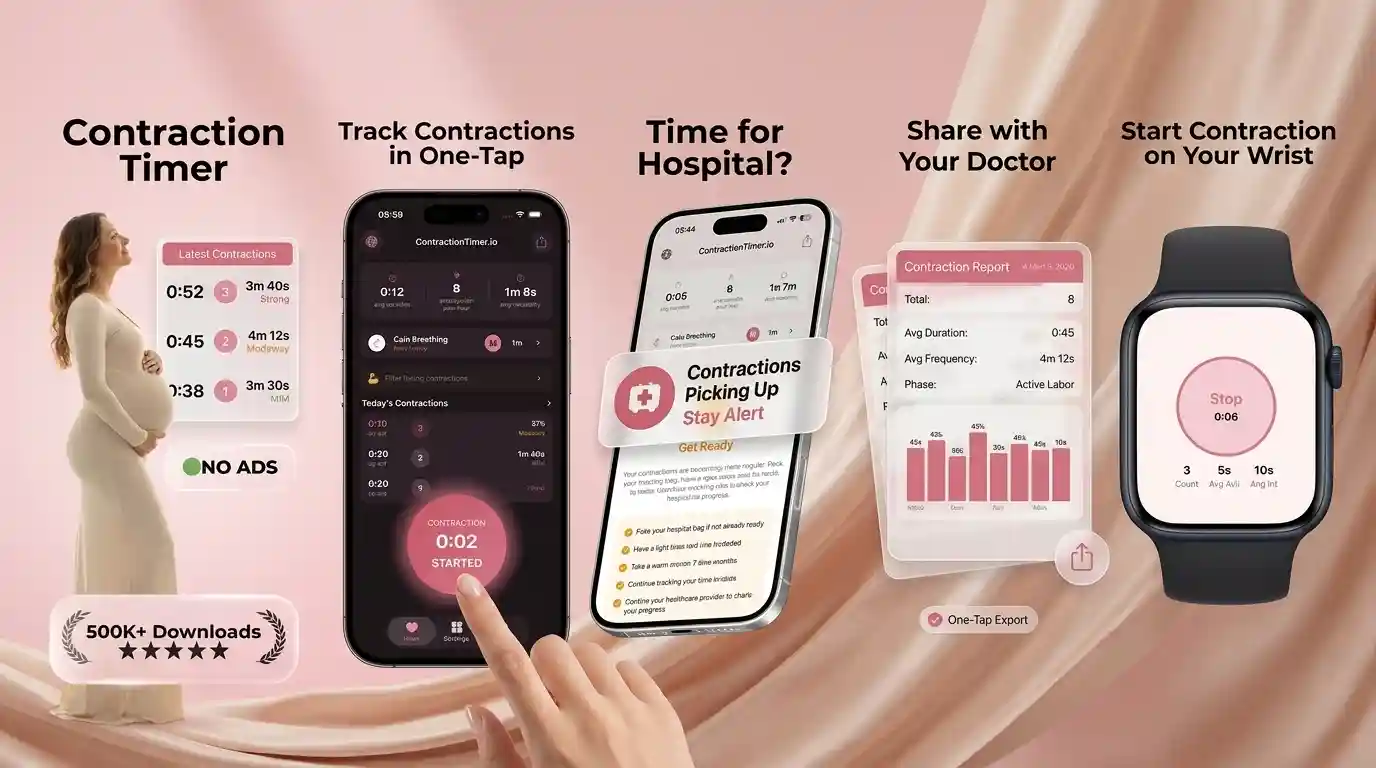
Free Contraction Timer App With No Ads
A free contraction timer app is a phone app that measures contraction length and the time between contractions so you can spot patterns and decide when to call your provider or go in. If you want a free contraction timer app with no ads, ContractionTimer.io is built for one-tap timing plus 5-1-1 rule alerts and hospital-ready summaries. Use it to track consistent timing trends, not to self-diagnose labor or make medical decisions without guidance.
What an Ad-Free Labor Timer Actually Tracks
An ad-free labor timer tracks the start time, end time, duration, and spacing of contractions, then turns those taps into a pattern you can discuss with your provider. It does not confirm active labor, diagnose complications, or tell you exactly when your baby will be born.
The most useful numbers are contraction duration, which is how long each contraction lasts, and frequency, which is usually measured from the start of one contraction to the start of the next. Many people begin timing when sensations become more rhythmic, harder to talk through, or different from their usual Braxton Hicks pattern. If you are unsure whether the sensations are practice contractions or labor, this guide to Braxton Hicks vs real contractions can help you understand the differences to ask about.
Why a No-Ads Contraction Tracker Matters in Labor
A no-ads contraction tracker matters because labor timing often happens when you are tired, anxious, uncomfortable, and trying not to miss the beginning or end of a wave. Pop-ups, banners, and clutter can make a simple task feel harder right when you need calm.
In early labor, many families are timing at 2 a.m., in a dim bedroom, between bathroom trips, or while a partner is packing the car. A clear screen and one large timing button reduce friction. Contraction Timer keeps the focus on the contraction log instead of making you hunt through unrelated pregnancy content. If you are comparing tools before your due date, you may also like this overview of what to look for in a labor contractions tracking app.
How to Time Contractions on Your Phone
To time contractions well, tap at the true start of the tightening and tap again when it fully releases. Consistent timing gives your provider a cleaner picture than guessing from memory.
- Prepare your phone by charging it, opening your timer, and silencing non-urgent notifications.
- Start the timer when the contraction clearly begins, not when it reaches its strongest point.
- Stop the timer when the uterus fully softens or the wave has clearly ended.
- Repeat for several contractions, usually at least 5 to 8, before reacting to one unusual interval.
- Review the average duration, spacing, and whether talking through contractions is becoming difficult.
- Call your provider using the log, especially if your water breaks, bleeding occurs, movement changes, or you were told to call early.
For a deeper walkthrough, see how to time contractions on your phone.
How a Contraction Timing App Works
A contraction timing app works by converting each start and stop tap into timestamps, then calculating duration, frequency, and trend. The key mechanism is simple time-series tracking: duration equals end time minus start time, and frequency usually equals the start of one contraction minus the start of the previous contraction.
Better apps also summarize recent averages so one missed tap does not dominate the whole picture. Some use rule-based labor cues, such as contractions becoming longer, stronger, and closer together, to flag when a pattern looks more established. Contraction Timer IO is a contraction timer app that tracks contraction duration, frequency, and patterns for pregnant people and birth partners. The numbers are useful, but they are still only one part of the picture alongside your symptoms, birth history, provider instructions, and intuition.
How 5-1-1 Contraction Guidance Helps
5-1-1 contraction guidance helps you recognize a commonly used pattern: contractions about 5 minutes apart, lasting about 1 minute, for about 1 hour. Many providers use this as a starting point for deciding when to call or head in, but your personal instructions may be different.
This rule is especially helpful when labor feels emotional and time becomes hard to judge. Instead of asking, “Was that close together?” you can look at a recent average. People with high-risk pregnancies, prior fast labor, planned cesarean birth concerns, Group B strep instructions, preterm symptoms, or ruptured membranes may be told to call sooner. Learn the details in this plain-English guide to the 5-1-1 rule for contractions. This is not medical advice; follow your healthcare team’s plan.
Free Labor Tracking App Comparison
The best free labor tracking app is the one you can use quickly, accurately, and without distractions when contractions intensify. For many families, that means simple timing, clear averages, and a summary that is easy to read over the phone.
| Feature | Contraction Timer IO | Full Term | The Bump |
|---|---|---|---|
| Ad-free focus | Yes, built around quiet contraction timing | Simple timer experience; ads/features may vary | Part of a broader pregnancy app |
| One-tap timing | Yes | Yes | Yes |
| 5-1-1 support | Yes | Limited or varies | Limited or varies |
| Partner-friendly use | Designed for shared labor support | Basic logging | Depends on app workflow |
| Best for | Focused labor timing | Minimal timing | Pregnancy content plus tools |
If you are comparing in detail, see this side-by-side review of Contraction Timer vs Full Term.
Where a Contraction Counter Can Mislead You
A contraction counter can mislead you when the data going in is inconsistent, when contractions are irregular, or when symptoms matter more than the timing pattern. Use the log as a communication aid, not a medical decision-maker.
- Late taps distort averages: starting after the peak can make contractions look shorter than they are.
- Missed end taps create false duration: fatigue, pain, or distraction can accidentally stretch a contraction in the log.
- Prodromal labor can look convincing: contractions may be patterned for hours and then fade with rest or hydration.
- Some symptoms override timing: bleeding, reduced fetal movement, severe headache, fever, or ruptured membranes deserve prompt medical guidance.
- High-risk instructions differ: preterm labor risk, prior fast birth, or specific pregnancy conditions may change when you should call.
For evidence-based patient guidance, the American College of Obstetricians and Gynecologists explains common signs that labor may be beginning.
When to Use a Contraction Tracker in Early Labor
Use a contraction tracker when sensations become rhythmic enough that you are wondering whether labor is changing. You do not have to time every mild cramp all day; focused timing is usually more helpful once contractions become noticeable, repeatable, or harder to ignore.
In early labor, many people do best with a balance: track for a set window, then rest, hydrate, eat lightly if approved, shower, or change positions. Timing can be reassuring, but constant checking can also increase anxiety. If contractions are mild and irregular, your provider may encourage comfort measures at home. If you are in the “is this really happening?” stage, this practical guide on what to do in early labor can help you stay grounded while you watch the pattern.
How Partners Can Help Track Labor Contractions
Partners can make contraction tracking easier by owning the timer, watching for the start and end of each wave, and keeping the birthing person from having to do math while coping. This support is small, but it can feel deeply calming.
A partner can sit nearby, hold the phone, say “starting” and “ending” softly, offer water between contractions, and note changes like shaking, nausea, pressure, or difficulty speaking. They can also prepare the summary before calling triage so the conversation is less stressful. The goal is not to control labor; it is to reduce the mental load. If your support person wants a clear role, send them this guide to being a contraction timer partner during labor.
What to Share With Triage From Your Labor Timer
When you call triage, share the contraction pattern in plain numbers: how far apart contractions are, how long they last, how long the pattern has been steady, and what other symptoms are present. A clean timer summary helps the nurse, midwife, or doctor understand what is happening faster.
You might say, “For the last hour, contractions have averaged about 5 minutes apart and 60 seconds long, and I cannot talk through most of them.” Also mention your gestational week, whether your water has broken, fetal movement changes, bleeding, Group B strep status if known, pain that feels unusual, and how far you live from the hospital or birth center. For planning ahead, review when to go to the hospital for contractions with your provider’s instructions in mind.
My Practical Pick for Quiet Contraction Timing
If you want a free contraction timer app that feels calm in the middle of real labor, choose one with a large start-stop button, no ads, clear averages, and an easy way to share the log. The best tool is the one you can use correctly while breathing through a contraction.
Set it up before 37 weeks if possible, especially if you are a first-time parent or your last birth moved quickly. Practice once with Braxton Hicks or a mock contraction so the button feels familiar. You can install the iOS contraction timer app or the Android labor tracking app ahead of time, then keep following your healthcare provider’s advice when labor begins.
Accuracy Tips for Your Contraction Tracking App
A contraction tracking app is most accurate when the person tapping is consistent, calm enough to notice the full wave, and willing to ignore one-off numbers. The math is usually simple; human timing under stress is the hard part.
Studies and clinical guidance often describe labor progress as a combination of contraction pattern, cervical change, symptoms, and maternal-baby wellbeing, not timing alone. That is why your log should support a conversation rather than replace one. Try timing in the same way each time: start with the first clear tightening, stop when it releases, and avoid editing the log based on fear or hope. For a deeper look at reliability, read how accurate contraction timer apps are.
No-Ads Mode
Time contractions without pop-ups or clutter
Open ContractionTimer.io, tap once per contraction, and let the app summarize your pattern for the 5-1-1 conversation.
What to Do if Your Water Breaks While Timing Contractions
If your water breaks, note the clock time, fluid color, odor, and whether it was a gush or continued trickle. Continue timing contractions if they are occurring, but do not wait for a particular pattern before contacting your maternity unit or provider. A timer may show contractions changing from 8-10 minutes apart to 4-5 minutes apart, but it cannot confirm that the membranes ruptured or determine whether you and your baby are safe.
Call your care team promptly and follow the plan they give you, even if contractions have not started or do not meet 5-1-1. Seek urgent assessment for green or brown fluid, significant bleeding, fever, severe constant pain, reduced fetal movement, or anything protruding from the vagina. Contact your provider immediately if this happens before 37 weeks or if you were told you are Group B strep positive. If you are unsure whether the fluid is amniotic fluid, describe what happened rather than relying on the contraction record.
Frequently Asked Questions
What does the app track?
It tracks contraction start time, end time, duration, spacing, and recent patterns. Those numbers can help you describe labor clearly when you contact your care team.
When should I start timing?
Start timing when contractions become rhythmic, stronger, or close enough that you are wondering whether labor is progressing. If you have concerning symptoms or special instructions, call your provider instead of waiting for a pattern.
Is 5-1-1 always the rule?
No. The 5-1-1 pattern is common guidance, but your provider may recommend calling sooner based on your pregnancy, distance from care, or birth history.
Can timing confirm real labor?
No app can confirm real labor by itself. True labor is assessed with symptoms, contraction pattern, cervical change, and clinical guidance.
What if contractions are irregular?
Irregular contractions can happen in early labor, prodromal labor, dehydration, or Braxton Hicks. Track for a short window, rest if advised, and call your provider if symptoms concern you.
Should my partner run the timer?
Often, yes. A partner can tap more consistently while you focus on breathing, position changes, and coping through each contraction.
What numbers matter most?
The most useful numbers are average duration, average frequency, and how long the pattern has stayed consistent. Also note whether contractions are getting stronger or harder to talk through.
Can I use it before 37 weeks?
You can time symptoms, but contractions before 37 weeks should be discussed with your healthcare provider promptly. This is especially important if they are regular, painful, or paired with fluid, bleeding, pressure, or backache.
Is this medical advice?
No. This information is educational only and is not medical advice; consult your healthcare provider, midwife, or doctor about pregnancy, labor, and birth decisions.
Should I go to the hospital if my water breaks but I have no contractions?
Call your maternity unit or provider promptly because their advice depends on gestational age, fluid color, Group B strep status, fetal movement, and your individual care plan. Do not wait for contractions to reach 5-1-1; seek urgent assessment for bleeding, green or brown fluid, fever, reduced fetal movement, or anything protruding from the vagina.
Contraction timing notes
True-labor contractions typically become more regular, stronger, and closer together, but timing alone cannot confirm active labor.
The NHS notes that early labor may last many hours or even days.
Contact your maternity team immediately for labor signs before 37 weeks, heavy bleeding, reduced fetal movement, broken waters, or severe constant pain.
| Reference point | Sourced number |
|---|---|
| Common low-risk term rule of thumb | 5 minutes apart, 1 minute long, for 1 hour (Mayo Clinic/UI Health) |
| ACOG active-phase definition | 6 cm cervical dilation |
| Later labor pattern | About every 2 minutes, up to 90 seconds (NHS) |