
Contraction Timer & Contraction Tracker App
Free online contraction timer and labor tracker. Measure duration and frequency, and know when it's time to go to the hospital.


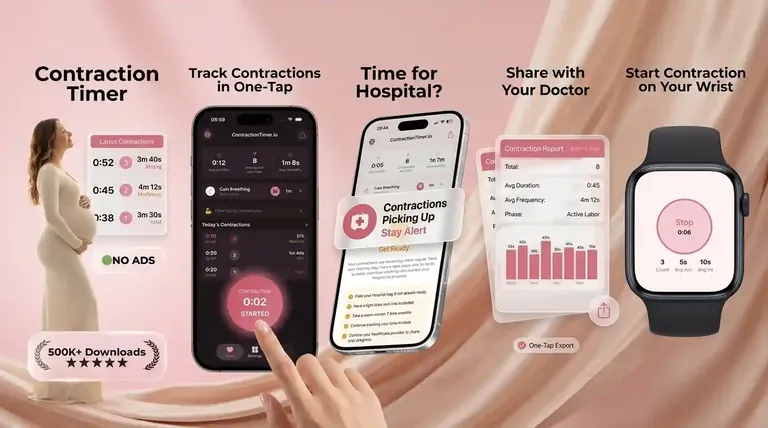
A contraction timer measures each contraction’s duration and the time between contractions, while a contraction tracker saves those sessions so you can review patterns and history. You can use the free online tool for quick timing or choose the Contraction Timer IO app for on-device history, alerts, sharing, widgets, and Apple Watch support; optional in-app purchases are available.
What the contraction tracker shows
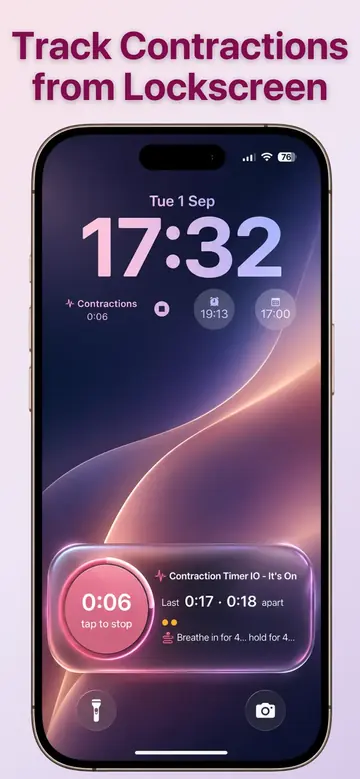
Lock Screen timing
Start and stop from the Lock Screen so you do not hunt for the app mid-wave.
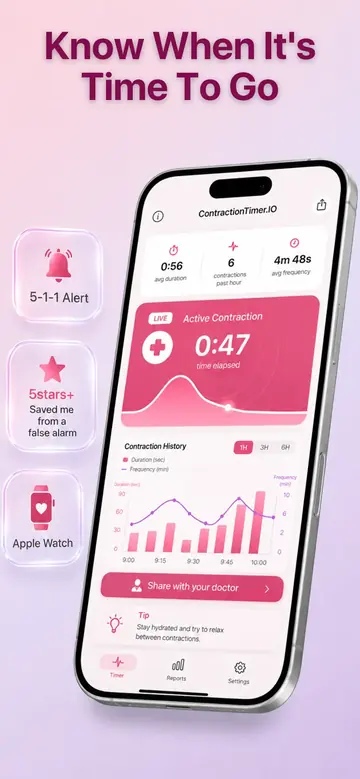
5-1-1 alerts
See when contractions are about 5 minutes apart for an hour.
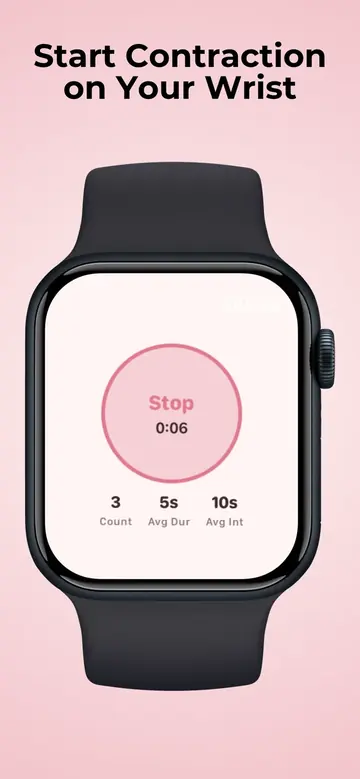
Apple Watch
Time from your wrist when the phone is across the room.
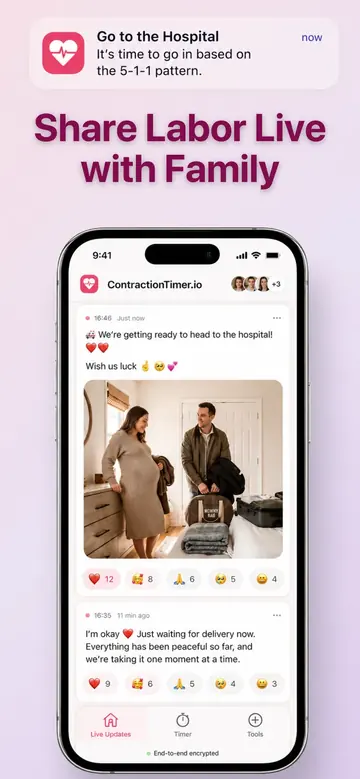
Live family link
Share a private link with a partner, doula, or family so they can follow contractions and updates.
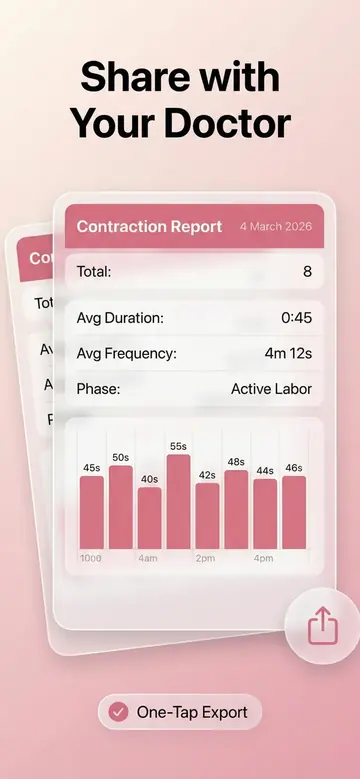
Doctor report
Export averages and phase notes instead of reading a scribbled list over the phone.
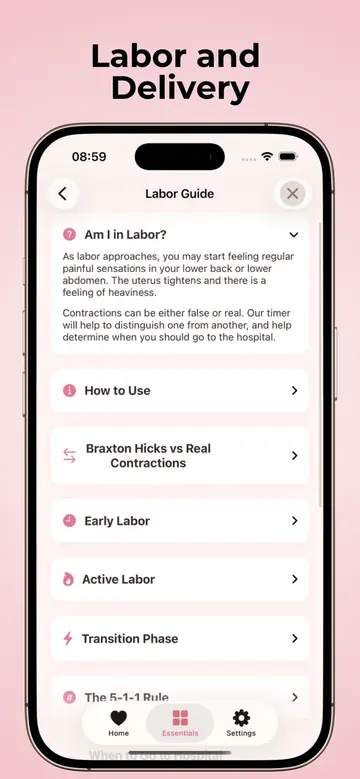
Labor guide
Braxton Hicks, early labor, active labor, and the 5-1-1 rule in one place.
Our contraction timer records the start and end of each labor wave so you can see duration, frequency, and whether contractions are getting closer. Use the free online contraction timer above, or a simple contraction counter in the Contraction Timer IO app if you want history, Lock Screen timing, and a shareable log.
Contraction Timer & Counter IO App
Contraction Timer & Counter IO - where IO means “It’s On” - is developed by ATN Marketing SRL. The site-published rating is 4.8 from 14,889 ratings, and the App Store copy says 500K+ parents; core timing is free, with optional purchases.
| Feature | What it does |
|---|---|
| One-tap timing | Calculates contraction duration, frequency, and interval. |
| Contraction history | Stores history on your device and lets you edit or delete entries. |
| Pattern guidance | Shows early, active, or transition pattern labels and hospital-style 5-1-1 alerts. Labels are not diagnoses, and some providers use 4-1-1 or 3-1-1 guidance. |
| Apple devices | Works on iPhone, iPad, and Apple Watch, with iPhone sync plus Lock Screen and Home Screen widgets. |
| Private sharing | Creates one live family link for a partner, mom, or doula and can generate a doctor or provider report. Followers view for free, and the link is gone when you end it. |
| Practical access | Works offline, requires no account, supports dark mode and 18 languages, and has no ads during labor. |
| Pregnancy tools | Includes a kick counter, due date calculator, hospital bag checklist, birth plan, breathing exercises, weight tracker, partner prep, postpartum guide, and one free calming audio; an optional hypnobirthing library is available. |
| Purchases and limits | The listing shows optional in-app purchases, including a $9.99 lifetime option and a weekly option. The app is not a medical device; always consult your care team. |
How a labor contraction timer works
A labor contraction timer records two moments: when a contraction starts and when it ends. From those taps it calculates duration, frequency, and whether the pattern is becoming longer, stronger, and closer together.
Duration is one wave from the first tightening to full release. Frequency is start-to-start. Early labor numbers often jump around. As active labor approaches, spacing usually settles. The online contraction timer vs the app: the browser tool is enough to practice; the app keeps working if the screen locks.
How to track labor contractions
Record several contractions in a row rather than judging from one wave. See the step-by-step guide to tracking contractions for examples.
- Start as soon as the tightening begins.
- Stop when your belly softens and the wave fully releases.
- Rest between waves. Do not over-read one unusual gap.
- Record five or six contractions to see if a pattern is forming.
- Share the history if contractions intensify, water breaks, or you feel unsure.
You can use the iOS contraction timer app or the Android labor tracking app when timing by hand feels like too much.
5-1-1 rule for contraction timing
The 5-1-1 rule means contractions about 5 minutes apart, lasting about 1 minute, continuing for 1 hour. Many hospitals use it as a general sign that active labor may be near in a full-term pregnancy.
Some providers prefer 4-1-1 or earlier arrival if you live far away, have a high-risk pregnancy, plan a VBAC, or were told to come in sooner. Read the 5-1-1 contractions guide and when to go to the hospital for contractions. This is not medical advice.
Real labor vs Braxton Hicks contractions
Real labor usually grows stronger, longer, and closer together. Braxton Hicks are often irregular and may ease with hydration, rest, or a position change. Timing the pattern is more useful than judging one intense wave. See Braxton Hicks vs real contractions. The NHS signs of labor guidance notes that regular painful contractions are a common labor sign.
Labor timing numbers worth knowing
These figures are typical ranges from clinical teaching, not a diagnosis. Your provider's plan comes first.
| Topic | Typical figure | Source |
|---|---|---|
| ACOG due-date calculation uses Naegele’s rule (280 days from last menstrual period). | The American College of Obstetricians and Gynecologists defines the estimated due date by convention as 280 days after the first day of the last menstrual period (Naegele’s rule), assuming a 28‑day cycle with ovulation around day 14. | American College of Obstetricians and Gynecologists (ACOG), Committee Opinion Methods for Estimating the Due Date 2017 |
| Clinical 5‑1‑1 rule for when to seek hospital or unit advice in labor. | Many US and UK hospital and maternity services advise first‑time parents to seek hospital or midwife assessment when contractions are about every 5 minutes, last around 1 minute each, and this pattern has continued for roughly 1 hour (a 5‑1‑1 pattern), provided there are no complicating factors; individual services may recommend slightly closer intervals or longer duration based on risk and distance. | Kaiser Permanente When to go to the hospital; UCLA Health Stages of Labor - When Labor Starts; NHS Signs that labour has begun 2020-2023 |
| NHS guidance on when to call or go in based on contraction timing (similar to 4‑1‑1/5‑1‑1). | The NHS advises pregnant people to contact their midwife or maternity unit when they think they are in labour and especially when contractions are regular, lasting at least about 60 seconds and coming every 5 minutes or more often; urgent advice is recommended if any contractions last longer than 2 minutes or if there are 6 or more contractions in 10 minutes. | NHS, Signs that labour has begun; NHS, Signs of going into labour 2020-2023 |
| Typical duration of established first stage of labour in first vs subsequent births (NICE‑based NHS guidance). | NHS guidelines derived from NICE intrapartum care recommendations state that in first labours, the established (active) first stage of labour lasts on average about 8 hours and is unlikely to last longer than 18 hours, whereas in second and subsequent labours it lasts on average about 5 hours and is unlikely to last longer than 12 hours; individual labours vary considerably. | NHS Labour Care clinical guidelines referencing NICE Care of healthy women and their babies in labour 2014-2022 |
Compare labor tracking apps
Pick the contraction timer you can run under pressure. Most people need start-stop timing, clear averages, and a shareable history.
| App | Best for | Key difference |
|---|---|---|
| Contraction Timer IO | Fast labor timing on iPhone, Android, Watch, or web | Duration, frequency, 5-1-1 alerts, live family link, doctor report |
| Bump Pulse | Partner live view | Strong sharing story; fewer platforms than a full iOS + Android + web timer |
| Labora | Lock Screen and Apple Watch | Free iOS timer; no Android app |
| Full Term | Simple logging plus kick counts | Popular basic timer inside a broader pregnancy toolset |
Compare contraction timers or see the full contraction timer apps comparison.
Limits of a contraction timer
A contraction timer organizes labor data. It cannot diagnose labor, assess your baby, or decide urgent care.
- It cannot measure dilation, baby position, fetal heart rate, or ruptured membranes.
- It may be less helpful in prodromal labor, induction, or clustered then slowing waves.
- Follow your provider if you have a high-risk pregnancy, preterm symptoms, a prior fast labor, a VBAC plan, or reduced fetal movement.
- Call now for heavy bleeding, severe constant pain, fever, green or foul fluid, decreased movement, or waters breaking before 37 weeks.
Read the safety notes before you rely on any timing rule.
Frequently asked questions
What is a contraction timer?
A contraction timer records when a contraction starts and when it ends. Duration is the length of one wave. Frequency is the time from the start of one contraction to the start of the next. An online contraction timer or a simple contraction counter both work if you tap consistently.
How do I time contractions?
Tap start when the tightening begins and stop when it fully releases. Time several contractions in a row. Frequency is start-to-start, not the rest gap between waves.
What is the 5-1-1 rule?
The 5-1-1 rule means contractions about 5 minutes apart, lasting about 1 minute, for at least 1 hour. Many providers use it as a general hospital-timing guide. Follow the plan your midwife or doctor gave you.
When should I start timing contractions?
Start when waves feel regular, stronger than Braxton Hicks, or different from practice tightenings. You can also start earlier if your provider asked you to watch a pattern.
Can a contraction timer confirm labor?
No. A timer cannot measure dilation, baby position, or fetal heart rate. It only organizes the pattern so you can describe it clearly when you call.
What is the difference between an online contraction timer vs the app?
The free online contraction timer on this page works in the browser. The Contraction Timer IO app keeps timing if the screen locks, supports Apple Watch and Lock Screen Live Activity, and can share a live family link or a doctor report.
How do I tell Braxton Hicks from real contractions?
Braxton Hicks are often irregular and may ease with rest, water, or a position change. Real labor usually grows longer, stronger, and closer together and does not stop with those changes.
When should I call triage?
Call if you reach the timing pattern your provider gave you, your water breaks, bleeding occurs, baby movement decreases, or something feels wrong. Do not wait for a perfect 5-1-1 pattern in those cases.
Is there an app for breathing or hypnobirthing between contractions?
Yes. Zen Pregnancy is a hypnobirthing and pregnancy meditation app for guided breathing, birth affirmations, and relaxation audio. Many people use Contraction Timer IO for timing and Zen Pregnancy between contractions. It is a companion, not a timer and not medical care.
Do I need a separate app for breathing or hypnobirthing?
Not required, but useful if you want audio separate from the clock. Zen Pregnancy handles hypnobirthing-style practice. Keep a contraction timer for duration, frequency, and 5-1-1-style review so the two jobs stay clear.
What can a contraction timer app measure and track?
A contraction timer app can record when each contraction starts and stops, calculate its duration, frequency, and interval, and preserve a contraction tracker history for reviewing patterns. Pattern labels and alerts can help organize timing information, but they cannot diagnose labor or replace guidance from your care team.
Can a contraction timer app share labor timing with family or a provider?
Depending on its features, an app can let a partner or doula follow timing remotely and can create a report for a doctor or provider. Contraction Timer IO also supports a private live family link, on-device history, offline use, widgets, and Apple Watch syncing, but urgent symptoms or concerns should always be discussed with your care team.
Understanding contraction patterns
Early labour contractions may be irregular, while established labour contractions are generally stronger, regular, and closer together. The 5-1-1 pattern is a consumer memory aid - not an official clinical threshold - so follow your maternity unit’s instructions. NHS guidance recommends urgent contact for unusually frequent or prolonged contractions.
| Pattern | Sourced range |
|---|---|
| Early labour | About 30-45 seconds; often irregular |
| Established labour | About 45-60+ seconds, every 3-5 minutes |
| Urgent review | 6+ contractions in 10 minutes, or one lasting over 2 minutes |