
Early Labor Clues


10 Signs Labor Is Starting Soon
The most reliable signs labor is starting are a clear change in contraction pattern (stronger, longer, closer together) plus physical cues like water breaking, bloody show, and increasing pelvic pressure. ContractionTimer.io helps you time contractions with one tap and spot when your pattern is trending toward active labor. This content is for informational purposes only and is not medical advice. Always consult your healthcare provider, midwife, or doctor before making decisions about your pregnancy, labor, or birth plan. Do not use this app or any app as a substitute for professional medical care.
Early Labor Signs That Matter Most
Early labor usually shows up as a pattern, not one isolated symptom. The classic signs labor is starting include contractions that build in intensity, lower back waves, pelvic pressure, bloody show, water breaking, nausea or loose stools, and a noticeable shift in energy.
Many people also feel emotionally different: focused, restless, teary, excited, or suddenly very quiet. That does not mean you need to rush anywhere. In early labor, your job is often to notice, rest, hydrate, eat lightly if allowed, and track what changes over time. The NHS notes that labor signs can include contractions, a show, backache, and waters breaking. This is not medical advice; contact your midwife, doctor, or labor unit if you are unsure.
Braxton Hicks vs Real Contractions
Real contractions tend to become more regular, more intense, and harder to talk through; Braxton Hicks contractions often stay irregular and may ease with water, rest, or changing position. The confusing part is that early labor can also be irregular at first.
A helpful test is to watch the trend for 30 to 60 minutes. If contractions fade after a warm shower, a nap, hydration, or lying on your side, they may be practice contractions. If they keep returning in a stronger rhythm, start timing. For a deeper side-by-side guide, see Braxton Hicks vs real contractions. Call your provider right away for heavy bleeding, decreased fetal movement, severe headache, vision changes, or if your water breaks.
What Contractions Feel Like in Early Labor
Early labor contractions often feel like menstrual cramps, tightening across the belly, pressure low in the pelvis, or waves that wrap from the back to the front. Some people feel back labor more than belly tightening, especially if baby’s position puts pressure on the spine.
The feeling matters less than the pattern. One strong contraction does not tell you much; five to eight contractions in a row can show whether your body is settling into labor. If you are wondering whether your sensations match other people’s descriptions, this guide to what contractions feel like can help you name what you are feeling without spiraling at 2 a.m. This is informational only, not medical advice.
How Contraction Timing Works When Labor Begins
Contraction timing works by recording two numbers: duration and frequency. Duration is how long one contraction lasts, and frequency is the time from the start of one contraction to the start of the next.
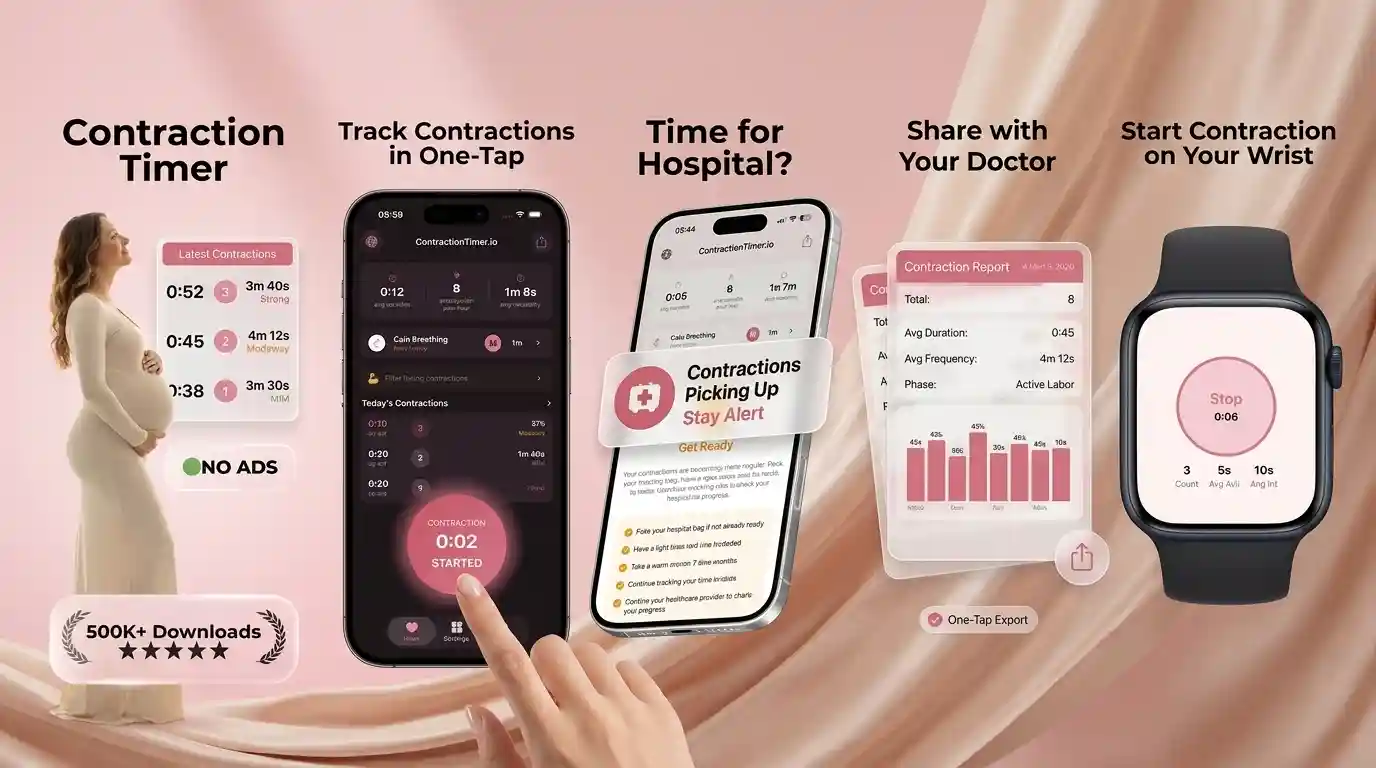
Contraction Timer IO is a contraction timer app that tracks contraction duration, frequency, and patterns for pregnant people and birth partners. A good log shows whether contractions are shortening in interval, holding around 45 to 60 seconds, and becoming harder to ignore. Apps do not diagnose labor, but they can reduce guesswork by turning scattered sensations into a timeline. Many families use that timeline when calling their midwife, doula, doctor, or hospital triage nurse.
How to Check Labor Clues and Time Contractions
Use a calm, repeatable process so you are not making decisions from panic. If symptoms are mild and there are no urgent warning signs, time a small set of contractions before deciding what to do next.
- Notice the whole picture: contractions, back pain, pelvic pressure, bloody show, fluid leaking, baby’s movement, and how you feel emotionally.
- Start timing at the beginning: tap when the wave starts and stop when it fully releases.
- Track at least five contractions: one or two contractions can be misleading in early labor.
- Compare your pattern: look at duration, spacing, and whether intensity is increasing.
- Follow your provider’s plan: many use the 5-1-1 rule for contractions, but your instructions may be different.
When to Use a Labor Tracking App
A labor tracking app is most useful when contractions are noticeable enough that you pause, breathe, or wonder if a pattern is forming. It is less useful for random twinges that happen once or twice and disappear.
Common moments to start tracking include after a membrane sweep, during nighttime cramping, when back waves come and go, after your mucus plug passes, or when you are deciding whether to rest at home or call triage. You can also learn how to track contractions manually if you prefer paper or notes. If you want a phone-based option, the iOS contraction timer app keeps a clear log you can discuss with your care team.
Back Labor, Pelvic Pressure, and Baby Dropping
Back labor can feel like intense waves in the lower back, sometimes with less obvious belly tightening. Pelvic pressure or “baby dropping” may make walking, peeing, or changing positions feel different in the final weeks.
These signs can happen before labor or during early labor, so they are clues rather than proof. Try hands-and-knees, side-lying release, counterpressure, a birth ball, or a warm shower if your provider says those are safe for you. If pain is severe, constant, or paired with bleeding or decreased fetal movement, call right away. For position ideas and what back waves can mean, read about back labor contractions.
When to Call Your Provider or Go In
Call your provider when contractions follow the timing instructions you were given, your water breaks, you have bleeding beyond light bloody show, fetal movement decreases, or you feel something is not right. Trust that last one; intuition matters in pregnancy.
Many hospitals use contraction patterns such as 5-1-1 or 4-1-1, but your plan may differ if you are high risk, Group B strep positive, planning a VBAC, far from the hospital, having multiples, or preterm. The U.S. National Library of Medicine advises calling if your water breaks, bleeding occurs, or contractions become regular. For timing-based guidance, see when to go to the hospital for contractions. This is not medical advice.
Contraction Timer Apps Compared for Labor Decisions
The best contraction timer depends on whether you want simple timing, partner sharing, pregnancy content, or alert support. For early-labor decisions, look for one-tap timing, readable history, export or sharing options, and clear spacing between contractions.
| App | Best for | Notable limits |
|---|---|---|
| Contraction Timer IO | One-tap timing, pattern tracking, 5-1-1 style alerts, and partner-friendly logs | Still cannot diagnose labor or replace clinical advice |
| Full Term | Simple contraction timing with a familiar layout | Less focused on shared decision support |
| What to Expect | Pregnancy tracking plus basic contraction tools | Contraction timing may be one feature among many |
| The Bump | Pregnancy content and planning tools | Timing features may feel less focused during active waves |
Limitations of Symptom Lists and Contraction Timers
Symptom lists and apps can support decision-making, but they cannot confirm cervical dilation, fetal wellbeing, infection risk, or whether you are safe to stay home. Use them as a record, not a diagnosis.
- False labor can look convincing: prodromal labor may create regular contractions that later slow or stop.
- Water breaking is not always dramatic: a slow trickle can be easy to confuse with discharge or urine.
- Pain level varies widely: some people have intense early labor, while others stay calm until active labor.
- High-risk factors change the plan: preterm symptoms, VBAC, multiples, hypertension, diabetes, or reduced fetal movement need individualized advice.
- Apps depend on accurate tapping: missed starts or stops can distort the contraction pattern.
Partner Support During Early Labor
A partner’s best job in early labor is to protect calm: time contractions, offer water, suggest rest, prepare the bag, and help decide when to call without taking over. The birthing person should not have to manage every detail between waves.
Partners can write down the exact time waters broke, fluid color, bleeding, baby movement, and contraction pattern. They can also practice phrases like, “You are safe, this wave will pass,” or “Let’s call and ask.” For more practical support ideas, read contraction timer tips for partners. Android users can track from a labor tracking app while keeping both hands free for counterpressure.
Calm Breathing While You Watch the Pattern
Breathing will not guarantee a painless birth, but it can help you soften your jaw, release your shoulders, and avoid fighting every contraction. A simple rhythm is inhale for four, exhale for six, then relax your hands and forehead.
In early labor, try to rest between waves instead of analyzing every sensation. If contractions are still mild, eat something light if your provider allows it, sip fluids, dim the room, and keep the mood boring. Boring is good at this stage. For specific practice, these labor breathing techniques pair well with timing contractions, especially during the final weeks of pregnancy.
Hospital Checklist
Time a few contractions, then decide with confidence
Use a one-tap timer, get 5-1-1 alerts, and send a clean log to your partner before you call your provider.
Signs of Preterm Labor Before 37 Weeks
If you are less than 37 weeks pregnant, possible labor symptoms need prompt clinical advice rather than waiting for a textbook contraction pattern. Preterm labor may begin with regular or frequent tightening, period-like cramps, a persistent low backache, new pelvic pressure, or a noticeable change in vaginal discharge. Symptoms can be mild, and a contraction timer cannot determine whether your cervix is changing.
- Call your maternity unit or provider promptly about repeated tightenings, even if they are not painful or do not follow the 5-1-1 pattern.
- Seek urgent advice for a gush or steady trickle of fluid, vaginal bleeding, or discharge that becomes watery, bloody, or mucus-like.
- Contact your care team immediately if your baby is moving less than usual; do not wait for contractions to become regular.
- Follow your provider’s individual plan if you have a history of preterm birth, cervical concerns, twins or other multiples, or pregnancy complications.
Frequently Asked Questions
What is the first sign of labor?
For many people, the first sign is contractions that begin to form a pattern, but others notice bloody show, backache, pelvic pressure, or waters breaking first. Call your provider if you are unsure or symptoms feel unusual.
Can labor start without contractions?
Yes, some people first notice waters breaking, bloody show, cramps, or pressure before clear contractions begin. Your provider can tell you what to do next based on gestational age, fluid color, and your health history.
How long can early labor last?
Early labor can last a few hours or more than a day, especially for first births. Rest, hydration, and calm tracking are often more useful than trying to force labor to speed up.
Does mucus plug mean labor today?
Not always. Losing the mucus plug can happen days or even weeks before birth, though bloody show with increasing contractions may be a stronger labor clue.
What does water breaking feel like?
It may feel like a gush, a pop followed by leaking, or a slow trickle that keeps wetting underwear. Call your provider if you think your waters broke, especially if fluid is green, brown, foul-smelling, or you are preterm.
When should I start timing contractions?
Start timing when contractions keep coming back, make you pause, or feel stronger than normal cramps. Track several in a row so you can see the pattern rather than reacting to one wave.
What is the 5-1-1 rule?
The 5-1-1 rule means contractions are about 5 minutes apart, lasting about 1 minute, for about 1 hour. Follow your own provider’s instructions if they gave you a different threshold.
Can contractions stop after starting?
Yes. Early or prodromal labor can slow down with rest, hydration, or no clear reason, and that does not mean anything is wrong. Call your care team if you have warning signs or feel concerned.
Should I go in for back labor?
Back labor alone does not always mean it is time to go in, but severe pain, regular contractions, water breaking, bleeding, or decreased fetal movement should prompt a call. Your provider can guide you based on your timing and symptoms.
Can increased vaginal discharge be a sign labor is starting?
Discharge may increase near labor and can look clear, pink, brown, or mucus-like, but discharge alone cannot confirm that labor has begun. Call your provider for watery leaking, bright-red bleeding, a bad odor, or any concerning change - especially before 37 weeks.
Labor timing notes
Regular, painful contractions that become closer together and cause cervical change are the clearest sign labor has begun.
A “show” may occur days beforehand, while waters breaking may be a trickle or gush and warrants prompt contact with your maternity team.
If these signs occur before 37 weeks, seek urgent guidance; see ACOG’s labor guidance.
| Measure | Sourced range |
|---|---|
| Early labor dilation | Less than 6 cm - Mayo Clinic |
| Active labor dilation | 6-10 cm - Mayo Clinic |
| ACOG active-phase threshold | 6 cm |
| Preterm labor | Before 37 completed weeks - ACOG/NHS |