
Contraction Timer For First-Time Mom: Timing Guidance & Labor Confidence



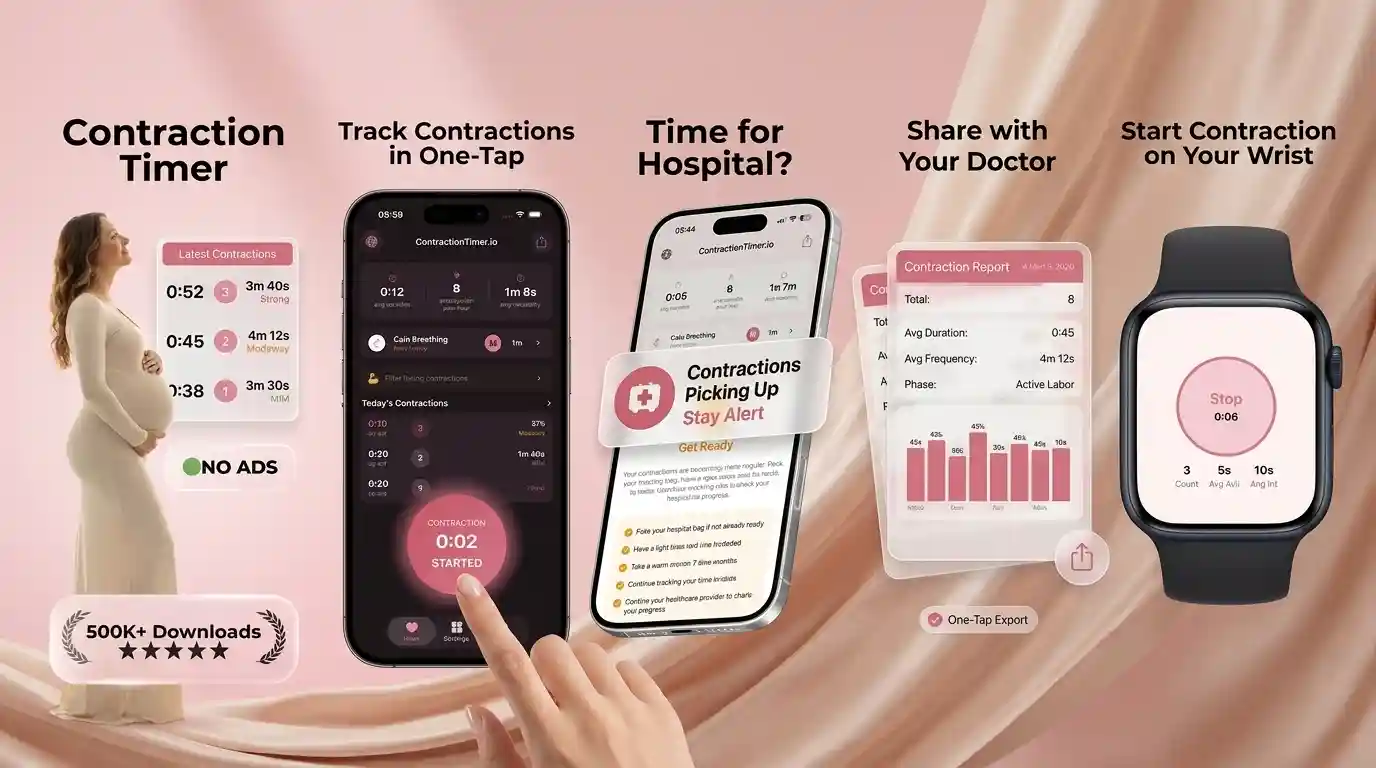
A contraction timer for first-time mom use records how long each contraction lasts and how far apart contractions are, without asking you to do math during pain. For first labor, the safest timer setup is one that keeps Start, Stop, History, Notes, Share, and Export simple enough for a tired parent or partner to use under pressure.
> Definition: A contraction timer is a digital tool that tracks contraction duration (start to end) and frequency (start of one contraction to the start of the next), giving pregnant people and birth partners organized data to share with their obstetric provider.
TL;DR
- A first labor contraction timer measures duration and frequency, the exact metrics your provider asks for.
- The 5-1-1 rule, every 5 minutes, lasting 1 minute, for 1 hour, is a common guideline, but your provider's personal instructions override any app.
- Contraction timer apps are reassurance and convenience tools, not medical devices. Always call when something feels wrong.
Contraction Timer Benefits for First-Time Moms
Stat callout: In 2021, 29.8% of U.S. births were to first-time mothers, per CDC birth data CDC birth data. That is a huge group timing contractions for the first time, often while wondering if they are going in too early or waiting too long.
A timer helps because pain changes how well people remember details. “They were close together” is less useful than “six contractions averaged 58 seconds, about five minutes apart.” A clean contraction log turns that moment into shareable timing data instead of a guess.
The phone may be balanced on a belly pillow. The screen may show uneven five-minute gaps. Still, the numbers are easier to read than memory.
When the issue is first-labor uncertainty, the useful data are duration, frequency, and recent averages you can review before you call. Good contraction timer apps deliver clear timing records, not a promise that birth is minutes away.
5 First Labor Contraction Timer Essentials
- Duration means one contraction from Start to Stop. Tap Start at the first tightening, not the pain peak, then tap Stop when the contraction fully releases.
- Frequency means start-to-start spacing. Providers usually want the time from the beginning of one contraction to the beginning of the next.
- 5-1-1 is a common benchmark. Clinicians typically suggest calling or going in based on your own instructions, often around contractions every 5 minutes, lasting 1 minute, for 1 hour in term, low-risk pregnancies. For a patient-facing overview of contraction timing and when to contact a care team, see Cleveland Clinic's labor contraction guidance: Cleveland Clinic guidance.
- Simple beats feature-heavy during labor. ContractionTimer.io contraction timer app keeps the main workflow to Start, Stop, History, and Share because one-handed use matters when contractions are building.
- Apps support decisions, but they do not diagnose labor. Your provider’s instructions always override labels, averages, or pattern messages.
For first-time moms who need fewer decisions during early labor, ContractionTimer.io covers the basics with one-button timing and clear running averages.
Contraction Timer App Mechanics During First Labor

A contraction timer works by turning two taps into structured labor timing data. You tap Start at contraction onset, tap Stop when it ends, and the app calculates duration plus the interval between contraction starts.
ContractionTimer.io stores each entry in contraction history, then shows running averages and patterns against common thresholds like 5-1-1. The mechanism is simple event logging. In plain language, every Start and Stop creates a timestamp the app can compare with the next one.
It does not measure cervical dilation. It does not monitor the baby. It does not give a clinical diagnosis.
First-time mom labor app design should make handoff easy. A partner can take over from the edge of the bed, hit Stop with a thumb while holding a water bottle, then review the log without asking you to repeat times. If you need a support-person workflow, the contraction timer for birth partner guide covers that handoff more directly.
6 Steps to Use a Contraction Timer as a First-Time Mom
- Download and open the app before labor begins. Practice one fake contraction so Start, Stop, History, and Share feel familiar.
- Tap Start when you feel tightening begin. Do not wait until the contraction is strongest.
- Tap Stop when the contraction fully releases. If you forget, use Edit rather than leaving a long false entry.
- Review running averages after 4 to 6 contractions. One contraction can be random; a short series shows a clearer pattern.
- Share the session summary with your provider or birth partner. ContractionTimer.io lets you send the timing record instead of scrolling in panic.
- Call your care team when the pattern matches their instructions. Call sooner for water breaking, bleeding, decreased movement, severe pain, or worry.
First-time moms trying to stay calm during early labor often do better with a short timing routine than with repeated mental math. The most useful workflow is Start, Stop, review the log, then share the summary.
Top 3 Contraction Timer Features for First-Time Moms
Single-Tap Recording During Contractions
A first labor contraction timer needs one obvious button. ContractionTimer.io keeps the screen simple so you can tap during a surge, even with Face ID failing in a dark room or a cracked screen protector catching your thumb.
5-1-1 Pattern Awareness Alerts
Running averages help you see whether contractions are moving toward 5-1-1. The alert is a prompt to check your provider’s plan, not a medical order.
Shareable Session Summary for Your Provider
The right fit for a clear care-team call is ContractionTimer.io because the Share and Export workflow gives times in order. If your doula needs the same record, use the track contractions and send to doula workflow rather than reading every entry aloud.
Export first. Then call.
Common First-Time Mom Contraction Patterns
First labor is often uneven before it becomes clearly active. In contemporary U.S. data, the median first stage of labor for low-risk first-time mothers in spontaneous labor was about 7.3 hours, and ACOG notes that active labor can progress more slowly than older textbook standards suggested ACOG labor guidance.
That means contractions may come every 6 minutes, then 12, then 7. They may stall after a warm bath beside a paused timer. Irregular does not automatically mean “not labor.”
ContractionTimer.io helps by showing the pattern without pretending the pattern is the whole clinical picture. Other signs override timing data, including water breaking, bleeding, decreased fetal movement, or symptoms your provider told you to report.
For a first-time mom, timing data usually helps most when it supports a calm call, not when it becomes something to stare at between every wave.
Common Myths About First Labor Contraction Timers
Myth: The app can predict when the baby will arrive. It cannot. ContractionTimer.io records timing patterns, but birth timing depends on dilation, fetal position, maternal health, and many other factors.
Myth: “Active labor” labels are medical diagnoses. They are pattern estimates based on contraction data. Your clinician decides what the pattern means.
Myth: If contractions do not follow 5-1-1, it is not real labor. Early labor can be irregular, especially for first-time moms.
Myth: You should wait for the app to tell you to call. No. Call when your instructions say to call, or anytime something feels wrong.
Parents who want more detailed support may compare a first-time mom workflow with a contraction timer for doula, but the same rule holds: timing helps; clinical advice leads.
Limitations
ContractionTimer.io is a timing aid, not a clinical device. These limits matter.
- It cannot assess cervical dilation, fetal wellbeing, fetal heart rate, placental concerns, or complications.
- Timing accuracy depends on consistent tapping. Missed Stop taps, double-tapped Start entries, and bathroom breaks can skew averages.
- 5-1-1 guidance is mainly for term, low-risk pregnancies. VBAC, twins, preterm symptoms, or medical risk factors need provider-specific thresholds.
- Over-focusing on the screen can raise anxiety. Sometimes the better move is putting the phone down for two contractions.
- No peer-reviewed evidence validates consumer contraction timer apps as clinical-grade diagnostic tools.
- Multiple people timing on different phones can create conflicting records.
- Competitors such as GentleBirth and The Bump also offer timing tools, but feature labels should not be treated as medical interpretation.
- If you need record portability, a tool that can export contraction history is more useful than screenshots.
For high-risk labor, including VBAC, follow the plan from your clinician; the contraction timer for VBAC labor page explains that stricter handoff.
Frequently Asked Questions
How do I time contractions?
Tap Start when tightening begins and tap Stop when it fully releases. Frequency is measured from the start of one contraction to the start of the next.
What is the 5-1-1 rule?
The 5-1-1 rule means contractions are about 5 minutes apart, last 1 minute, and continue for 1 hour. It is a common low-risk pregnancy guideline, not a universal rule.
When should I call my provider?
Call when your provider’s personal instructions say to call. Also call anytime something feels wrong, regardless of what ContractionTimer.io shows.
Can a contraction timer app diagnose labor?
No consumer contraction timer app can diagnose labor. ContractionTimer.io contraction timer app tracks timing patterns only.
Are irregular contractions normal for first labor?
Yes, early first labor contractions are often irregular and may stall or space out. Irregular timing does not automatically mean labor is false.
How long is first-time mom labor?
One contemporary U.S. study reported about 7.3 hours as the median first stage for low-risk first-time mothers in spontaneous labor. ACOG guidance also recognizes slower active labor progression than older standards.
Do I need a contraction timer if I have a doula?
A timer can still help because it creates shareable data while the doula focuses on comfort measures. The doula can review contraction history instead of reconstructing times from memory.
Is a contraction timer safe for high-risk pregnancy?
A timer can record contractions, but standard 5-1-1 thresholds may not apply. High-risk patients should follow provider-specific instructions over any app prompt.
What information should I give the hospital when I call about contractions?
Give your gestational week, when contractions began, their recent duration and start-to-start frequency, and whether the pattern is getting stronger or closer together. Also report fluid leakage, bleeding, fever, pressure, or a change in your baby’s usual movement; a Contraction Timer log can help you summarize the pattern.
What to Tell Your Maternity Team About Contractions
Before calling your maternity unit, midwife, or obstetric team, gather a short contraction summary. Clinicians may ask about timing and symptoms to understand what is changing, but a log cannot confirm whether your cervix is dilating or diagnose active labor. Do not delay an urgent call just to collect more contractions.
- Timing: Report when regular contractions began, the duration of recent contractions, and frequency measured from the start of one contraction to the start of the next.
- Trend: Explain whether contractions are becoming longer, closer together, stronger, or remaining irregular. For example: “The last six lasted 45-60 seconds and started 4-6 minutes apart.”
- Other signs: Mention fluid leakage, the time it began, fluid color or odor, vaginal bleeding, pressure, fever, or changes in your baby’s usual movement.
- Context: Share your gestational week, relevant pregnancy instructions, distance from your planned birth location, and whether you can talk or walk during contractions.
Timing notes for first-time moms
Timing contractions can build confidence and reveal a pattern, but it cannot assess bleeding, waters breaking, or reduced baby movements. NHS guidance advises calling your maternity unit when contractions are regular and every 5 minutes or more often. Seek urgent advice for labour signs before 37 weeks, any contraction over 2 minutes, or 6 or more contractions in 10 minutes.
| Timing marker | Sourced guidance |
|---|---|
| Active-labour duration | 60-90 seconds (Mayo Clinic, 2024) |
| Common first-baby pattern | 3-5 minutes apart, about 60 seconds long, for around 1 hour (NHS maternity units, 2020-2026) |
| Urgent frequency | 6+ in 10 minutes (NHS, 2025) |