
Compare Contraction Timers and Pregnancy Apps
Compare contraction timers and pregnancy apps by timing workflow, Apple Watch support, lock-screen access, sharing, reports, alerts, ads, and accounts.


Compare Contraction Timers and Pregnancy Apps
The best contraction timer is not necessarily the app with the longest feature list. During labor, speed, clarity, and reliability matter more than extra content. This hub helps you compare Contraction Timer IO with options such as Bump Pulse, Labora, Tide, Full Term, Storky, 9m, Freya, Sprout Pregnancy, and The Bump. Some products focus closely on contractions, while others are broader pregnancy apps. Features, pricing, and platform support can change, so confirm current details in the app listing before choosing. Start by deciding what you need during a contraction: fast start and stop controls, an understandable history, useful pattern alerts, and a simple way to share progress.
How to compare contraction timers in a realistic labor workflow
Do not compare apps only by reading feature lists. Test each one as if contractions have already begun. Open it from a locked phone, start a contraction, stop it, correct an accidental entry, and review the pattern. The main controls should be obvious enough to use while walking, breathing, talking to a support person, or managing discomfort.
Pay attention to how the app displays duration and frequency. Duration is how long one contraction lasts. Frequency is generally measured from the beginning of one contraction to the beginning of the next. A useful history should make both values clear and show whether the pattern is becoming longer, stronger, or closer together. If an app uses different terminology, make sure everyone who may use it understands the display.
Then test interruptions. Lock the phone during an active contraction, switch to another app, and return. Check whether timing continues and whether the current state is easy to recognize. If you plan to use an Apple Watch, test starting and stopping from the watch rather than assuming the phone experience will carry over.
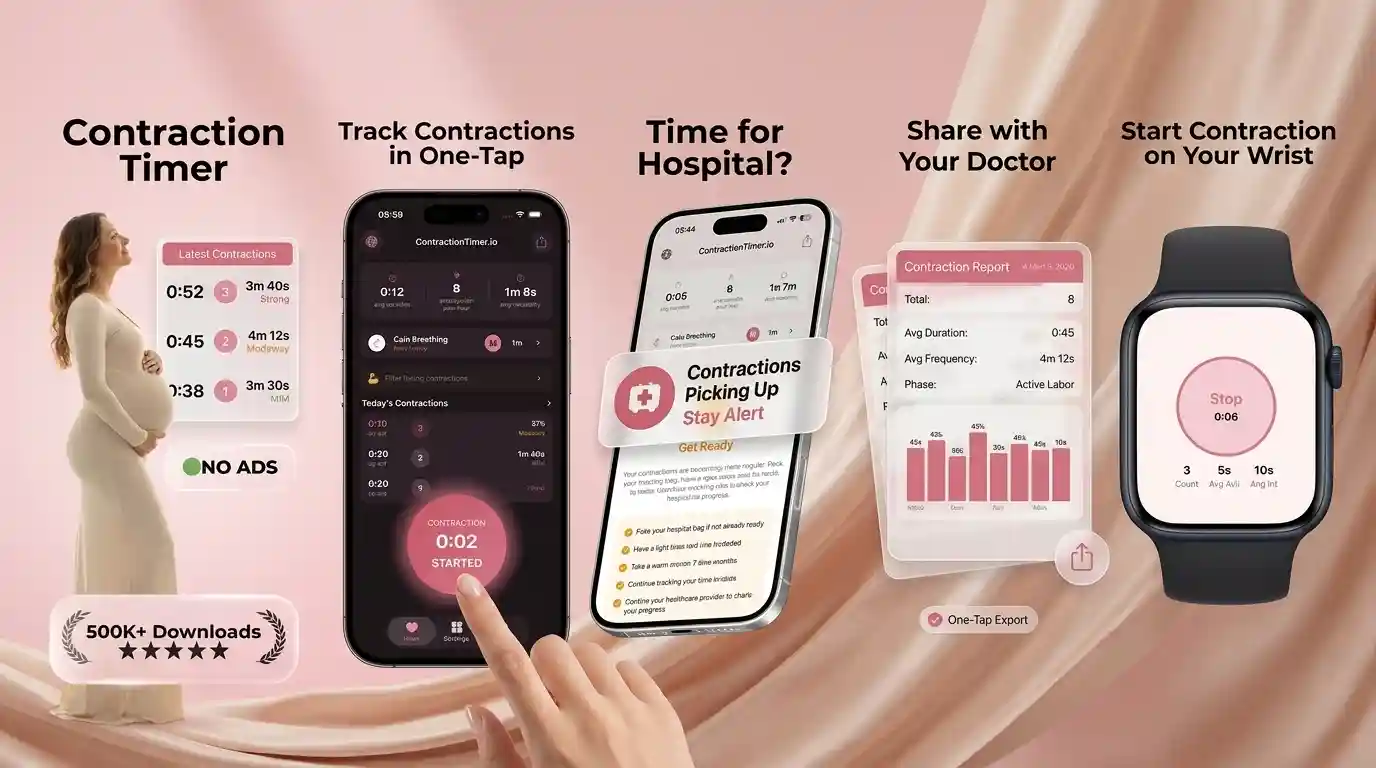
Finally, involve the person who may help you. Can a partner time contractions without learning a complicated interface? Can family follow without repeatedly asking for updates? Can you summarize recent contractions for a clinician? Contraction Timer IO provides free core timing with no ads in the core experience, works on iPhone, Apple Watch, Android, and the web, and includes a live family link, a doctor report, and 5-1-1 pattern alerts.
Contraction timer vs. contraction tracker vs. full pregnancy app
The terms contraction timer and contraction tracker often overlap. A timer usually emphasizes the immediate start-and-stop action. A tracker may place more emphasis on history, trends, notes, intensity, or exported records. Many dedicated labor apps do both, so the label matters less than the actual workflow.
A full pregnancy app serves a broader purpose. It may include week-by-week development, articles, checklists, appointment tools, kick counting, community features, or newborn information. That can be useful throughout pregnancy, but it does not automatically make the labor timer faster or easier. If contraction timing is buried several screens deep, a broad app may be less convenient when contractions become demanding.
Your shortlist may include focused tools such as Bump Pulse, Labora, Tide, Full Term, Storky, 9m, or Freya, as well as broader pregnancy products such as Sprout Pregnancy and The Bump. Product scope and features can change, so treat those groupings as a starting point rather than a permanent classification.
Choose a focused timer if you want minimal setup and direct controls. Consider a tracker if detailed history, notes, or reports are important. A full pregnancy app may be the better overall download if you already use its other tools and its contraction feature is accessible enough for labor. You can also use a pregnancy app during pregnancy and keep a separate, simpler timer ready for labor.
What to check: Watch access, lock screen, sharing, ads, and accounts
Apple Watch support: Confirm that the watch can actually start and stop contractions. A watch notification or companion display is not the same as full timing controls. Also check whether phone and watch entries stay synchronized after a weak connection, restart, or accidental tap.
Lock-screen behavior: Timing should remain dependable when the screen turns off. Look for a visible active state, a quick way to return, and protection against duplicate or missed entries. Android and iPhone handle background activity differently, so test the device you will use.
Sharing: There is a difference between sending a screenshot, exporting a report, and sharing live progress. Screenshots are quick but become outdated. A report can help summarize a session for a doctor, midwife, or hospital team. A live link can let a trusted person follow changes without needing your account or requesting constant messages. Review what information the recipient can see and how access can be stopped.
Ads and purchases: Check where ads appear, not merely whether the download is free. An ad on an educational screen is different from an interruption beside the timing controls. Determine whether essential functions such as history, alerts, Watch use, exports, or sharing require payment. Contraction Timer IO keeps core timing free and does not place ads in the core timing experience.
Account requirements: A mandatory signup can slow down first use and may affect privacy. Check whether timing works without an account, what data is stored online, and whether deletion or export controls are available. If syncing or live sharing requires an account, create and test it before labor rather than during an urgent moment.
Honest limits of contraction apps and pattern alerts
A contraction app records the information entered into it; it does not determine why contractions are happening or whether labor is safe. Timing can be inaccurate if someone forgets to tap, starts late, stops early, or hands the phone to another person without explaining the process. Intensity ratings are subjective, and a neat pattern on a screen cannot capture every medical factor.
The commonly discussed 5-1-1 pattern generally means contractions about five minutes apart, lasting about one minute each, for about one hour. Definitions and recommendations can vary by clinician, hospital, pregnancy history, and individual circumstances. An alert based on that pattern is a practical prompt, not a diagnosis or a universal instruction to remain at home until the threshold is reached.
Follow the personalized guidance from your obstetrician, midwife, or labor and delivery unit. Contact them promptly if you are concerned, even when the timer has not reached a particular pattern. Seek urgent medical help for severe or constant pain, heavy bleeding, trouble breathing, loss of consciousness, an urge to push, significantly reduced fetal movement, or any situation that feels like an emergency. If your water may have broken, follow your care team's instructions rather than waiting for a timer alert.
Technology also has ordinary limits: batteries die, watches disconnect, browsers refresh, and phones can be unavailable. Keep your device charged, test the app ahead of time, and know how to estimate timing with a regular clock as a backup.
Head-to-head comparisons
Alternatives if you are leaving another app
Frequently asked questions
What is the difference between a contraction timer and a contraction tracker?
A timer focuses on starting and stopping each contraction to calculate duration and frequency. A tracker usually adds history, trends, intensity, notes, or reports. Many apps combine both functions, so compare the actual controls and records rather than relying on the product label.
Is a dedicated contraction timer better than a pregnancy app?
A dedicated timer is often faster to open and simpler to use during labor. A pregnancy app may be more convenient if you already use it and its timer is easy to reach. Test how many taps it takes to begin timing and whether the screen remains clear during an active contraction.
Do I need Apple Watch support for timing contractions?
No, but it can be useful when your phone is across the room or in someone else's hands. Verify that the watch supports actual start-and-stop controls, synchronization, and history - not just notifications. Practice with it before labor.
Should a contraction timer work from the lock screen?
Reliable lock-screen or quick-return behavior is valuable because repeatedly unlocking a phone can become frustrating. Test whether timing continues when the screen turns off and whether the active contraction remains obvious when you return.
What is the best way to share contractions with a partner or doctor?
Live sharing is useful for a partner or family member following current progress. A concise report is usually more useful for summarizing frequency, duration, and recent history for a clinician. Screenshots can work, but they become outdated and may omit context.
Are free contraction timer apps really free?
It depends on the app. Check whether the free version limits history, alerts, Watch controls, reports, sharing, or the number of contractions. Also check whether ads appear near the timing controls. Contraction Timer IO offers free core timing with no ads in the core experience.
Do I need to create an account to time contractions?
Not necessarily. Some apps allow immediate local timing, while others require an account for basic use, synchronization, backup, or sharing. If an account is needed for a feature you want, set it up and test access before labor.
Can a 5-1-1 alert tell me when to go to the hospital?
It can identify a commonly discussed contraction pattern, but it cannot assess your full medical situation or replace instructions from your care team. Recommendations vary. Contact your clinician whenever advised or whenever you have concerning symptoms, regardless of what the timer shows.
What store listings currently show
Public listings change. Confirm Watch, lock-screen, price, and rating on the live App Store or Play page before you decide. Labora and Contraction Timer IO both advertise Apple Watch timing; not every competitor does.
| App | Public listing note |
|---|---|
| Contraction Timer IO | iPhone, iPad, Apple Watch; iOS 17+ and watchOS 10+ on the current US listing |
| Full Term | Published iOS rating about 4.7; Android listing also exists |
| 9m Contraction Timer | Long-running iOS timer; check the live listing for the current rating |