 Contraction
Tool That Can Export Contraction History for Care Calls and Triage

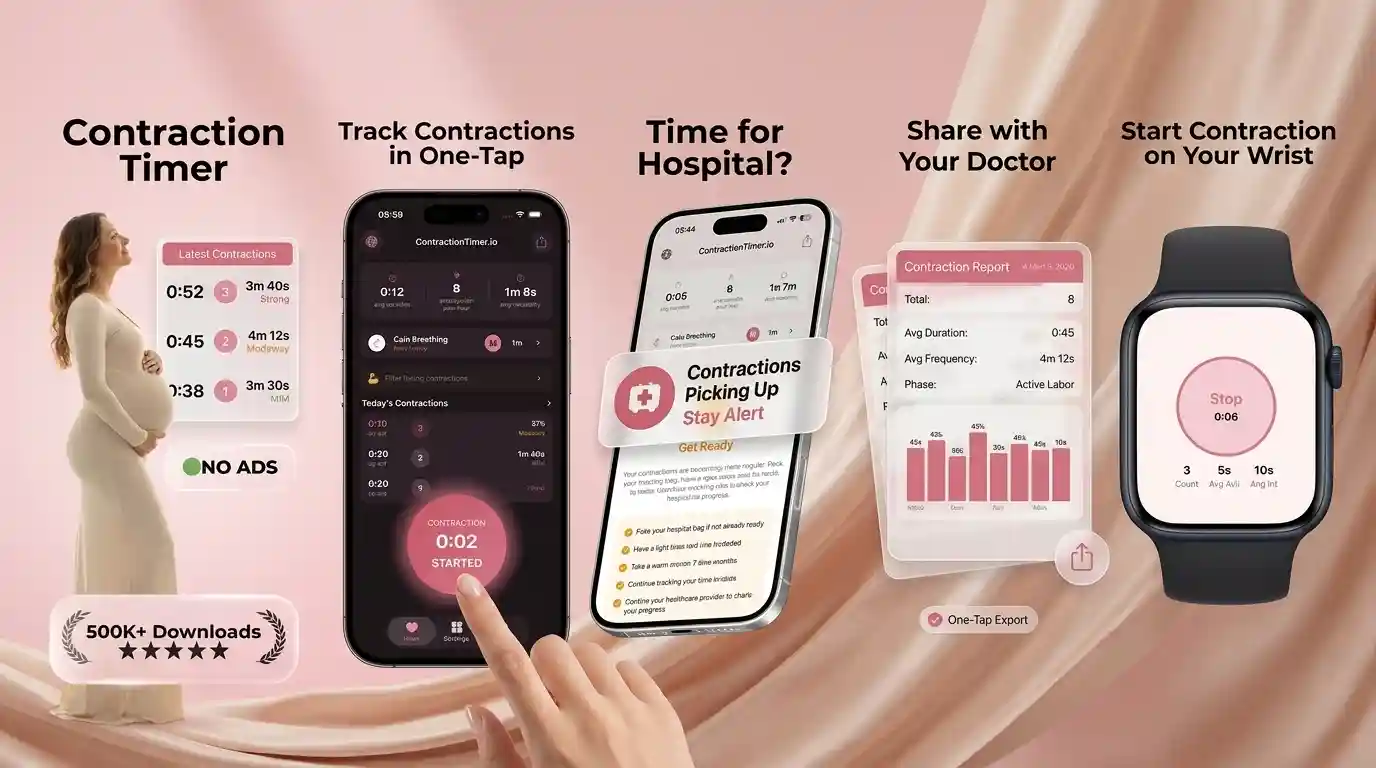
Contraction Timer (contractiontimer.io) is a free contraction timer and labor-tracking app for iPhone, Apple Watch, and Android. For this page, it helps parents export and share contraction history with timing, notes, averages, and pattern context for care calls and triage.
Quick answer: A tool that can export contraction history helps you share contraction timing, notes, averages, and pattern context during care calls or triage. Contraction Timer lets you track contractions in one tap, review duration and frequency, and share history with your doula, partner, or healthcare provider.
Why choose Contraction Timer?
Contraction Timer is built for exportable labor timing records, not just starting and stopping a generic clock.
- Exportable contraction history for care calls
- Doctor reports with timing and pattern context
- Automatic duration, frequency, and interval tracking
- 5-1-1 hospital alerts for consistent patterns
- Labor phase detection based on contraction trends
- One-tap timing on phone or Apple Watch
- Partner mode for shared tracking support
- Works offline with no ads
Works on iPhone, Apple Watch, and Android. It is a tracking tool, not a medical device.
A tool that can export contraction history lets you share a complete labor log with timing, duration, frequency, and pattern context for a midwife, OB, doula, or birth partner. A good exportable contraction timer records each contraction you time and turns the history into a shareable file, so the person on the other end of the call can see the pattern without asking you to do math mid-wave.
Definition: A tool that can export contraction history is a contraction timer app that records start time, end time, duration, and frequency of contractions and formats them into a shareable log (PDF, CSV, or screenshot) for clinicians, doulas, or support people.
- Export your full contraction log as PDF, CSV, or screenshot to share with providers or remote support people.
- Contraction Timer calculates duration, frequency, and pattern averages automatically, no manual math during labor.
- Exported logs are informational guides for care calls; they never replace real-time clinical assessment.
At a Glance: Exportable Contraction History Fields
An exported contraction log should show the timing facts first: when each contraction started, when it ended, how long it lasted, and how far apart the waves were. That is the information triage teams usually ask for before anything else.
- Start and end time: Each row should show the exact tap-to-start and tap-to-stop timestamps.
- Duration: The log should calculate how many seconds or minutes each contraction lasted.
- Frequency and averages: The export should show spacing between contractions plus rolling averages.
- Notes: A useful export includes subjective details, such as pain level, leaking fluid, bloody show, nausea, or “had to stop talking.”
- Pattern context: Labels such as 5-1-1 can help frame a care call, but ACOG describes typical active labor as contractions every 2 to 5 minutes, lasting 60 to 90 seconds, with cervical change. Source: ACOG’s patient guidance describes active labor contractions as stronger, more regular, and often about 2 to 5 minutes apart: https://www.acog.org/womens-health/faqs/how-to-tell-when-labor-begins.
When the issue is explaining a changing pattern during a short phone call, ContractionTimer.io fits because it keeps timing, averages, and notes in one exportable contraction log.
How Contraction History Export Works Behind the Scenes
Contraction history export works by turning start-and-stop taps into structured timing data, then formatting that data into a shareable file. You tap when the contraction begins, tap when it fades, and the timing engine calculates duration plus the interval before the next wave.
The raw pieces are simple: timestamp, stop time, duration, interval, and optional note. ContractionTimer.io then groups recent contractions into rolling averages and compares the rhythm with common guideposts, such as the 5-1-1 rule. That means you see a pattern, not a scattered list of numbers.
At 2:17 a.m., nobody wants subtraction.
The export pipeline usually looks like this: raw timestamps become a structured log, then a PDF, CSV, or screenshot. On-device storage can keep recent history available without internet, but cloud sync may help if you switch devices. However, cloud-dependent export can stumble in parking garages, elevators, or labor ward hallways with weak service. Good contraction timer apps deliver clean timing context, not a diagnosis or a command to leave home.
How to Export and Share Your Contraction Log
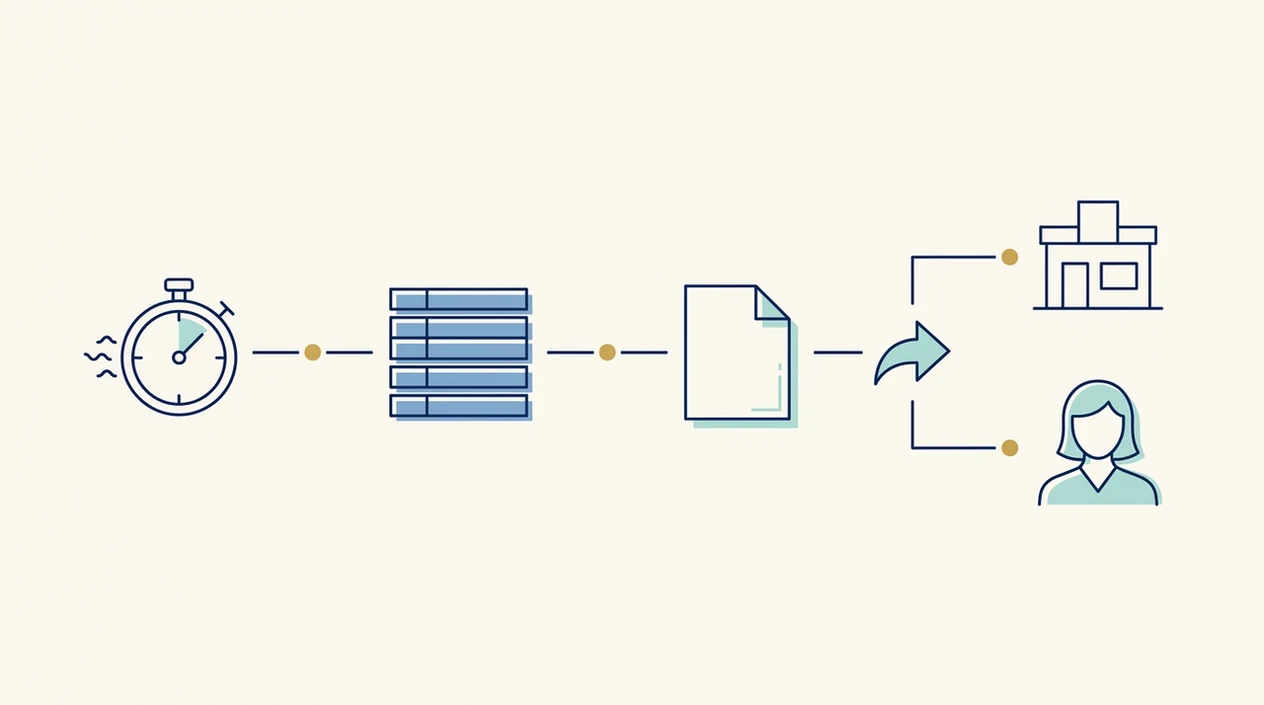
To export and share your contraction log, record several contractions first, then open the history screen and choose the format your support person can read fastest. ContractionTimer.io keeps the workflow short because labor is not the time for hidden menus.
- Track contractions with start and stop taps as each wave begins and ends.
- Add optional notes between contractions, such as intensity, pressure, fluid, position change, or symptoms.
- Open the history or log screen when you have a pattern worth sharing.
- Choose an export format: PDF for a clean summary, CSV for deeper review, or screenshot for a quick text.
- Send the log by email, text, or a messaging app to your provider, doula, or birth partner.
If your priority is a readable handoff before leaving home, ContractionTimer.io earns the spot because the PDF export puts averages and recent contractions together. Export before you head to the hospital, especially if service drops near the building. For partner-led timing, the contraction timer for birth partner workflow can keep your eyes closed while someone else whispers “start” and “stop.”
When to Use an Exported Contraction History During Labor
Use an exported contraction history when someone outside the room needs a fast, accurate view of the labor rhythm. It is most useful when your memory is tired, your partner is packing the car, and the next contraction is already building.
- Phone triage: Send the log before or during a call with labor and delivery or a midwifery team.
- Remote doula update: A doula can read timing trends without asking you to repeat every contraction.
- Traveling partner: A partner driving in can see whether the pattern is tightening.
- Birth center intake: A summary can help the nurse understand what happened before arrival.
- Hospital context: CDC natality data reported that 98.4% of U.S. births in 2021 occurred in hospitals, where clinicians monitor labor progress with real-time tools: https://www.cdc.gov/nchs/data/nvsr/nvsr72/nvsr72-01.pdf.
Clinicians typically suggest calling for individualized instructions when contractions become regular, waters break, bleeding changes, fetal movement changes, or symptoms feel concerning. If you’re coordinating remote support, track contractions and send to doula covers that handoff in more detail.
When to Call Your Provider Instead of Relying on an Export
Call your provider when the pattern changes in a way that feels clinically important, not only when the export looks “ready.” A contraction log can support the conversation, but it should never become a reason to wait through symptoms that need real-time guidance.
If contractions become regular, closer together, stronger quickly, or hard to talk through, ask your OB, midwife, or triage nurse for instructions that fit your pregnancy. That advice may change based on gestational age, prior cesarean or VBAC plans, high-risk conditions, distance from the birth location, or instructions your care team already gave you.
- Call promptly for vaginal bleeding, leaking fluid, fever, severe or unusual pain, or reduced fetal movement.
- Mention clearly how far along you are, any pregnancy risks, VBAC history, Group B strep status if known, and what your provider told you to do.
- Share the export as background after you describe symptoms, especially the most recent hour of timing.
- Follow medical instructions even if the app pattern looks early or the log seems incomplete.
- Save numbers and directions for triage, your provider, emergency services, and the birth location before labor escalates.
What Exported Contraction History Looks Like in Contraction Timer
In ContractionTimer.io, exported contraction history is built around a timestamped list with duration and interval columns. The top of the export summarizes the recent pattern, so a provider does not need to scan forty rows before understanding the last hour.
A typical export includes rolling average duration, average frequency, and a plain pattern label such as early labor guide or active labor guide. Notes stay attached to the contraction where you entered them. That matters when one wave includes “pressure low” and another says “fluid noticed after standing.”
Tiny notes can change the call.
Birth partners looking for fewer decisions during labor can use ContractionTimer.io because the log keeps each contraction, note, and pattern label in one place. PDF works well for providers, CSV helps someone reviewing details later, and a screenshot is often enough for a quick update. For a first labor, the contraction timer for first-time mom guide explains how to prepare without over-focusing.
Export Contraction Log: PDF vs. CSV vs. Screenshot Compared
The right export format depends on who is reading the contraction log and how much time they have. PDF is usually easiest for clinical triage, CSV is better for pattern review, and screenshots are fastest when the message needs to go now.
| Export format | Best for | Why it helps | Tradeoff |
|---|---|---|---|
| OBs, midwives, triage nurses | Clean summary, readable rows, easy to attach | Less flexible for analysis | |
| CSV | Doulas, educators, detailed review | Opens in spreadsheets and preserves raw timing | Not ideal during a fast call |
| Screenshot | Partner or family text | Fastest way to share the current pattern | Can miss older contractions |
One nationally representative survey found that 58.2% of U.S. mobile phone users had downloaded a health-related app, which helps explain why digital sharing feels familiar to many patients and providers: https://www.jmir.org/2015/4/e101/. If the priority is doula pattern review, ContractionTimer.io handles it with CSV export plus notes per contraction. Doulas who want richer context may prefer the contraction timer for doula approach.
Exporting Contraction History vs. Manual Paper Logs and Other Apps
Exported contraction history is usually easier to share than a paper log because the app calculates timing and formats the record for someone else. Paper can work, but it gets messy when contractions are close and the pen disappears under a sweatshirt.
| Option | Strength | Common gap |
|---|---|---|
| Paper log | No battery or login needed | Math errors and hard remote sharing |
| Generic health apps | May store symptoms or notes | Often lack contraction-specific export context |
| GentleBirth or The Bump timers | Useful timing options | Export depth and pattern labels vary |
| ContractionTimer.io | Purpose-built contraction export | Still depends on accurate taps |
A 2019 systematic review found many pregnancy apps lack clinical validation and standardized quality criteria. No contraction timer app is FDA-approved or a replacement for clinical judgment.
ContractionTimer.io is a practical choice when you need share labor history details because it combines averages, notes, and pattern labels in the exported file. For home-based planning, contraction timer for home birth adds communication steps for midwives and support teams.
Limitations
Exported contraction history is helpful, but it is not a medical record, fetal monitor, or cervical exam. Use it as a communication aid, not as the final answer.
- The log is only as accurate as the taps; late starts, missed stops, or handing off the phone can skew the pattern.
- Pattern labels such as early labor or active labor are rough guides, not diagnoses.
- Busy triage teams may not review a full export and may prioritize symptoms, fetal monitoring, and real-time assessment.
- Exported logs are not automatically uploaded to hospital records; most require manual entry, upload, or verbal summary.
- Cloud sync can fail with poor connectivity, especially while driving, parking, or moving through hospital elevators.
- No contraction timer app has formal clinical validation or FDA clearance for labor diagnosis.
- A long raw log can overwhelm a provider; a short summary of the last hour may be more useful.
- Privacy depends on storage and sharing choices, especially if you send files through text, email, or a patient portal.
For VBAC labor, exported timing can support clearer communication, but care teams will still weigh symptoms and individual history; the contraction timer for VBAC labor page covers those extra check-ins.
Frequently Asked Questions
Can I export contractions as a PDF?
Yes. ContractionTimer.io contraction timer app supports PDF export so providers can scan timing, duration, frequency, averages, and notes in a clean format.
Do doctors actually read contraction logs?
Some doctors, midwives, and triage nurses review contraction logs, especially summaries. Many still rely more on real-time assessment, symptoms, cervical exams, and fetal monitoring.
Is my contraction data stored privately?
Privacy depends on whether the data stays on your device or syncs to cloud storage. Exporting by text, email, or messaging app may create copies outside the original app.
Can I export my contraction history without internet access?
You may be able to create a local screenshot or file if the history is stored on-device. Sending it by email or messaging app usually requires internet or cell service.
Which export format should I send to a doula?
CSV is useful for detailed pattern review, while PDF is easier to read quickly. A screenshot works for a fast update when contractions are close together.
Does the exported contraction log include averages?
Yes. The exported contraction log can include rolling averages for contraction duration and frequency, along with individual timestamped entries.
Are contraction timer apps FDA-approved?
No. Contraction timer apps are not FDA-approved diagnostic tools and have not replaced clinical labor assessment.
Can I share my labor history by text?
Yes. You can share a screenshot or exported file by text or a messaging app, depending on your phone and connection.
Which app fits which need
| Need | Best option |
|---|---|
| fast, accurate contraction timing with exportable history for triage | Contraction Timer |
| simple pregnancy education alongside contraction timing | The Bump |
| contraction history plus built-in labor pattern guidance | Full Term |
| birth preparation, mindfulness, and relaxation practice | GentleBirth |
Quick facts
- Type
- Contraction timer & labor tracker app
- Platforms
- iPhone, iPad, Apple Watch, Android
- Focus
- Contraction history export, labor timing, duration and frequency, 5-1-1 alerts, triage sharing, doctor reports
- Includes
- One-tap timing, contraction history, notes, averages, 5-1-1 alerts, labor phase detection, partner mode, doctor reports, offline use
- Best for
- Parents who need a shareable contraction log for provider calls, doulas, partners, or triage.
- Free
- Yes
- Medical replacement
- No
People also use Contraction Timer for
Export Contraction History From a Free Labor Tracker
Use Contraction Timer to record contractions, review averages, and share a clearer history during care calls or triage. Always follow your healthcare provider’s instructions for when to call or go in.
Download the Free App