
Contraction Timer for VBAC Labor: Provider-First Tracking Guide



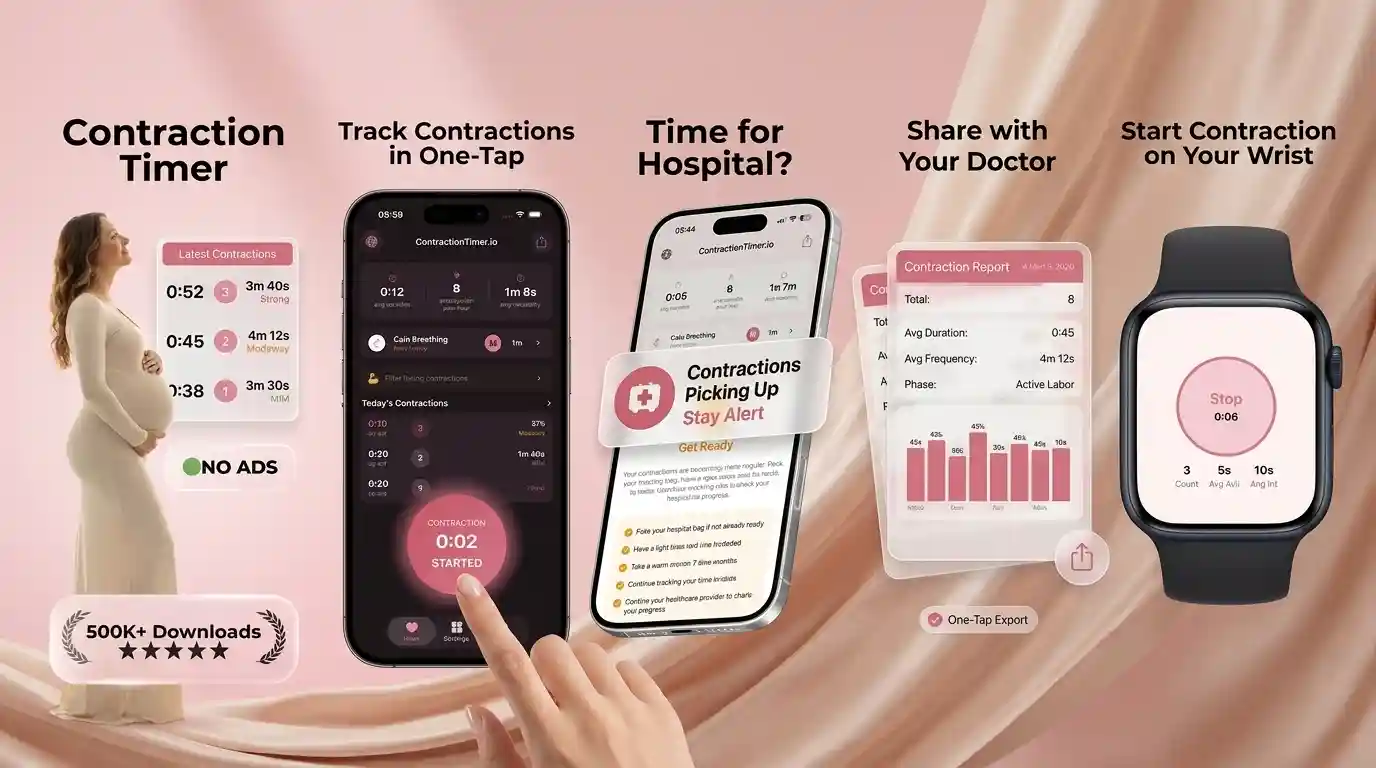
A contraction timer for VBAC labor helps you record how long contractions last and how far apart they are, but it must always be used alongside your provider's individualized VBAC plan, not as a substitute for clinical judgment. Your OB or midwife may ask you to call or come in earlier than standard timing rules, so set up your tracking expectations before labor begins.
This guide is informational and is not medical advice. If your VBAC plan, symptoms, or provider instructions conflict with anything here, follow your care team.
Definition: A contraction timer for VBAC labor is an app or tool that logs contraction duration, frequency, and patterns for people attempting a vaginal birth after cesarean, designed to supplement, not replace, provider-specific monitoring instructions.
TL;DR
- A VBAC labor tracker is a support tool, not a diagnostic device. Your provider's plan always overrides timer thresholds.
- VBAC candidates may need to go to the hospital earlier than the typical 5-1-1 rule. Confirm your specific call-in pattern in advance.
- No contraction timer app can detect uterine rupture, fetal distress, or placental complications. Urgent symptoms always warrant immediate medical contact.
VBAC Scar Risk and Contraction Timing Rules
A prior cesarean scar changes the risk profile of labor, so VBAC contractions should not be managed by generic timing rules alone. Your provider may set an earlier call-in point than 5-1-1 or 4-1-1, especially if your hospital wants you monitored sooner.
ACOG reports that VBAC after trial of labor succeeds in about 60-80% of people with one previous low-transverse cesarean and no contraindications, and recommends TOLAC only in facilities capable of emergency cesarean delivery ACOG labor guidance. Symptomatic uterine rupture after one prior low-transverse cesarean is reported around 0.5-0.9% in published reviews published labor research.
That does not mean labor is unsafe. It means the timing plan needs a clinician’s rules, not internet defaults.
Write the call-in pattern down before labor. When contractions start, nobody wants to decode a portal message with Face ID failing in a dark room.
5 Must-Know Facts About VBAC Contractions and Timing
- A timer is a tracking tool, not a safety monitor. It records duration and frequency, but it cannot say whether staying home is safe during VBAC labor.
- Your provider may want earlier hospital arrival. Some VBAC plans use a lower threshold than 5-1-1 because continuous or earlier monitoring may matter.
- The pattern matters more than perfect taps. For VBAC contractions, a clear trend is more useful than one flawless entry. Longer, stronger, closer together is the pattern to notice.
- An app cannot detect rupture or fetal distress. Sudden severe pain, bleeding, or a change in fetal movement overrides any timer screen.
- Timing works better with rest, hydration, and communication. The most useful VBAC labor tracker is the one that helps your support person read the log calmly, not one that keeps everyone staring at every cramp.
A partner with the phone timer held in one hand and car keys beside the timer is already doing two jobs. Keep the system simple.
VBAC Contraction Timer Measurements and Labor Patterns
A contraction timer works by logging two measurements: duration and interval. You tap Start when the tightening begins, tap Stop when it fades, and the app calculates the time between contraction starts automatically.
That interval is often called frequency. In spontaneous term labor, contractions commonly last 30-70 seconds and may come every 2-5 minutes as active labor progresses, per MedlinePlus guidance Medlineplus guidance. A timer can show whether contractions are getting longer, stronger, and closer together, but it cannot assess cervical dilation, effacement, fetal status, or uterine scar integrity.
The screen is only data.
If you double-tap Start or forget Stop, use Edit rather than starting over. One corrected entry is cleaner than a fake pattern. For a support person doing most of the taps, a contraction timer for birth partner can make the handoff less messy when the birthing person needs to focus on breathing.
6 Steps for Using a VBAC Labor Tracker With Your Provider's Plan
Use a VBAC labor tracker as a shared record between you, your support person, and your care team. The goal is clear timing, not winning a dashboard.
- Confirm your provider's specific call-in pattern before labor starts, including symptoms that mean call now.
- Set up the contraction timer app on your phone in the third trimester, with charger access and Do Not Disturb checked.
- Tap Start at the beginning of each contraction, then tap Stop when the tightening fades.
- Review the pattern summary instead of fixating on one strange contraction or one missed tap.
- Share the logged data with your provider when you call or arrive at the hospital.
- Stop timing and seek immediate care if you have sudden severe pain, bleeding, or changed fetal movement.
For VBAC labor, pattern tracking is often more useful than memory because pain makes time feel unreliable. A phone balanced on a belly pillow can still capture a clean History screen if the steps are practiced once.
Top 3 Contraction Timer Features for VBAC Candidates
1. Session history and exportable logs. Look for History, Share, and Export options so your provider can review the timing record without someone scrolling in panic. If exporting matters, use a tool that can export contraction history before labor day.
2. Pattern trend view. A useful VBAC labor tracker shows whether contractions are getting longer, stronger, and closer together across a session.
3. Custom alert thresholds. Default 5-1-1 alerts may not fit your VBAC plan. Set the reminder to your OB or midwife’s call-in rule instead.
Tools like ContractionTimer.io can help record and share timing data, not determine whether VBAC labor is medically safe. Good contraction timer apps deliver clean logs and simple summaries, not clinical diagnosis.
4 VBAC Contraction Myths a Timer Can't Resolve
Myth 1: A 5-1-1 pattern guarantees active labor. It does not. Cervical change is assessed clinically, not by a timer.
Myth 2: A VBAC labor tracker can alert you to uterine rupture. No app can detect scar separation, placental abruption, or fetal distress.
Myth 3: Timing every twinge improves VBAC success. Obsessive early tracking usually adds noise. Rest may be more useful until contractions form a pattern.
Myth 4: Non-textbook timing means VBAC has failed. Labor can stall, restart, space out, or shift after position changes. That is not the same as failure.
A practice contraction in a grocery aisle can look dramatic on a screen, then disappear after water and sitting down. Annoying, yes. Diagnostic, no.
For people comparing different support roles, a contraction timer for doula may help separate timing notes from comfort notes.
VBAC Labor Tracking Patterns and Provider Call Triggers
Early labor often shows irregular contractions, sometimes 5 to 20 minutes apart, according to MedlinePlus guidance on labor signs source. Rest, hydration, food if allowed, and light movement may matter more than logging every wave. As active labor develops, many people see contractions every 3 to 5 minutes, lasting about 45 to 70 seconds, but VBAC provider thresholds may differ from standard labor rules. Clinicians typically recommend that VBAC candidates follow their individualized TOLAC plan because hospital monitoring needs can vary.
Your timer should support the call, not delay it. If you notice sudden severe pain, vaginal bleeding, or a change in fetal movement, contact your care team or seek urgent care regardless of the interval shown.
The front porch air between contractions can make a decision feel clearer. Have the log read aloud slowly before you call, then follow the plan you were given.
Anxiety, False Labor, and VBAC Tracker Data Gaps
A contraction timer cannot distinguish true labor from prodromal labor. It also cannot assess cervical dilation, effacement, fetal heart rate, or whether the uterine scar is tolerating labor.
This is where tracking can turn against you. Irregular cramps fading after water may still leave a messy log that looks more serious than it is. If the app keeps pulling your attention back every six minutes, take a break unless your provider told you to keep timing.
Over-reliance can delay care when symptoms matter more than numbers. For one-handed use on iPhone, setup details are covered in the contraction timer for iPhone guide, but the same safety rule applies on any device.
Limitations
A contraction timer for VBAC labor has clear limits. Use it for timing records, not medical interpretation.
- It cannot detect uterine rupture, placental abruption, or fetal distress.
- It cannot distinguish true labor from prodromal or false labor.
- It cannot reliably show cervical dilation, effacement, station, or labor stage.
- Standard timing rules such as 5-1-1 may not apply to your individual VBAC plan.
- Timing very early contractions is often unnecessary and may increase anxiety.
- App thresholds can delay care if you wait for an alert despite urgent symptoms.
- ACOG recommends TOLAC in facilities capable of emergency cesarean delivery. No home app replaces that hospital infrastructure.
- A low battery, cracked screen protector, or locked phone can break the workflow at the wrong time.
Reset the plan.
If your provider says to come in, go in. The ContractionTimer.io contraction timer app can help organize contraction history, but the clinical decision belongs with your OB, midwife, or hospital team.
Frequently Asked Questions
Should VBAC patients go to the hospital earlier?
Many providers advise earlier hospital arrival for VBAC candidates than standard timing rules suggest. Follow the call-in threshold in your individualized VBAC or TOLAC plan.
Does the 5-1-1 rule apply to VBAC labor?
The 5-1-1 rule is a general labor guideline, not a universal VBAC rule. Your provider may recommend calling or coming in before contractions reach that pattern.
Can a contraction timer detect uterine rupture?
No contraction timer can detect uterine rupture. Sudden severe pain, bleeding, faintness, shoulder pain, or changed fetal movement requires immediate medical contact.
What is the 3-1-2 rule for contractions?
The 3-1-2 rule usually means contractions are 3 minutes apart, lasting 1 minute, for 2 hours. VBAC candidates should use their provider’s specific timing threshold instead.
When should I start timing VBAC contractions?
Start timing when contractions feel regular enough to form a pattern. Do not obsessively time every early twinge unless your provider told you to.
Do VBAC contractions feel different from first labor?
VBAC contractions may feel different because every labor and scar history is individual. A timer measures timing, not pain quality or scar sensation.
Are free VBAC labor tracker apps reliable enough to use?
Free contraction timer apps can be useful if they include Start, Stop, History, Edit, Share, and Export. ContractionTimer.io is one option for simple timing records.
How successful is VBAC after one cesarean?
ACOG reports a 60-80% VBAC success rate after trial of labor in selected people with one prior low-transverse cesarean. Individual chances depend on medical history and provider assessment.
Should I share contraction logs with my OB or midwife?
Yes, sharing contraction history can help your provider understand duration, frequency, and pattern changes. A clear log is easier to review than memory during painful contractions.
Can labor be induced when planning a VBAC?
Induction may be considered for some people planning a VBAC, but the method depends on the previous uterine incision, pregnancy details, cervical readiness, and hospital protocol. Your obstetric team should explain which mechanical or medication options are appropriate and how you and the baby will be monitored.
Timing Contractions During an Induced or Augmented VBAC Labor
Induction or augmentation can make VBAC contraction patterns change more quickly than spontaneous early labor. Record when each intervention begins or changes - such as placement of a cervical balloon, breaking the waters, or an oxytocin dose adjustment - alongside contraction duration and frequency. For example, a note reading “oxytocin adjusted at 2:15 p.m.; contractions changed from 7-9 minutes apart to 3-4 minutes apart” gives the clinical team useful context.
Induction methods are individualized because a previous uterine incision affects which options a hospital or provider may offer. Once medication is being used, bedside monitoring and staff assessment take priority over app data. A timer cannot measure contraction strength, uterine resting tone, cervical change, fetal heart rate, or scar integrity. Do not change position, medication, or the timing of hospital arrival based only on an app pattern; follow the induction plan and immediately report new constant abdominal pain, heavy bleeding, faintness, breathing difficulty, or concerns about fetal movement.
VBAC timing notes
Use contraction timing as one safety tool - not as a substitute for assessment by your midwife or obstetric team.
Established-labor patterns are educational ranges; follow your individual VBAC plan and contact your provider if contractions change rapidly, pain is severe, or symptoms concern you.
NICE intrapartum care guidance emphasizes advance planning, clear contact instructions, and vigilance after a previous cesarean.
| Measure | Sourced number |
|---|---|
| VBAC success | About 60-80% - ACOG |
| Established contractions | Every 2-5 minutes - Mayo Clinic |
| Typical duration | 60-90 seconds - Mayo Clinic |
| Active phase | Begins at 6 cm - ACOG |