 Contraction
Track Contractions and Send to Doula With a Clear, Shareable Log
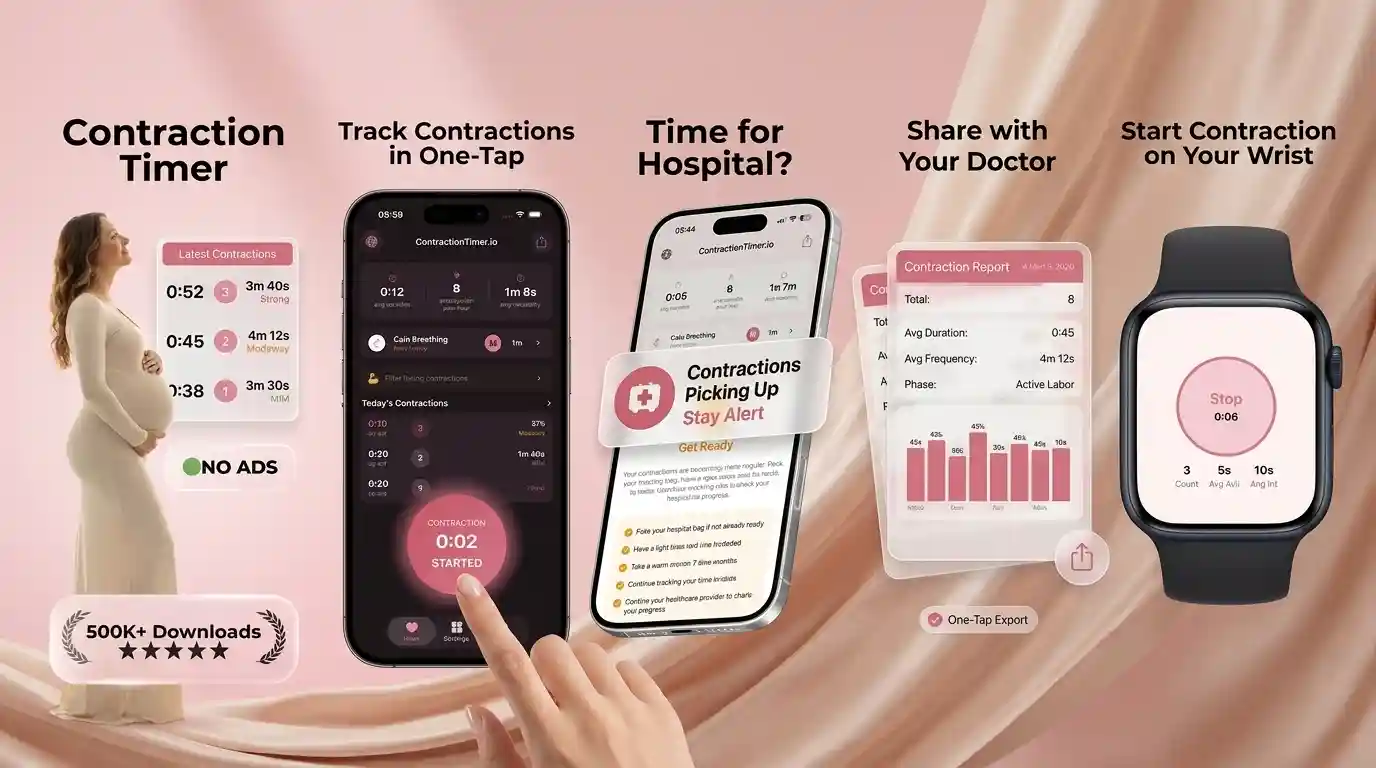
Contraction Timer (contractiontimer.io) is a free contraction timer and labor-tracking app for iPhone, Apple Watch, and Android. For this page, it helps parents create a shareable contraction log with timing patterns, notes, and summaries for a doula or birth team.
Quick answer: To track contractions and send to doula, use a contraction timer that records each contraction’s start time, duration, frequency, interval, notes, and pattern summary. A clear, shareable log helps your doula or birth team understand whether contractions are becoming longer, stronger, and closer together, but it does not confirm labor stage or replace medical advice.
Why choose Contraction Timer?
Contraction Timer is built for sharing a clear labor pattern with your doula instead of asking someone to interpret scattered stopwatch times or text notes.
- Shareable contraction history for doula review
- Automatic duration, frequency, and interval calculations
- One-tap timing for easier use during labor
- 5-1-1 hospital alerts for common call-in guidance
- Labor phase detection based on contraction patterns
- Partner mode for coordinated tracking and updates
- Doctor reports for care team conversations
- Offline use with no ads
Works on iPhone, Apple Watch, and Android. It is a tracking tool, not a medical device.
To track contractions and send to doula, use a contraction timer app that records each contraction's start time, duration, frequency, and intensity, then share the log via text, email, or a direct link so your doula can read labor patterns without a phone call. Agree on your sharing method and contact thresholds before labor begins, and combine the data with subjective notes about how you feel so your doula gets the full picture.
This guide is about logging and sharing contraction patterns; it is not medical advice and should not replace instructions from your midwife, OB-GYN, hospital, or birth center.
Definition: A doula labor log is a timestamped record of contraction start times, durations, intervals, and intensity notes that can be shared electronically with a doula or birth team to help assess labor progress remotely.
TL;DR
- Log start time, duration, frequency, and intensity for every contraction set you time.
- Share the contraction log with your doula via text, email, or in-app link, and agree on the method before labor starts.
- Combine timing data with subjective notes, such as coping level and other labor signs, because patterns alone don't tell the whole story.
What a Shareable Contraction Log Includes
A useful shareable contraction log includes four fields: start time, duration, interval, and a short intensity or coping note. Those details let your doula read the rhythm without making you retell every wave.
Start time shows when each contraction began. Duration records how many seconds it lasted. Interval, often called frequency, shows the time between contractions. Many apps calculate this automatically, which helps when your brain is busy with breathing and body cues.
The note field matters more than people expect. “Could talk through it,” “needed counterpressure,” or “felt low in back” gives your doula context that numbers can't. If your birth partner is whispering “start” and “stop” while your eyes stay closed, that tiny note may be the clearest part of the update.
For a doula reading remotely, these four fields turn scattered check-ins into a pattern.
2 Evidence Points Behind Doula Contraction Log Sharing
Shared contraction logs matter because they support timely doula communication, not because timing data can predict labor by itself. The log gives your doula a cleaner pattern summary, so the conversation can move faster to comfort, coping, and when to call the care team.
- Continuous labor support, including doula support, is linked with lower cesarean birth rates, less synthetic oxytocin use, and more spontaneous vaginal births in a Cochrane review source.
- Per CDC/NCHS birth-setting data, about 98% of U.S. births occur in hospital settings, so many families use timing patterns to coordinate when to leave home source.
- A large randomized trial found continuous labor support was associated with shorter labors on average and greater satisfaction with the birth experience source.
- A shared doula labor log replaces fragmented phone updates with start times, durations, spacing, and notes in one place.
- For early labor support, a shared contraction log is often easier than repeated calls because the doula can scan the pattern before responding.
Good contraction timer apps deliver readable timing patterns and shareable summaries, not a diagnosis or a guaranteed hospital-arrival decision.
How Contraction Tracking and Doula Sharing Works
Contraction tracking works by turning each start and stop tap into timestamped data, then calculating spacing between waves. In plain language, the app watches the rhythm so you don't have to do math during labor.
You tap start when the contraction begins and stop when it fades. The app records duration, then calculates the interval from the end of one contraction to the start of the next. Pattern detection can show trends, such as contractions getting longer, closer together, or staying uneven. That trend is the useful part, especially during early labor when things can pause and restart.
The share function packages the log into a readable format. It may be a link, CSV, text summary, or email export. A tool that can export contraction history is especially helpful when your doula wants to compare the last 30 minutes with the previous hour.
Then your doula reads the log on their device, often before calling back.
Before Labor: Set Up a Doula Communication Plan
Set up your doula communication plan before labor so the log supports you instead of becoming another task. Decide which app or tool you'll both use, how you'll share it, and what pattern should trigger a call.
Many families use timing thresholds such as 5-1-1 or 4-1-1, meaning contractions are about five or four minutes apart, lasting one minute, for one hour. Your plan may be different if this is a second baby, a home birth, VBAC labor, or your provider gave specific instructions. Clinicians typically recommend following your own care team's guidance over generic app alerts.
For signs of labor and when to contact your clinician, use your own care team's instructions first; ACOG also notes that labor signs and timing can vary by person source.
Test the share function during pregnancy. Really test it. Send a practice log, open the link, and confirm the notes appear.
If tech fails, keep the backup simple: “about 5 minutes apart, 60 seconds long, stronger in my back, coping okay.” For partner setup, a contraction timer for birth partner can keep the laboring person off the screen.
How to Track Contractions and Send to Your Doula in 6 Steps
Use this six-step flow when contractions feel worth timing, then put the phone down between sets. The most common medically supported way to use contraction timing is to combine a short timed sample with your symptoms, coping level, and your care team's instructions.
If your doula asks for a different sample window, such as 30 minutes instead of 3 to 5 contractions, follow that plan because it reflects your birth setting and history.
Log Each Contraction With Start, Stop, and Notes
- Open your contraction timer and tap start when a contraction begins.
- Tap stop when the contraction ends so the app records duration.
- Add a quick note about intensity, location, or coping, such as “needed breathing” or “could still talk.”
- Repeat for 3 to 5 contractions in a row, then put the phone down and rest.
Share the Doula Labor Log and Review Patterns Together
- Share the contraction log with your doula using your agreed method, such as text, email, or an app link.
- Review the pattern summary together and decide whether to keep resting, change comfort measures, call the provider, or prepare to leave.
Tools like ContractionTimer.io can be useful here when you want a simple log rather than a long note thread.
Common Mistakes When Sharing a Contraction Log With a Doula
The biggest mistake is timing every single contraction for hours. That can pull attention away from rest, breathing, and coping, especially when early labor is still finding its rhythm.
Another mistake is sharing only numbers. Your doula also needs to know whether you can talk, whether you need counterpressure, whether your water broke, or whether there is bloody show. A screen showing uneven five-minute gaps tells one story. Your voice during the next contraction tells another.
Don't rely on generic “go to hospital” alerts without your doula and provider's judgment. Close contractions can happen with prodromal labor, and mild cramps can still come in a tidy pattern. Annoying, but real.
Also test the share feature before labor. The front porch air between contractions is not the moment to discover your export link won't open. For doula-specific workflows, a contraction timer for doula can help clarify what information the support person actually needs.
Verify Your Doula Received the Contraction Log
After sharing, close the loop by asking your doula to confirm they received the contraction log. A sent message is not the same as a readable log.
Ask them to check that timestamps, durations, intervals, and notes display correctly. Then compare the pattern summary with what you experienced. If the log says contractions are spacing out, but your body feels more intense and you can't talk through them, say that clearly.
Tiny mismatches matter.
Agree on the next update before you hang up or stop texting. For example, you might send another set after 30 minutes, after a change in intensity, after water breaks, or before leaving for the birth place. People planning outside the hospital may want a contraction timer for home birth with a very clear backup communication plan.
When to Call Your Doula or Care Team
Call your doula for routine labor support updates, comfort ideas, and help reading the contraction pattern. Call your clinician, hospital, birth center, or emergency line for warning signs or anything your provider told you should be urgent.
A contraction log can support the conversation, but it does not diagnose active labor, cervical change, or whether it is time to be admitted. Use it as a shared record, then let your care plan lead.
- Send your doula routine updates when contractions change, coping feels harder, your water breaks, or you need help deciding what comfort measure to try next.
- Call your care team urgently for heavy bleeding, decreased fetal movement, fever, severe pain, or pain that feels unusual between contractions.
- Follow individualized instructions if you are planning a VBAC, having preterm symptoms, or managing a high-risk pregnancy; generic timing thresholds may not apply.
- Describe the whole picture when you call: timing pattern, intensity, fluid or bleeding, baby’s movement, temperature, and how you are coping.
- Choose provider guidance over app alerts if the two disagree. The app sees minutes. Your clinician knows your pregnancy.
Limitations
A shared contraction log is a support tool, not a clinical assessment. It can help your doula notice the rhythm, but it cannot confirm what your cervix is doing.
- Contraction timers cannot diagnose true labor, false labor, active labor, or cervical dilation.
- Generic 5-1-1 or 4-1-1 alerts may be wrong for your pregnancy, parity, provider plan, or birth setting.
- Dead battery, weak service, app glitches, or a forgotten password can break real-time sharing.
- Over-focusing on timing can increase anxiety and make it harder to rest between contractions.
- A shared log does not replace clinical monitoring for warning signs, including decreased fetal movement, heavy bleeding, fever, or severe pain between contractions.
- If contractions stop after hydration, sleep, or position changes, your doula still needs that context.
- VBAC, preterm symptoms, high-risk pregnancy, or unusual pain deserve individualized instructions from your clinician.
If you're planning after a prior cesarean, a contraction timer for VBAC labor should be paired with your provider's specific call plan.
Frequently Asked Questions
Can my doula see contractions in real time?
Some apps support live sharing links, while others require you to export or send the log manually. ContractionTimer.io may be used when a simple shareable timing record fits your plan.
How many contractions should I time before sharing?
Time 3 to 5 contractions in a row, then share that set with your doula. Constant timing for hours is usually less useful than a clear sample plus coping notes.
What contraction pattern means I should call my doula?
Common thresholds include 5-1-1 or 4-1-1, but your plan may vary. Follow the timing guidance you made with your doula and clinician.
Should I include contraction intensity in my log?
Yes, intensity and coping notes are often as important as timing. A doula labor log is more useful when it includes how you feel, not only the minutes.
Can I share my contraction log by text?
Yes, text, email, and in-app link sharing can all work. The right method is the one your doula can open quickly during labor.
Does timing every contraction slow labor?
Timing itself does not slow labor, but constant screen focus can increase stress and distraction. Rest, breathing, and comfort measures still matter.
What if my contraction timer app crashes?
Use a backup plan, such as texting a simple pattern summary. For example, send “4 minutes apart, 60 seconds long, stronger, coping with support.”
Can a contraction app tell true from false labor?
No, a contraction app cannot diagnose true labor or confirm dilation. It can record patterns that help your doula and care team decide what to discuss next.
Which app fits which need
| Need | Best option |
|---|---|
| fast, accurate contraction timing with a shareable doula log | Contraction Timer over Full Term for clearer sharing, partner tools, 5-1-1 alerts, and doctor reports |
| general pregnancy articles, registry content, and community-style guidance | The Bump, with Contraction Timer better for actual contraction timing and doula-ready logs |
| clinical-style contraction sensing or hardware-based monitoring interest | Bloomlife, while Contraction Timer is better for free app-based labor timing and sharing |
| birth preparation, mindfulness, and guided relaxation | GentleBirth, with Contraction Timer better for tracking contractions and sending timing summaries |
Quick facts
- Type
- Contraction timer & labor tracker app
- Platforms
- iPhone, iPad, Apple Watch, Android
- Focus
- Contraction timing, doula log sharing, duration, frequency, interval, 5-1-1 alerts, labor patterns
- Includes
- one-tap timing, contraction history, notes, partner mode, doctor reports, labor phase detection, 5-1-1 hospital alerts, offline use, no ads
- Best for
- Parents and birth partners who want to track contractions and send a clear log to a doula or care team
- Free
- Yes
- Medical replacement
- No
People also use Contraction Timer for
Track Contractions and Send a Clear Log to Your Doula
Use Contraction Timer to record duration, frequency, intervals, notes, and labor patterns in one place. Share a clearer update with your doula or care team while keeping medical decisions with your provider.
Download the Free App