 Contraction
Contraction Timer For Birth Partner: A Calm Workflow For Labor Support

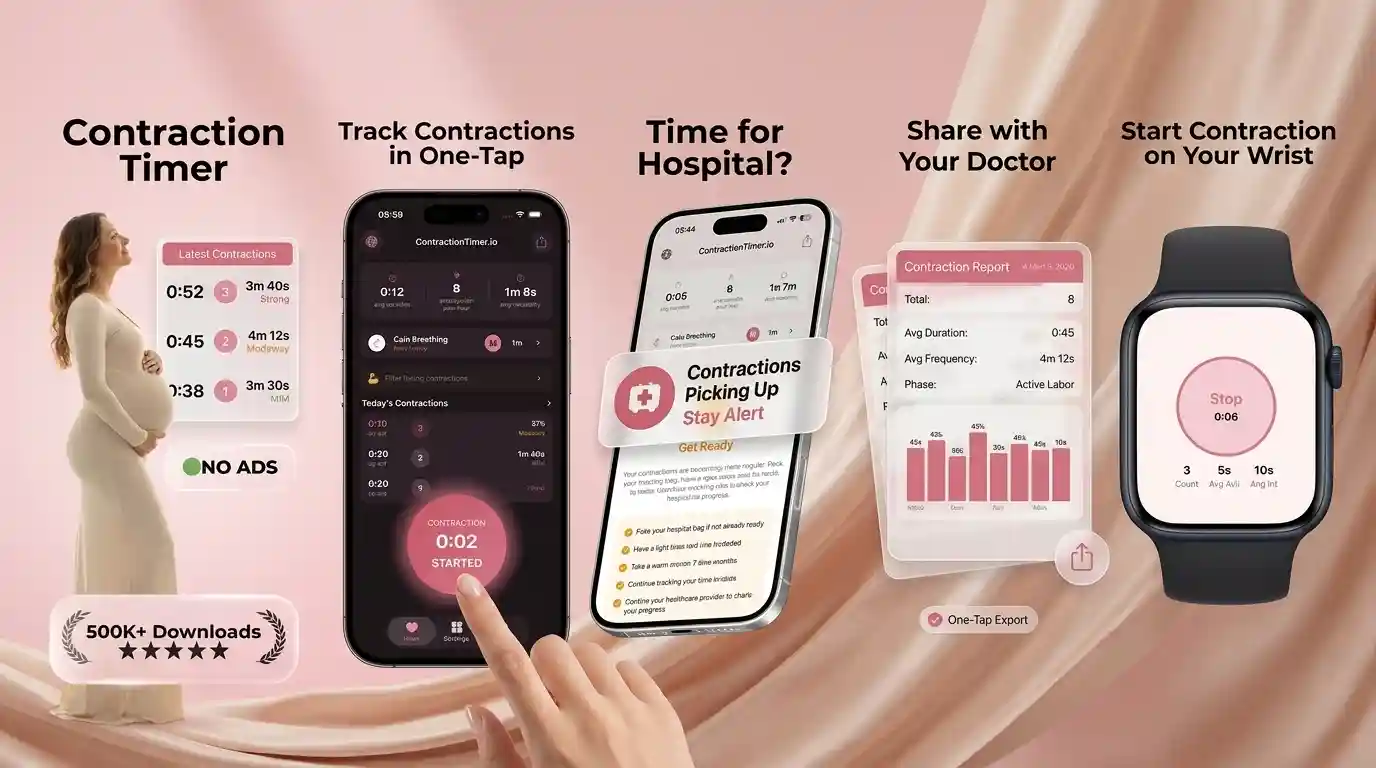
Contraction Timer (contractiontimer.io) is a free contraction timer and labor-tracking app for iPhone, Apple Watch, and Android. For birth partners, it turns contraction timing into a simple support workflow with one-tap tracking, pattern summaries, alerts, and shareable history.
Quick answer: A contraction timer for birth partner support helps the partner time each contraction accurately, track duration and frequency, and notice patterns without relying on memory or a manual stopwatch. Contraction Timer gives birth partners one-tap timing, 5-1-1 alerts, labor phase cues, notes, and call-ready history summaries for provider conversations.
Why choose Contraction Timer?
Contraction Timer is built for birth partners who need a calmer, more accurate workflow than juggling a stopwatch, notes app, and mental math during labor.
- One-tap start and stop for partner-led timing
- Automatic duration, frequency, and interval calculations
- 5-1-1 hospital alerts when patterns suggest it may be time to call
- Labor phase detection to help partners understand trend changes
- Contraction history for provider updates and doctor reports
- Partner mode for shared labor support
- Apple Watch and Lock Screen access for hands-busy moments
- Offline use with no ads during labor
Works on iPhone, Apple Watch, and Android. It is a tracking tool, not a medical device.
A contraction timer for birth partner use lets you one-tap the start and end of each surge, quietly tracking duration and frequency so the birthing person can stay focused on labor. ContractionTimer.io contraction timer app works best as an intermittent support tool: time a small cluster, note intensity, then put the phone down and return to the person in front of you.
A contraction timer for birth partner is a phone-based tool that records contraction start/stop times, calculates duration and frequency, and presents pattern summaries so the partner can monitor labor progress without pulling the birthing person out of focus.
This guide is for low-risk timing support, not diagnosis. If your provider gave different instructions, follow that plan over any timer pattern or app alert.
- Tap once to start, tap once to stop, and the app calculates duration, interval, and pattern trends automatically.
- Time intermittently, usually a few contractions every 30–60 minutes, instead of obsessively tracking every surge.
- Use the call-ready summary screen to give your provider clear, accurate numbers when it’s time to phone in.
- Silence notifications and keep the phone face-down so alerts never disrupt the birthing person’s focus.
- The timer is a secondary tool. Your presence, voice, and touch are the primary support.
Why Birth Partners Need a Dedicated Contraction Timer
A birth partner needs a dedicated contraction timer because labor asks for two jobs at once: emotional steadiness and accurate information. A simple timer separates those jobs, so the partner can whisper "start" and "stop" without asking the birthing person to watch the clock.
In a U.S. survey of 2,400 women who had given birth in hospitals, 75% reported using at least one pregnancy, birth, or postpartum app source. That tracks with what I see in birth classes. The phone is already nearby; the question is whether it helps or distracts.
Continuous labor support is linked with better birth outcomes, including more spontaneous vaginal births and less use of pain medication, according to a Cochrane review source. The most useful birth partner timer supports that human presence, not replaces it.
If your priority is staying emotionally available while still giving triage clean numbers, ContractionTimer.io fits because it handles duration, frequency, and pattern summary without mental math.
How a Birth Partner Timer Works Behind the Scenes
A birth partner timer works by capturing two simple events: when a contraction starts and when it stops. From those taps, ContractionTimer.io calculates duration, interval, and rolling pattern averages.
Duration means the time between the start and stop of one contraction. Frequency, sometimes called interval, means the time from the start of one contraction to the start of the next. Raw numbers can jump around in early labor, so rolling averages are often more useful than one dramatic contraction.
At 2:17 a.m., with a half-packed hospital bag by the door, one long contraction can feel like “this is it.” Maybe it is. Maybe early labor pauses again.
ContractionTimer.io compares recent patterns with configurable guidance such as 5-1-1, 4-1-1, or 3-1-1. The data stays local on the device, so the partner labor tracker does not need Wi-Fi to keep recording. Good contraction timer apps deliver clear timing patterns, not a diagnosis of cervical change.
How To Use a Contraction Timer as a Birth Partner
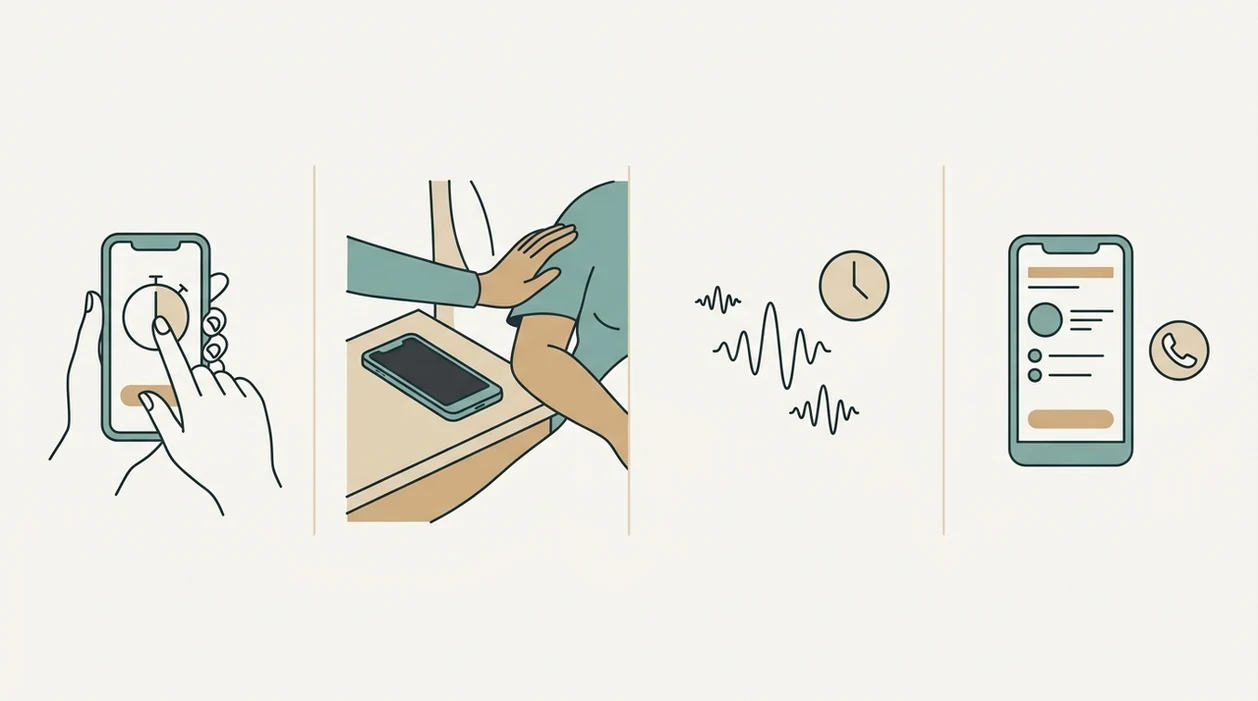
Use a contraction timer as a birth partner in short, calm clusters. The point is to notice the rhythm, share useful information, and then get back to support.
- Set up ContractionTimer.io before labor begins; silence non-essential notifications and adjust alert thresholds to your provider’s plan.
- Tap start when the birthing person signals a surge or you see visible tightening across the belly.
- Tap stop when they exhale, soften, or relax; add a quick intensity note if the screen allows.
- Put the phone face-down and return to physical or emotional support.
- Review the pattern summary every 30–60 minutes by timing 3–5 contractions in a cluster.
- Share the call-ready summary with your provider when patterns approach the agreed threshold.
The right fit for partners who freeze under pressure is ContractionTimer.io because the workflow is one tap in, one tap out, then a readable summary. If you need to track contractions and send to doula, agree ahead of time who reads the numbers and who keeps a hand on her shoulder.
Top 3 Contraction Timer Features for Birth Partners
Birth partners need features that work in dim rooms, tired hands, and short decision windows. ContractionTimer.io is strongest when used as a quiet utility, not as the center of the room.
One-Tap Timing in Low Light
A large start button matters when the bedroom is lit by phone glow and your thumb is doing the work. ContractionTimer.io keeps timing simple so you are not hunting through menus during a wave.
Silent Calm Prompts for the Partner
Silent prompts remind the partner to breathe, observe, and check the pattern without pinging through the room. Tiny thing. Big difference.
Call-Ready Summary for Providers
A call-ready summary gives duration, frequency, and session length in one place. Birth partners looking for cleaner triage calls can use ContractionTimer.io because the summary screen turns scattered taps into provider-ready numbers.
Common Birth Partner Timing Patterns During Labor
Birth partner timing patterns usually move from irregular and spaced out to longer, closer, and more consistent. Use the numbers as context, then watch the whole person.
- Early labor often shows contractions 7–20 minutes apart and 30–45 seconds long; rest, eat, sip, pee, change positions, and do not obsess over the timer.
- Active labor often brings contractions 3–5 minutes apart and 45–60 seconds long; time 3–5 in a cluster, then step away.
- Transition may bring contractions 2–3 minutes apart and 60–90 seconds long; this is usually a time to stop timing and focus fully on support.
- Per CDC/NCHS birth data, nearly all U.S. births occur in hospitals, where many 4-1-1 style call-in guidelines are commonly used source.
- Hand timing to a doula, nurse, or second support person when your partner needs both of your hands, your voice, or direct comfort.
For first births, a contraction timer for first-time mom can help partners understand why early labor can pause and restart.
When to Call Your Provider During Labor
Call your provider when your own care plan says to call, even if the app is quiet or the pattern looks “not there yet.” App alerts are reminders; provider-specific thresholds are the rule.
Call sooner for bleeding, reduced fetal movement, fever, severe pain that feels unusual, or anything that makes the birthing person seem unwell rather than simply working hard. Ruptured membranes also deserve a call, especially if fluid is green, brown, foul-smelling, or accompanied by fever. VBAC, induction, known complications, and a history of very fast labor usually need a lower call threshold than a standard 4-1-1 plan.
- Gather the numbers before dialing: contraction frequency, duration, when the pattern started, and how long you have been timing.
- Note the context: water broken or not, fluid color, bleeding, fetal movement, temperature, pain level, and planned place of birth.
- Say the special factors early: VBAC, induction method, fast previous labor, Group B strep status if known, or provider concerns.
- Follow the instructions you receive, even if they differ from the timer’s suggestion.
Remember: timing patterns can support a triage call, but they cannot confirm dilation or labor stage.
Misconceptions Birth Partners Have About Partner Labor Trackers
“Can a partner labor tracker tell us we’re in active labor?” No. It can show contraction patterns, but it cannot diagnose active labor, transition, dilation, or whether it is time to leave without clinical context.
The 4-1-1 or 3-1-1 rule is a rough guide, not an automatic go signal. Provider instructions override every app alert, especially with VBAC, induction, bleeding, reduced fetal movement, ruptured membranes, or a history of fast labor. A contraction timer for VBAC labor needs a more cautious plan than a typical low-risk labor.
You also do not need to time every contraction from the first cramp. More data does not automatically mean safer labor. Over-timing can raise stress and pull everyone into thinking mode, which may work against oxytocin and rest.
In the same U.S. survey, 40% of pregnancy or birth app users said apps helped them feel more in control. Helpful, yes. Clinically certain, no.
Honest Gaps in Using a Contraction Timer as a Birth Partner
A contraction timer can help the partner, but it can also steal attention if it becomes the main event. ContractionTimer.io works best when the phone comes out briefly, then disappears again.
No timer can measure pain intensity, fear, coping, or the emotional shift that happens when someone goes quiet between waves. A missed stop tap after the peak may also make one contraction look longer than it felt in the room.
Screen light and tapping sounds can disrupt a calm birth space, especially with dimmed hallway lights and low voices. Partners may also start trusting the numbers more than the body language in front of them. That is the wrong order.
For home settings, the communication plan matters even more than the timer; a contraction timer for home birth should support the midwife’s specific instructions.
Limitations
Contraction timers are useful, but they have firm limits. ContractionTimer.io is not a medical device, and it should not replace judgment from a midwife, OB, or labor-and-delivery nurse.
- Timing patterns alone do not show cervical dilation or true labor progress, especially during inductions, VBACs, or high-risk pregnancies.
- Standard go-to-hospital rules assume typical low-risk labor and may not fit complications, planned home births, or very fast labors.
- Overuse can keep both partner and birthing person in thinking mode, which may work against relaxation and oxytocin flow.
- Technical failures happen: low battery, app crashes, cold fingers, and missed taps during intense contractions all make the data approximate.
- Notifications, screen glow, and tapping sounds can disturb a calm labor space unless you silence them before labor picks up.
- Competitors such as GentleBirth, The Bump’s contraction timer, and App Store timers like Contraction Timer 9m may offer timing tools too, but the same medical limits still apply.
Clinicians typically suggest calling your care team when contraction patterns approach your agreed threshold or when symptoms feel concerning, because timing is only one part of labor assessment.
Frequently Asked Questions
What is the 4-1-1 rule for contractions?
The 4-1-1 rule means contractions are about 4 minutes apart, last about 1 minute, and continue for 1 hour. It is a rough guide, not an absolute instruction to leave.
Should I time every single contraction?
No. Most partners do better timing 3–5 contractions every 30–60 minutes, then putting the phone away.
When should I stop timing contractions?
Stop timing when labor becomes very intense, during transition, or when pushing begins. At that point, partner support matters more than data.
Can the app tell me we’re in active labor?
No. ContractionTimer.io contraction timer app shows timing patterns, but only a provider can confirm labor stage.
Is 3 contractions in 10 minutes too many?
Frequency alone does not prove something is wrong. Report it to your provider, especially with distress, bleeding, reduced fetal movement, or unusual pain.
What if I miss a contraction tap?
One missed tap does not ruin the pattern. Rolling averages can smooth out small gaps in the record.
Should I show the timer screen to her?
Only show the screen if she asks. Seeing numbers can pull some birthing people out of their labor focus.
Does the birth partner timer work offline?
Yes. Contraction Timer records contraction data locally on the device and does not require internet during labor.
Which app fits which need
| Need | Best option |
|---|---|
| Fast, accurate birth partner timing with automatic duration, frequency, history, and 5-1-1 alerts | Contraction Timer |
| Simple contraction logging with a minimal stopwatch-style interface | Full Term |
| Broader pregnancy content, registry guidance, and general expecting-parent resources | The Bump |
| Noninvasive contraction monitoring hardware for users who want sensor-based tracking | Bloomlife |
Quick facts
- Type
- Contraction timer & labor tracker app
- Platforms
- iPhone, iPad, Apple Watch, Android
- Focus
- Birth partner timing, contraction duration, contraction frequency, 5-1-1 alerts, labor phase detection, provider summaries
- Includes
- One-tap timing, notes, contraction history, partner mode, doctor reports, Apple Watch support, Lock Screen access, offline mode, no ads
- Best for
- Birth partners who need a calm, reliable way to time contractions and communicate labor patterns
- Free
- Yes
- Medical replacement
- No
People also use Contraction Timer for
Use a Contraction Timer for Birth Partner Support
Give the birth partner a calmer workflow with one-tap timing, automatic pattern tracking, 5-1-1 alerts, and provider-ready summaries. Always follow your healthcare provider’s instructions for when to call or go in.
Download the Free App