
Active Labor Contraction Patterns: Timing Examples and When to Act




Active labor contraction patterns typically show contractions arriving every 3-5 minutes, lasting 45-60 seconds each, and maintaining that rhythm for at least one hour without easing up during rest or position changes. These patterns build in strength and regularity as the cervix dilates, but only a healthcare provider can confirm true active labor through a cervical exam. A contraction timer app helps you document these patterns accurately so you can share clear data when you call your provider.
> Definition: Active labor contraction patterns are recurring, progressively stronger uterine contractions that arrive at regular intervals, typically every 3-5 minutes and lasting 45-60 seconds or more, indicating the cervix is actively dilating toward delivery.
TL;DR
- Active labor contractions come every 3-5 minutes, last 45-60+ seconds, and persist for at least an hour.
- The 4-1-1 and 3-1-1 rules are helpful timing guides, but they are not medical absolutes; call your provider if concerned.
- A contraction timer app tracks patterns but cannot diagnose dilation or confirm active labor.
At a Glance: Active Labor Contraction Timing Ranges
Active labor contractions usually become regular, close together, and hard to talk through. These numbers are useful for pattern recognition, not for diagnosing labor at home.
For clinical context, ACOG notes that active labor is more reliably identified around 6 cm dilation, while patient-facing labor guidance commonly uses contraction timing as one part of the decision to call or go in: ACOG Safe Prevention of the Primary Cesarean Delivery and Merck Manual: normal labor.
- Frequency: Active labor contractions often arrive every 2-5 minutes, with many people noticing a steady 3-5 minute rhythm first.
- Duration: Each contraction commonly lasts 45-90 seconds, especially as labor moves forward.
- One-hour pattern: Many providers use “for at least 1 hour” because one or two close contractions can be misleading.
- Dilation range: Active labor is often discussed around 4-6 cm dilation, with older guidance using 4 cm and newer guidance often recognizing 6 cm as a clearer active-phase point.
- Active phase length: Active labor often lasts roughly 4-8 hours, but normal variation is wide.
The phone screen with one-minute durations can feel oddly serious. Still, the pattern matters more than one single contraction.
What Defines Active Labor Contraction Patterns
Active labor contractions are contractions that get stronger, closer together, and longer over time without fading after rest, hydration, or position changes. They are usually intense enough that you stop walking, stop talking, or need to focus until the wave passes.
In older clinical language, active labor often began around 4 cm dilation. Many newer frameworks describe active labor as clearer between 4-6 cm, because some people dilate slowly before that point. Clinicians typically recommend using contraction timing together with symptoms, risk factors, and your care plan, not timing alone.
Early labor and prodromal labor can feel convincing. You may get three strong contractions, then a long quiet gap. Or your belly may harden during a car ride and settle later. Active labor tends to keep organizing instead of scattering.
For a wider view of how patterns change before this stage, compare these signs with early labor contraction patterns.
How Active Labor Contraction Patterns Work
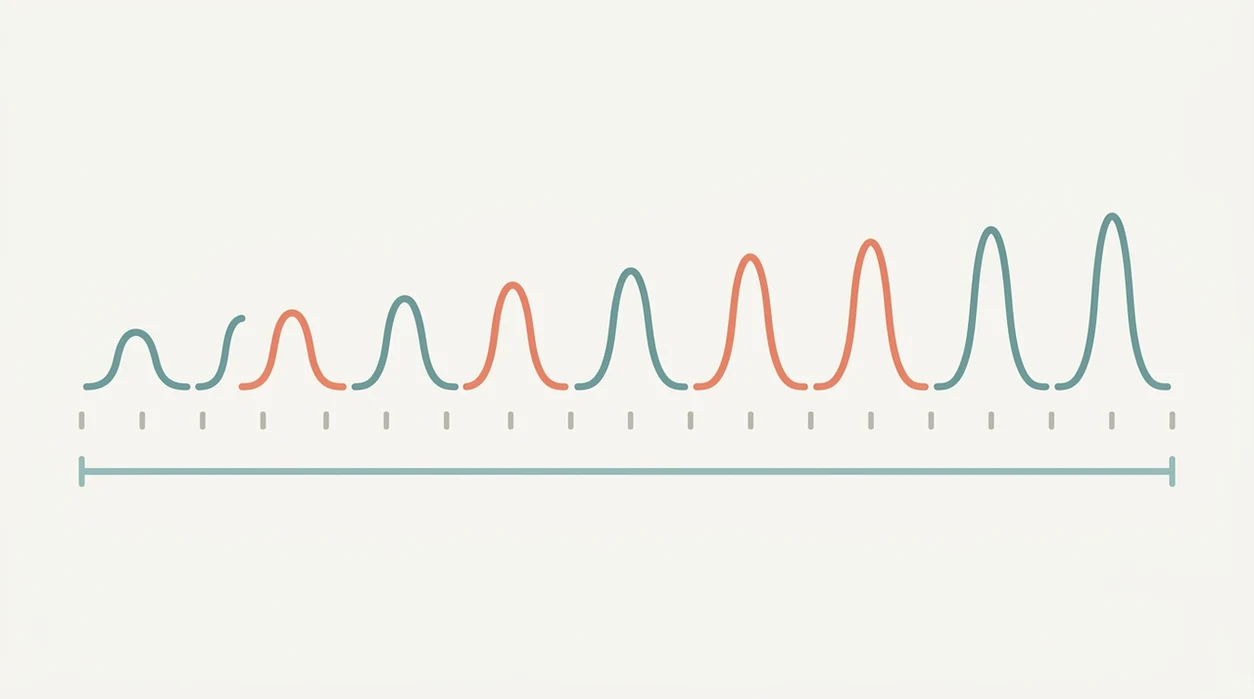
Active labor contraction patterns work through coordinated uterine tightening that opens and thins the cervix while helping move the baby downward. The timing you record shows the rhythm of those waves, but clinical confirmation depends on cervical assessment.
During a contraction, the uterine muscle pulls upward and inward. That pressure helps cervical dilation, or opening, and effacement, or thinning, while the baby’s head or presenting part adds downward pressure. As labor becomes more established, hormonal signaling and muscle coordination usually make contractions longer, stronger, and closer together, which is why the log often starts to look more organized.
A practical way to separate the pieces is:
- Track the start, stop, spacing, and strength trend of contractions over several cycles.
- Notice whether the pattern keeps building instead of fading with rest, hydration, or position changes.
- Confirm progress with your provider, because only an exam can show whether dilation and effacement are changing.
Even then, active labor varies widely. Baby position, prior births, hydration, stress, epidural or induction medication, and simple body-to-body variation can all change the pattern.
Before You Start Timing Active Labor Contractions
Before you start timing active labor contractions, make sure the timing plan is already clear. The best log is easier to use when you know who to call, when to call, and what symptoms should skip the counting altogether.
- Confirm your provider’s call-in rule before labor begins, especially whether they prefer 5-1-1, 4-1-1, 3-1-1, or a personalized threshold based on your pregnancy.
- Save the hospital, birth center, midwife, office, and after-hours triage numbers somewhere obvious, not buried in a portal password you may not remember during contractions.
- Choose who will run the timer when contractions get intense. A partner, doula, or nearby support person can tap Start and Stop while you breathe, move, or stay still.
- Review the warning signs that override the contraction pattern. Call right away for heavy bleeding, decreased fetal movement, fever, severe headache, unusual constant pain, or if your water breaks and your provider told you to report it immediately.
- Keep your notes simple: average spacing, average length, how long the pattern has continued, and whether it is getting stronger.
How Active Labor Contraction Patterns Progress
Active labor contraction patterns progress because the uterine muscle becomes more coordinated. The medical term is uterine contractility, which simply means the uterus tightens in stronger, better-timed waves that help open the cervix.
As labor advances, contractions may shift from about every 5 minutes to every 2-3 minutes. Duration can lengthen from about 45 seconds to 60-90 seconds. Older teaching often used roughly 1 cm per hour as a benchmark, but ACOG cautions that labor progress varies and that slower dilation before 6 cm can still be normal: . Some labors move in bursts. Some pause, then speed up.
How active labor contraction patterns work: stronger uterine waves press the baby downward while cervical effacement and dilation continue, so timing often becomes closer and more regular as the active phase progresses.
Transition is usually the most intense part. Contractions can come very close together, with less recovery time. The full transition contractions pattern is worth reviewing before you are trying to read a timer between peaks.
How to Track Active Labor Contractions With a Timer App
A contraction timer app is useful when it records start time, stop time, duration, frequency, and trend without making you do math during labor. Use it as a timing record, not a verdict.
- Start timing when you feel a consistent pattern forming, not every mild tightening that comes and goes.
- Tap Start at the first tightening, then tap Stop when the contraction fully releases.
- Review the log after several cycles to check frequency, duration, and regularity.
- Compare the pattern with your provider’s 4-1-1 or 3-1-1 guidance.
- Share the summary by phone or in person so your provider can hear clear times instead of scattered guesses.
Avoid obsessively logging every Braxton-Hicks tightening. That can make the screen feel louder than your body.
Tools like ContractionTimer.io can help keep the screen simple when a partner takes over. Good contraction timer apps deliver clean timing records, not a diagnosis of dilation.
Active Labor Timing Examples: First-Time vs Experienced Parents
Active labor timing can look different for first-time and experienced parents. First labors often build more gradually, while later labors may move into a tight pattern faster.
Sample Pattern for a First-Time Parent
A first-time parent might have contractions every 5 minutes for 1 hour, each lasting about 60 seconds. Over the next hour, that pattern may close to every 3 minutes, with contractions becoming harder to talk through. The kitchen clock glowing past midnight is familiar here. You keep checking whether the spacing is really changing.
Sample Pattern for an Experienced Parent
An experienced parent may move from irregular contractions to every 3 minutes quickly, and the active phase may be shorter. That said, parity does not guarantee speed. Sleep loss, stress, dehydration, and a tense room can make patterns harder to read.
For stage-by-stage context, the active labor timeline explains how timing fits with the rest of labor.
The 4-1-1 and 3-1-1 Rules for Active Labor Contractions
What are the 4-1-1 and 3-1-1 rules for active labor contractions? The 4-1-1 rule means contractions are 4 minutes apart, lasting 1 minute each, and continuing for 1 hour; the 3-1-1 rule uses 3 minutes apart instead.
These rules are common active labor timing guides, but they are not diagnostic thresholds. A provider may want you to call earlier if your waters break, if bleeding occurs, if fetal movement decreases, if you have a prior cesarean, or if your pregnancy has added risk factors.
Your specific instructions matter more than a generic rule. Write them down before labor if you can. Front porch air between contractions can help you hear the nurse’s questions clearly, but the call should not wait for perfect numbers if something feels wrong.
When to Call Your Provider During Active Labor
Call your provider during active labor when contractions meet your personal timing rule, or sooner if warning signs appear. Do not wait for a perfect 4-1-1 or 3-1-1 pattern if something feels urgent or different from your usual instructions.
Bleeding that is more than light spotting, fever, decreased fetal movement, severe constant pain, severe headache, or feeling faint should prompt a call right away. Ruptured membranes may also need earlier contact, especially if fluid is green or brown, has a strong odor, or your provider asked you to report water breaking immediately. Call earlier if you have a prior cesarean, are carrying multiples, may be in preterm labor, or have a high-risk pregnancy plan.
When you call:
- State how far apart contractions are, how long they last, and how many minutes or hours the pattern has continued.
- Describe whether contractions are getting stronger, closer together, or harder to talk through.
- Report any bleeding, fever, fluid leaking, fetal movement changes, or unusual pain.
- Mention your due date, prior cesarean, multiples, preterm concerns, or other risk factors.
- Follow the provider’s next step, even if it differs from a timer app or general rule.
Common Myths About Active Labor Contraction Patterns
Active labor does not always begin with neat, textbook spacing. Many patterns tighten gradually, with a messy middle where contractions are stronger but not perfectly even yet.
One myth is that you must hit exact numbers before calling your provider. You do not. Timing rules help you describe what is happening, but concern is enough reason to call. Another myth is that an app can confirm active labor. It cannot check your cervix, baby’s position, membrane status, blood pressure, or fetal heart rate.
Painful close contractions also do not always mean active labor. Prodromal labor can create strong, frequent contractions without steady cervical change. Annoying, yes. Misleading too.
A broader contraction timeline can help separate early, active, and transition patterns before the timing starts to blur.
Common Mistakes When Interpreting Contraction Timing
The most common timing mistake is treating every Braxton-Hicks tightening as a true contraction. If a tightening stays mild, irregular, and fades with rest or hydration, it may not belong in the same log as active labor contractions.
Another mistake is timing only duration. A 70-second contraction matters more when you also know whether it came 8 minutes later, 4 minutes later, or 2 minutes later. Frequency and regularity carry the pattern.
People also wait too long because their contractions do not match an example exactly. That can be risky if bleeding, decreased fetal movement, ruptured membranes, fever, severe headache, or unusual pain appears. The timer does not see those signs.
On the app side, common errors are forgetting to tap Stop, double-tapping Start, or timing from the pain peak instead of the first tightening. Edit the entry if needed. Then reset your focus.
Verifying Your Active Labor Contraction Pattern With a Provider
Only a clinical assessment can confirm active labor. A cervical exam remains the practical standard for checking dilation, effacement, and whether contractions are changing the cervix.
Use this page as educational timing guidance, not medical advice. If your provider has given different instructions for your pregnancy, follow those instructions instead of any general timing rule here.
When you call, share the pattern plainly: average frequency, average duration, how long it has continued, and whether contractions are getting stronger. If you used a timer, read from the log instead of scrolling in panic. Exporting the timing record before calling the midwife can help your partner speak clearly while you breathe.
Your provider may also assess fetal heart rate, membrane status, baby’s position, bleeding, blood pressure, and your medical history. Induction medications, epidurals, prior cesareans, multiples, and other factors can change expected contraction patterns.
Apps such as ContractionTimer.io contraction timer app can organize the timing record. They do not replace the person deciding whether you need evaluation.
Limitations
Contraction timing is helpful, but it is an imperfect proxy for labor progress. Regular, intense contractions can happen with slow dilation, and some people progress quickly with less tidy timing.
- No single correct active labor pattern exists; 3-5 minutes, 60 seconds, and 1 hour are guides.
- Apps cannot detect fetal distress, abnormal bleeding, high blood pressure, fever, or decreased fetal movement.
- Clinical definitions have shifted, with active labor described around 4 cm in older guidance and closer to 4-6 cm in newer use.
- Induction, epidural medication, prior cesarean, multiples, baby position, and preterm concerns can alter patterns.
- A contraction log can be wrong if Start or Stop is tapped late, missed, or edited inaccurately.
- Pain intensity alone does not confirm dilation.
- Provider instructions should override generic 4-1-1, 3-1-1, or 5-1-1 rules.
If you are unsure, call. No timing rule replaces clinical judgment.
Frequently Asked Questions
What is the pattern of active labor contractions?
Active labor contractions usually come every 3-5 minutes, last 45-60 seconds or longer, and continue regularly for about an hour. They also tend to get stronger and harder to talk through.
What is the 5-1-1 rule for labor?
The 5-1-1 rule means contractions are 5 minutes apart, lasting 1 minute each, for 1 hour. Some providers use it as an early call guideline before tighter 4-1-1 or 3-1-1 patterns.
How long does active labor usually last?
Active labor often lasts about 4-8 hours, but the range is wide. First labors may be longer, and later labors may move faster.
Can an app confirm active labor?
No. ContractionTimer.io can track timing patterns, but only a healthcare provider can assess dilation and confirm active labor.
Do active labor contractions ever stop?
True active labor contractions usually keep coming and do not stop with rest, hydration, or position changes. Contractions that fade may be early or prodromal labor.
When should I go to the hospital?
Many providers use 4-1-1 or 3-1-1 guidance, but your personal instructions matter most. Call earlier for bleeding, ruptured waters, decreased fetal movement, or risk factors.
Are contractions different for second pregnancies?
They can be. Experienced parents often move into active labor faster and may have a shorter active phase.
What if my contractions are irregular but painful?
Painful irregular contractions can happen in prodromal or early labor. Contact your provider if you are uncertain or if any warning signs appear.
Are labor contractions timed from start to start?
Yes. Contraction frequency is generally measured from the start of one contraction to the start of the next, while duration runs from the beginning to the end of a single contraction. A timer can calculate both, but your provider should interpret the pattern alongside symptoms and your individual care plan.
How to Calculate Contraction Frequency, Duration, and Rest Time
Contraction frequency is measured from the start of one contraction to the start of the next. Duration is measured from when a contraction begins until it ends. The rest interval is the time from the end of one contraction to the beginning of the next. For example, if a contraction starts at 2:00, ends at 2:00:55, and the next starts at 2:04, its duration is 55 seconds, its frequency is 4 minutes, and the rest interval is 3 minutes 5 seconds.
Use the same method for every contraction and assess several entries rather than relying on one unusually close or long contraction. If the beginning or end is difficult to identify, record your best estimate consistently and note changes in strength, pressure, fluid leakage, bleeding, or fetal movement separately. Timing definitions can differ in casual conversation, so tell your provider that your spacing is measured start-to-start. Do not delay calling because the pattern looks incomplete if you have urgent symptoms or have been given different instructions.
If you’re wondering what app identifies active labor patterns, Contraction Timer IO can track contraction frequency, duration, and consistency. However, no app can confirm cervical dilation or diagnose active labor.
Contact your maternity care team for guidance, especially if contractions become regular and stronger, your water breaks, you have heavy bleeding, or you notice decreased fetal movement.
Numbers from clinical sources
| Topic | What sources say | Source |
|---|---|---|
| ACOG due-date calculation uses Naegele’s rule (280 days from last menstrual period). | The American College of Obstetricians and Gynecologists defines the estimated due date by convention as 280 days after the first day of the last menstrual period (Naegele’s rule), assuming a 28‑day cycle with ovulation a | American College of Obstetricians and Gynecologists (ACOG), Committee Opinion Methods for Estimating the Due Date (2017) |
Active labor timing notes
ACOG considers 6 cm cervical dilation the start of active labor, but contraction patterns vary.
NHS guidance says to contact your maternity team when contractions are regular and every 5 minutes or more often.
Call urgently for waters breaking, bleeding, reduced baby movement, possible labor before 37 weeks, contractions over 2 minutes, or 6 or more contractions in 10 minutes.
| Pattern | Sourced example |
|---|---|
| Active phase | 6 cm or more - ACOG |
| Typical duration | 45-60 seconds or longer - NHS trusts |
| Typical spacing | Every 3-5 minutes for over an hour - NHS trust |
| Urgent frequency | 6+ in 10 minutes - NHS |