
Preterm Contractions Before 37 Weeks: When To Call Your Provider



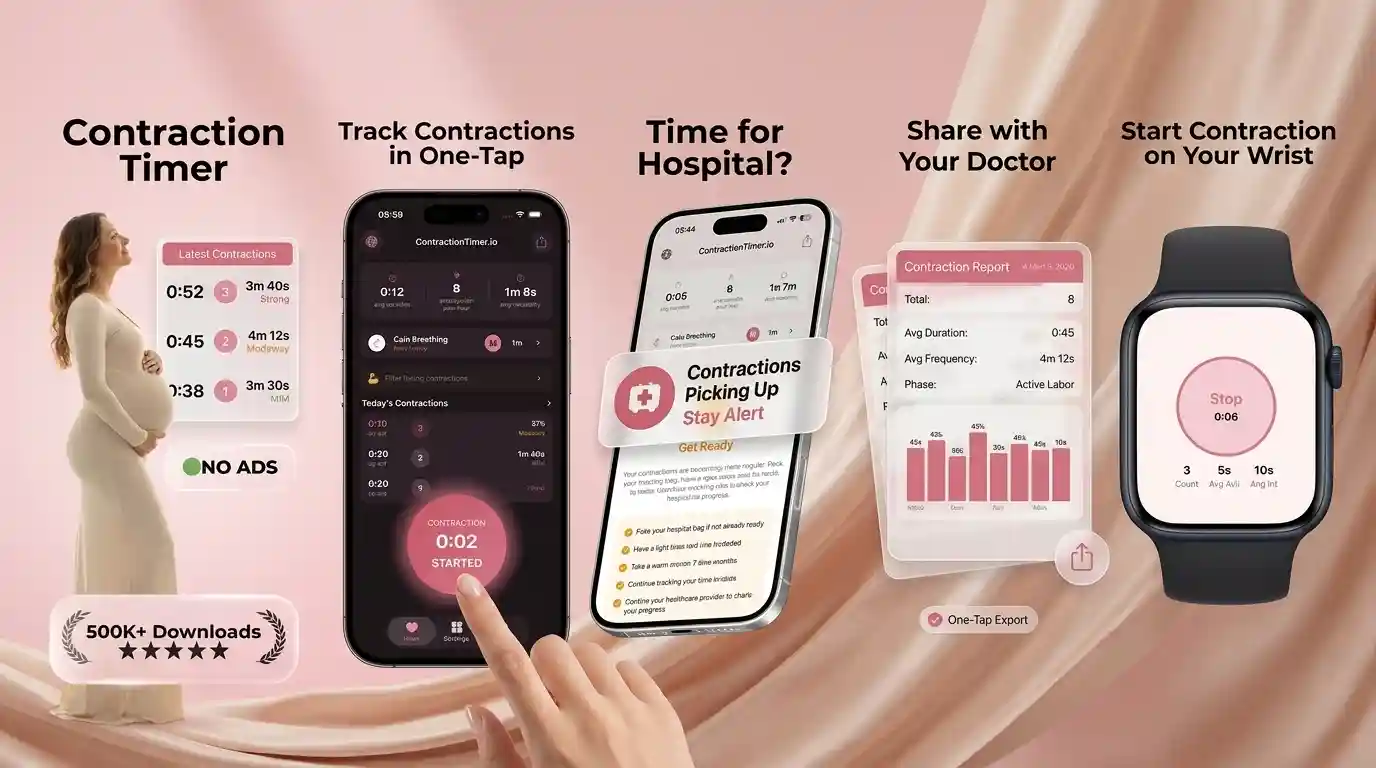
Preterm contractions before 37 weeks, defined as regular uterine tightenings occurring between 20 and 36+6 weeks, require urgent medical evaluation whenever they happen more than 4-6 times per hour, grow closer together, or arrive with back pain, pelvic pressure, bleeding, or fluid leakage. A contraction timer can help you document frequency and duration, but only a clinician can check whether your cervix is changing, so the safe default is always to call rather than wait.
> Definition: Preterm contractions before 37 weeks are regular or patterned uterine tightenings that occur between approximately 20 weeks and 36 weeks 6 days of pregnancy and may or may not indicate true preterm labor requiring cervical evaluation.
- Any contractions before 37 weeks that are regular, painful, or more than 4-6 per hour warrant an immediate call to your provider.
- A contraction timer app tracks frequency and duration objectively but cannot assess cervical change or rule out preterm labor.
- Early medical evaluation enables time-sensitive treatments, like corticosteroids for fetal lung maturity, that work best the sooner they are started.
Preterm Contractions Before 37 Weeks: Definition and Braxton Hicks Differences
Preterm contractions before 37 weeks are regular uterine tightenings between 20 weeks and 36 weeks 6 days that may cause cervical change. Braxton Hicks contractions are usually irregular, milder, and more likely to fade with hydration, rest, or a position change.
The key difference is not just how the tightening feels. It is whether the cervix is opening or thinning. That part cannot be checked from the couch, the car, or a grocery aisle when your belly hardens and you wonder if it “counts.”
Preterm birth is common enough to take seriously. In the United States, about 10.4% of babies were born before 37 weeks in 2022, per the CDC CDC birth data. Globally, the WHO estimated 13.4 million preterm births in 2020 Who guidance.
A useful timer records what happened. It does not decide what it means.
Medical Scope and Safety Disclaimer
This article is educational and cannot diagnose preterm labor, rule it out, or tell you whether it is safe to stay home. It can help you describe a contraction pattern, but the medical decision depends on clinical assessment.
Cervical change means the cervix is opening, thinning, or shortening, and that cannot be measured by symptoms, a timer, or how intense the tightening feels. Your own pregnancy history also matters: prior preterm birth, cervical procedures, twins or multiples, placenta concerns, infections, and provider instructions can all change the safest next step.
If you are having contractions before 37 weeks, use this page as a communication aid, not a permission slip to wait.
- Follow the individualized instructions from your obstetrician, midwife, maternal-fetal medicine specialist, or triage unit, even if they differ from general online guidance.
- Call your provider or labor and delivery triage promptly for regular contractions, a changing pattern, back pain, pelvic pressure, cramps, bleeding, spotting, fluid leakage, fever, or decreased fetal movement.
- Go to emergency care or use local emergency services if symptoms feel severe, you cannot reach your care team, or you are worried something is urgently wrong.
5 Facts About Contractions Before 37 Weeks

- Preterm labor requires cervical change. Regular contractions before 37 weeks become preterm labor when they cause the cervix to open or thin.
- The 4-6 per hour threshold matters. If you have four to six or more contractions in one hour before 37 weeks, call your provider or labor unit. Many hospital triage instructions use this threshold for calling before 37 weeks; for example, ACOG lists regular contractions, pelvic pressure, backache, cramps, and fluid leakage as preterm labor warning signs ACOG labor guidance.
- Warning signs change the urgency. Low back pain, pelvic pressure, bleeding, spotting, menstrual-like cramps, or fluid leakage should prompt immediate contact.
- A timer tracks the pattern, not the cervix. Duration and frequency help your nurse understand the situation, but they cannot confirm or rule out labor.
- Early treatment is time-sensitive. Corticosteroids may help fetal lung maturity, and tocolytics may slow contractions long enough to complete treatment.
ACOG notes that corticosteroids may be used before preterm birth to help the baby’s lungs and other organs mature, and short-term medicines may be used in some cases to delay birth long enough for treatment source.
For preterm contractions, a written timing record is often easier than memory because stress makes “every few minutes” hard to report accurately. Clinicians typically recommend calling promptly for regular contractions before 37 weeks, especially when symptoms are changing or new.
Preterm Labor Contraction Biology and Cervical Change
Preterm labor contraction biology involves coordinated uterine muscle activity, prostaglandins, oxytocin receptors, and sometimes an inflammatory cascade. In plain language, the uterus may start contracting in a more organized way before the pregnancy has reached term.
Some episodes settle down. Others progress because the cervix begins to soften, thin, or open. That is why a pattern alone is not enough. According to StatPearls, about 30% of people who present with preterm labor symptoms deliver within 7 days, which means many do not deliver quickly but still need evaluation published labor research.
Clinicians use tools you cannot reproduce at home: physical exam, cervical length measurement, fetal fibronectin testing, and fetal monitoring. The most common medically supported way to separate uterine irritability from possible preterm labor is clinical assessment combined with contraction history.
The overnight bag by the stairs can wait. The call should not.
Warning Signs Alongside Preterm Contractions
What warning signs with preterm contractions mean I should call right away? Call urgently if contractions before 37 weeks come with low back pain, pelvic pressure, cramping, bleeding, fluid leakage, or a pattern that becomes longer, stronger, and closer together.
Watch for low back pain that does not ease when you change position. Pelvic pressure can feel like the baby is pushing down, even between tightenings. Menstrual-like cramps may come in waves or sit low across the belly.
Bleeding, spotting, a gush of fluid, or a steady trickle can signal something that needs immediate assessment. If fluid is part of the picture, the separate guide on contractions after water breaks explains why timing rules are not enough.
A partner whispering the last duration helps, but symptoms matter as much as minutes.
When To Call Your Provider About Preterm Contractions
Call your provider if you have 4-6 or more contractions in one hour before 37 weeks. Also call if contractions continue after drinking water, resting, emptying your bladder, and changing position.
If you cannot reach your provider quickly, call your labor and delivery triage unit or local emergency number; do not keep timing at home when symptoms are escalating.
Any contraction pattern plus warning signs means immediate contact. That includes bleeding, fluid leakage, worsening back pain, pelvic pressure, cramps, fever, or decreased fetal movement. If symptoms feel severe, do not wait for a full hour of timing.
When you call, say your gestational age first. Then give the contraction frequency, average duration, when the pattern started, and any symptoms. A simple chart beside hospital notes is easier to read than a panicked scroll through messages.
Calling is always safer than waiting at home when contractions are regular before 37 weeks. If you are unsure what a timer can and cannot decide, the safety boundary is covered in can contraction timer tell if labor.
How To Track Preterm Contractions With a Timer App
Use a contraction timer to document what is happening, then share the pattern with your provider. Timer data supports clinical evaluation, but it never replaces it.
- Open the app and tap Start when the tightening begins, not when the pain peaks.
- Tap Stop when the tightening fully releases, so the duration is accurate.
- Continue logging each contraction for at least one hour unless symptoms require calling sooner.
- Review the frequency and duration summary before you call, including the average spacing.
- Share the log with your provider or triage nurse by phone, screenshot, Share, or Export.
Tools like ContractionTimer.io can help keep Start, Stop, History, Notes, Edit, and Share in one place when a partner takes over the phone. A good contraction timer app gives clear timing data, not a diagnosis or permission to stay home.
If Face ID fails in a dark room, hand the phone over unlocked. Small thing, big difference.
Common Myths About Contractions Before 37 Weeks
Myth: contractions that stop with water and rest were definitely not preterm labor. Better framing: hydration and rest can reduce uterine irritability, but improvement does not prove your cervix was unaffected.
Myth: preterm contractions only matter if water breaks or bleeding occurs. Regular contractions, back pain, pelvic pressure, and cramping can matter before bleeding or fluid appears.
Myth: a contraction timer app can confirm real labor versus Braxton Hicks. It cannot. Even the ContractionTimer.io contraction timer app can only record frequency, duration, and pattern, which is why clinical assessment still matters.
Myth: a previous full-term birth removes preterm labor risk. It may lower concern in some histories, but it does not eliminate risk in the current pregnancy.
A partner counting breaths beside the bed may see the pattern before you do. If they say the tightenings are coming steadily, take the note seriously.
Limitations
Home tracking has real limits with contractions before 37 weeks.
- No home tool can check cervical dilation or effacement.
- Many contraction episodes before 37 weeks resolve on their own, so pattern alone cannot predict who will deliver early.
- No proven method completely prevents preterm labor; prenatal care reduces risk but does not erase it.
- Mild backache and cramps overlap with normal pregnancy discomfort, which makes self-triage unreliable.
- Online information and generic timing rules cannot replace advice from a clinician who knows your pregnancy.
- App data is a communication aid, not a diagnostic tool.
- A low phone battery, missed Stop tap, or edited entry can affect the log.
If you use any pregnancy app for sensitive health notes, review pregnancy app privacy before sharing screenshots or exports. For formal safety boundaries, read the contraction timer medical disclaimer.
Frequently Asked Questions
Are contractions before 37 weeks normal?
Some irregular tightening can be Braxton Hicks, especially if it fades with rest or hydration. Regular, painful, or frequent contractions before 37 weeks require provider evaluation.
How many contractions per hour is preterm labor?
Four to six or more contractions in one hour before 37 weeks is a common threshold for calling your provider. Only a clinician can determine whether it is preterm labor.
What are warning signs of preterm labor?
Warning signs include regular contractions, low back pain, pelvic pressure, menstrual-like cramps, vaginal bleeding or spotting, and fluid leakage. Call urgently if any occur before 37 weeks.
Can a contraction timer detect preterm labor?
No. A contraction timer tracks frequency and duration, but it cannot assess cervical change or confirm preterm labor.
Do preterm contractions always mean early delivery?
No. About 30% of people presenting with preterm labor symptoms deliver within 7 days, so many episodes do not lead to immediate birth. They still require medical monitoring.
How long can preterm labor be delayed?
Tocolytics may delay birth for about 48 hours in some cases, often to allow corticosteroids to work. The outcome depends on gestational age, cervical change, and clinical findings.
Should I go to hospital or call first?
Call triage or your provider first if you can do so safely and give timer data clearly. Go directly for bleeding, fluid leakage, severe pain, or urgent symptoms.
Do all babies born before 37 weeks need NICU?
No. NICU need depends on gestational age, birth weight, breathing, feeding, and overall condition. Late preterm babies may need shorter or no NICU stays.
Can dehydration cause preterm contractions?
Dehydration can trigger uterine irritability or Braxton Hicks contractions. Hydration alone cannot rule out preterm labor if contractions are regular or painful.
What happens at the hospital for preterm labor?
Evaluation may include cervical check, fetal monitoring, contraction monitoring, cervical length measurement, and fetal fibronectin testing. Treatment may include corticosteroids, tocolytics, antibiotics, or observation.
Can preterm contractions happen without pain?
Yes. Preterm contractions may feel like painless tightening, menstrual-like cramps, pelvic pressure, or a persistent backache rather than obvious labor pain. Before 37 weeks, contact your maternity provider promptly if tightenings become regular, persistent, or occur with fluid leakage, bleeding, reduced fetal movement, or other concerning symptoms.
What To Tell Your Provider About Contractions Before 37 Weeks
When you call, give a short, specific summary rather than waiting until you can describe the pattern perfectly. Do not delay the call to collect more data if you have bleeding, leaking fluid, severe or constant pain, pelvic pressure, reduced fetal movement, or feel that something is wrong. Be ready to share:
- Gestational age: State the exact week and day, such as 31 weeks and 4 days.
- Timing: Report when contractions began, how many occurred in the last 30 or 60 minutes, and their typical duration.
- Pattern changes: Explain whether they are becoming closer together, longer, stronger, or continuing despite rest.
- Other symptoms: Mention backache, cramps, pelvic pressure, discharge changes, bleeding, suspected fluid leakage, fever, or urinary symptoms.
- Relevant history: Include prior preterm birth, cervical procedures, multiple pregnancy, or instructions your maternity team has already given you. A timer record can support this conversation, but only a clinician can assess whether cervical change or preterm labor is occurring.
Preterm contraction notes
Before 37 weeks, regular tightenings, period-like pain, unusual backache, bleeding, fluid leakage, or reduced fetal movement warrant an urgent call to your midwife, maternity unit, or obstetric provider.
ACOG advises that preterm labor needs medical attention right away, although it does not always result in preterm birth.
A contraction timer cannot diagnose labor; clinicians assess contraction patterns, symptoms, and cervical change.
| Measure | Sourced figure |
|---|---|
| Preterm labor | Before 37 weeks - ACOG |
| Reported contraction thresholds | 4-12 per hour - clinical summary |
| Suggested observation | At least 2 hours in some guidelines |
| U.S. preterm birth rate | 10.4% in 2024 - March of Dimes |