
Can a Contraction Timer Tell If Labor Is Starting?



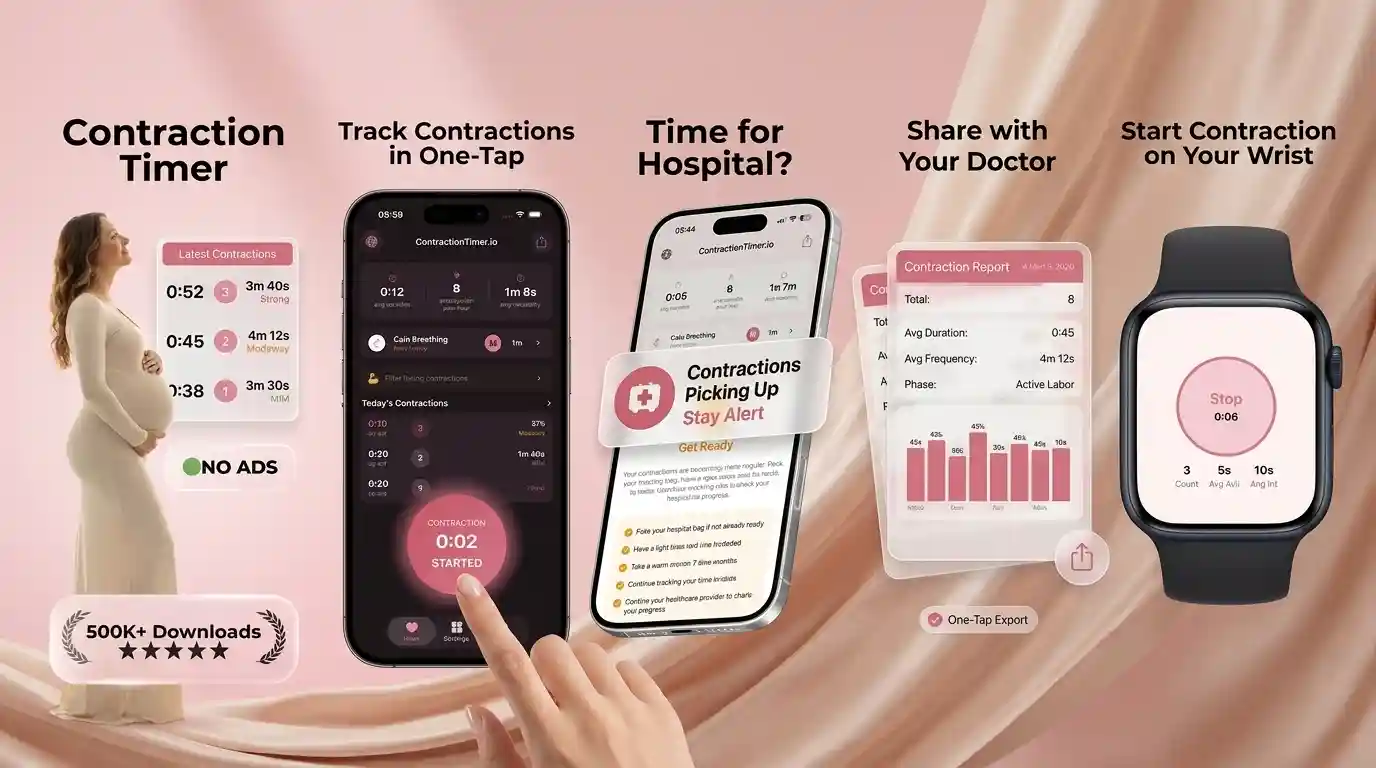
No, if you're asking “can contraction timer tell if labor,” a contraction timer cannot diagnose labor, assess cervical change, or replace a clinical evaluation by your midwife or doctor. It records contraction frequency and duration as useful context to share with your care team.
> Definition: A contraction timer is a tracking tool that logs contraction start and stop times to display duration, frequency, and pattern trends. It is not a medical device and cannot diagnose labor.
TL;DR
- Contraction timers measure timing patterns only, they cannot confirm or rule out real labor.
- True labor requires progressive cervical dilation, which no app can assess.
- Always contact your care provider when you have concerns, regardless of what the app displays.
What a Contraction Timer App Actually Measures
A contraction timer measures user-entered timing data: when you tap Start, when you tap Stop, and the gap between one contraction and the next. It can show duration, interval, and whether the pattern looks closer together over time.
That’s it.
A timer cannot measure cervical dilation, effacement, fetal heart rate, fetal position, your blood pressure, or your temperature. It also cannot know whether the tightening you felt was the first edge of a contraction or the strongest peak. That matters when someone is trying to tap Stop with a thumb while holding a water bottle at the edge of the bed.
The output is descriptive timing data, not a clinical assessment. Good contraction apps give a clear log, not a diagnosis. If your screen shows contractions every five minutes, that is a useful note to share, not proof that active labor has started.
How Contraction Timing Works Behind the Scenes
Contraction timing works by turning Start and Stop taps into timestamps, then calculating averages from those entries. The app stores each start time, end time, duration, interval, and trend direction in the contraction history.
The light technical term is “time-series data.” In plain English, it means the app is stacking timed events in order and looking for a pattern. Some apps compare that pattern with common rules such as 5-1-1, where contractions are about 5 minutes apart, last 1 minute, and continue for 1 hour.
Clinicians typically recommend using timing as one part of the picture, not the whole decision. ACOG guidance describes active labor as generally beginning around 6 cm cervical dilation, which a timer cannot assess ACOG labor guidance.
For most families, timing is most useful when it creates a clean record to read aloud during a call, especially when Face ID fails in a dark room and nobody wants to scroll in panic.
5 Facts About Whether a Contraction App Can Diagnose Labor

- Fact 1: A contraction app measures frequency and duration only; it cannot diagnose labor or confirm active labor.
- Fact 2: True labor is confirmed through progressive cervical change and clinical assessment, not timing patterns alone.
- Fact 3: The 5-1-1 rule is a generic guideline; it does not apply safely to every pregnancy, especially high-risk pregnancies or previous fast labors.
- Fact 4: App labels such as “early labor,” “active labor,” or “go to hospital” usually rely on generic algorithms, not validated personal medical criteria.
- Fact 5: Reduced fetal movement, bleeding, abnormal fluid, severe pain, or a strong feeling that something is wrong should override any app reading.
The safest use is simple: record the pattern, review the log, and call your provider when instructed or concerned. For birth partners, a contraction log is often easier than memory because pain changes time perception quickly. The quiet reminder between contraction peaks can be more useful than another screen alert.
Clinical Assessment Details a Contraction Timer Cannot Check
A healthcare provider can check cervical dilation, cervical effacement, fetal heart rate, fetal position, and maternal vital signs. A contraction timer cannot check any of those, even when the timing pattern looks convincing.
ACOG notes that many women who arrive at the hospital appearing to be in active labor are later found not to be in active labor. That is not user error. Labor is variable, and even trained teams use more than timing to assess it.
Early labor can also be long. StatPearls notes that latent labor can extend beyond 20 hours in some first-time mothers without automatically meaning something is wrong published labor research. A U.S. study of first-time mothers found a median active first-stage labor duration of about 6 hours, with wide variation published labor research.
The most common medically supported way to confirm active labor is cervical assessment combined with the full clinical picture.
Common Myths About Contraction Apps and Labor Diagnosis
Myth: if the app says active labor, you are definitely in real labor. That label is a timing estimate, not a cervical check.
Myth: irregular contractions mean you cannot be in active labor. Some labors do not read like a neat chart, and bodies do not always follow app-friendly intervals.
Myth: contraction apps can reliably distinguish Braxton Hicks from true labor. They can show that contractions are irregular, frequent, short, or changing, but they cannot know whether the cervix is changing. Braxton Hicks are common in late pregnancy and can feel strong after ordinary strain, like a tight belly after climbing stairs.
Myth: tracking for hours replaces an in-person assessment. It doesn’t. A long History screen may help your midwife understand the pattern, but it cannot check fetal well-being. If you are before term, read guidance on preterm contractions before 37 weeks and call your provider promptly.
Contraction Timer Scope: What It Can and Cannot Do
Contraction timers can reliably log duration and interval when the Start and Stop taps are accurate. They can also show visual pattern trends that are easier to share than a half-remembered list of times.
Specific Guarantees of a Contraction Timer
A good timer can save each contraction, show contraction history, let you edit an entry, and help you share the summary. Tools like ContractionTimer.io are useful when you need a plain timing record before calling the midwife.
Contraction timers provide timing records, not labor diagnosis.
What a Contraction App Cannot Cover
A contraction app cannot provide medical stage classification, fetal well-being assessment, or instructions that replace your birth plan. It also cannot override provider-agreed protocols.
Most apps state they are not medical devices. The same safety boundary is explained in the contraction timer medical disclaimer.
When to Call Your Provider Instead of Checking the App
When should you call your provider instead of checking the app? Call when you have reduced fetal movement, vaginal bleeding, abnormal fluid, severe or unrelenting pain, or a gut feeling that something is wrong.
Patient-facing maternity guidance also treats bleeding, suspected fluid leakage, and reduced fetal movement as reasons to contact maternity services promptly NHS signs of labour.
Trust that last one more than a neat interval.
High-risk pregnancy factors, preterm symptoms, previous fast labors, and provider-specific instructions all override generic app thresholds. If your water has broken or you suspect fluid leakage, timing contractions is secondary to your care team’s instructions; this is covered more directly in contractions after water breaks.
Use the app as supporting data during the call. Say, “The last six contractions were about four minutes apart and lasted around one minute,” then follow the clinician’s direction. If movement feels reduced while you are tracking, read about decreased fetal movement while tracking contractions and contact your provider.
Limitations
Contraction timers are useful, but their limits are real.
- User-input data can be wrong during pain, distraction, nausea, or uncertainty about when the contraction truly began.
- A missed Stop tap can turn a 60-second contraction into a 9-minute entry.
- Double-tapping Start can create a false extra contraction in the log.
- Apps cannot assess cervical dilation, effacement, fetal position, fetal heart rate, maternal blood pressure, or temperature.
- Stage labels and “go now” alerts are generic algorithms, not clinically validated across all pregnancies.
- Waiting for the “right” app pattern can delay care when symptoms are concerning.
- Apps are not medical devices and do not replace professional advice.
- Privacy settings still matter if you export or share a timing record; review pregnancy app privacy before sending sensitive data.
ContractionTimer.io contraction timer app can help keep the record readable, but the decision belongs with your care team.
Medical Review and Source Scope
This article is educational and is not individual medical advice. It explains what contraction timing can and cannot show, while leaving pregnancy-specific decisions to your own midwife, doctor, hospital, or birth center.
Clinical claims are bounded by a simple source hierarchy: major obstetric guidance first, such as ACOG; public health and patient guidance from NIH and NHS; then standard clinical references where they clarify labor definitions, variation, or safety signals. App-related claims are narrower. ContractionTimer.io and similar tools can record timing, duration, intervals, and trends, but they do not diagnose labor, triage symptoms, assess fetal well-being, or decide when it is safe to stay home.
For safest use:
- Treat the timer as a record, not a ruling.
- Compare your pattern with the instructions your provider gave you, not only a generic rule.
- Call promptly for warning symptoms or if your pregnancy has special risks.
- Follow your own care team’s directions, even when they differ from an app alert.
Last medically checked: May 2026.
Frequently Asked Questions
Can an app tell if labor is real?
No consumer app can confirm real labor. True labor requires clinical assessment, including cervical change.
Is the 5-1-1 rule always accurate?
No. The 5-1-1 rule is a population-based guideline, not a universal diagnostic rule.
Can contraction timers detect Braxton Hicks?
Contraction timers can show timing patterns. They cannot reliably distinguish Braxton Hicks from true labor.
Should I go to hospital based on my app?
Use app data as supporting information only. Follow your provider’s instructions about when to go in.
What does a contraction timer actually measure?
A contraction timer measures duration and interval from Start and Stop taps. It does not measure cervical change.
Can irregular contractions still mean labor?
Yes. Irregular contractions do not rule out labor, especially if symptoms are changing or concerning.
Do contraction apps replace a cervical check?
No. Cervical dilation is a clinical marker of active labor, and no app can assess it.
When should I call my midwife instead?
Call for reduced fetal movement, bleeding, abnormal fluid, severe pain, or a gut feeling something is wrong. Call sooner if you have high-risk factors.
Are contraction timer alerts medically validated?
Most contraction timer alerts use generic timing algorithms. They are not clinically validated across all populations.
Does contraction intensity matter more than timing?
Both can provide useful context, but neither intensity nor timing alone confirms labor. Perceived strength is subjective, so report whether contractions are becoming harder to talk or walk through, along with their duration, frequency, trend, and any other symptoms.
What to Tell Labor and Delivery About Your Contraction Pattern
When you call your maternity unit, midwife, or doctor, summarize the pattern rather than reading every timer entry. For example: “I recorded six contractions in 40 minutes. They lasted 45-60 seconds, started 6-8 minutes apart, and are getting closer together.” Frequency is usually reported from the start of one contraction to the start of the next.
- Pregnancy details: State how many weeks pregnant you are and whether you have received specific calling instructions.
- Timing trend: Report how long you have timed, the duration range, frequency range, and whether the pattern is becoming more regular.
- How they feel: Describe whether you can walk or talk through them and whether discomfort is increasing.
- Other symptoms: Mention leaking fluid, vaginal bleeding, reduced fetal movement, fever, severe constant pain, or pressure.
- Relevant history: Include previous rapid births, pregnancy complications, or a planned cesarean birth. A contraction log supports this conversation but cannot confirm labor.
If you’re asking “does contraction timer work,” it can record how long contractions last and how frequently they occur, helping you notice patterns that may be consistent with labor. A timer cannot confirm labor or replace medical evaluation.
So, do contraction apps actually help? They can make it easier to share timing details with your care team. Contact your provider for guidance, especially if contractions intensify, your water breaks, you have bleeding, or you notice decreased fetal movement.
Numbers from clinical sources
| Topic | What sources say | Source |
|---|---|---|
| ACOG due-date calculation uses Naegele’s rule (280 days from last menstrual period). | The American College of Obstetricians and Gynecologists defines the estimated due date by convention as 280 days after the first day of the last menstrual period (Naegele’s rule), assuming a 28‑day cycle with ovulation a | American College of Obstetricians and Gynecologists (ACOG), Committee Opinion Methods for Estimating the Due Date (2017) |
What timing can - and cannot - show
A contraction timer can reveal whether tightenings are becoming regular, longer, stronger, and closer together, but it cannot confirm labor or cervical change. ACOG guidance says true labor contractions typically continue despite rest or movement. Contact your maternity team based on its instructions and urgently for the warning patterns below.
| Pattern | Sourced guidance |
|---|---|
| Typical true-labor duration | 60-90 seconds (ACOG) |
| When to call | Every 5 minutes or more often (NHS) |
| Urgent contact | Any contraction over 2 minutes, or 6+ in 10 minutes (NHS) |
| Active labor | Begins at 6 cm dilation (ACOG) |