
Contractions After Water Breaks: What To Track and When To Call



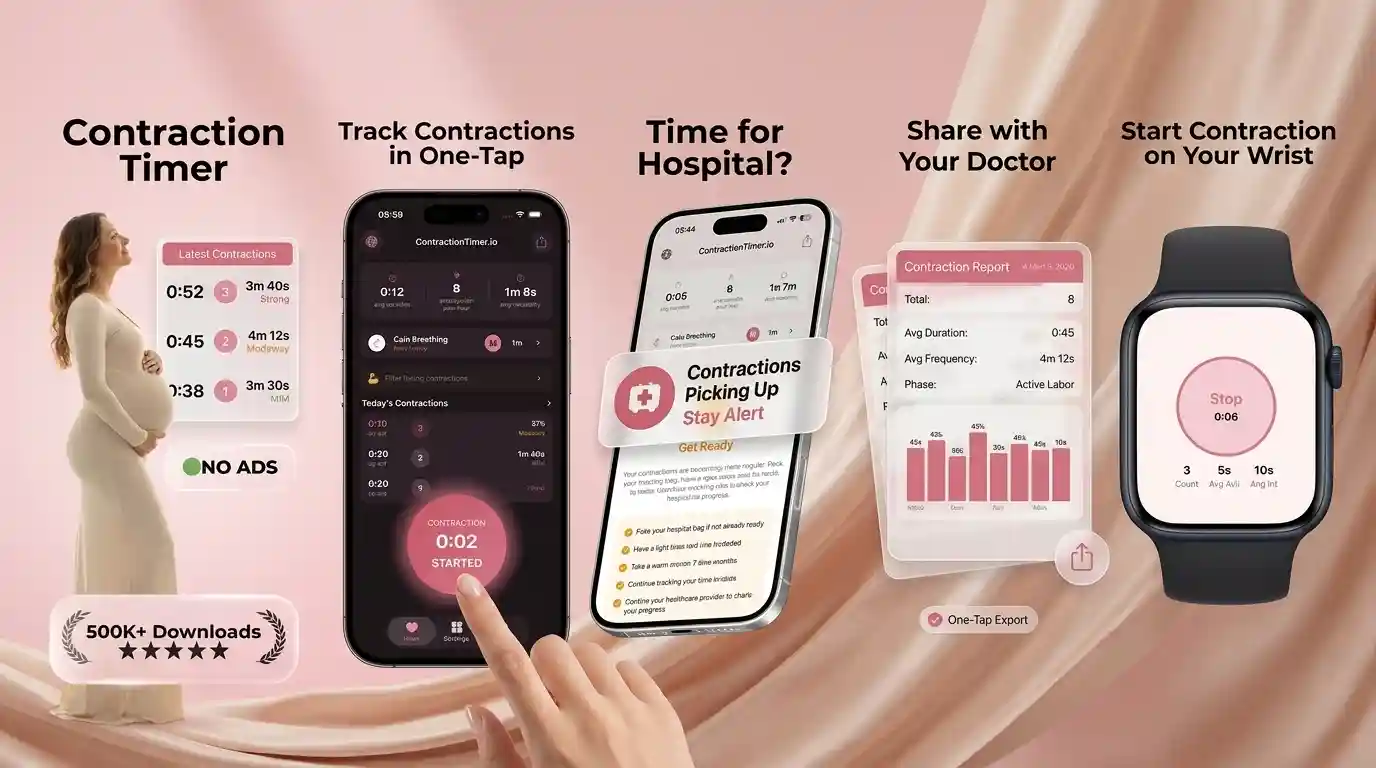
Contractions after water breaks usually begin within 24 hours at term, and tracking their timing, duration, and frequency helps your care team decide next steps. Start logging each contraction as soon as your water breaks, even if cramps haven't begun yet, and follow your provider's specific instructions on when to come in or call.
Definition: Contractions after water breaks are the rhythmic tightening and cramping waves that follow rupture of the amniotic sac, signaling that labor is starting or already underway.
TL;DR
- About 60% of people start regular contractions within 24 hours of water breaking at term.
- Track contraction start time, duration, and gap between them alongside fluid color and baby movements.
- A contraction timer app organizes the data, but your provider's call-now rules override any pattern.
- Infection risk rises over time after membranes rupture; most providers recommend induction within 18-24 hours if labor hasn't started.
- Green/brown fluid, fever, foul smell, or reduced baby movement means call immediately regardless of contraction pattern.
5 Facts About Contractions After Your Water Breaks
- Around 60% of pregnant people whose waters break before contractions start will go into labor within 24 hours at term, according to StatPearls published labor research.
- Term prelabor rupture of membranes, often called term PROM, happens in about 8% of pregnancies, according to StatPearls source.
- Contractions can feel sharper after the fluid cushion is gone because the baby’s head presses more directly on the cervix.
- Infection risk rises as time passes after rupture, so many providers discuss induction if regular contractions have not started within 18-24 hours.
- Always notify your care team when your water breaks, even if you feel only mild cramps or nothing yet.
The first useful log entry is simple: rupture time, fluid appearance, baby movement, and whether contractions have started. Not glamorous. Useful.
Clinicians typically recommend calling your maternity unit or provider after your waters break because timing, fluid color, and risk factors change the plan.
How Contraction Patterns Work After Water Breaks
After the amniotic sac ruptures, prostaglandins can help stimulate uterine contractions. In plain terms, the body often gets a stronger labor signal once the membranes are open.
Without the fluid cushion, pressure from the baby’s head may feel more direct. That can make each wave feel stronger, lower, or more intense in the back. Some people get strong contractions within minutes. Others wait hours while the cervix and uterus shift into a steadier rhythm.
Irregular contractions can still be real labor after water breaking. A log may show 8 minutes, then 4 minutes, then 11 minutes, especially early on. Back labor can be messier on paper too.
In the TermPROM trial, 95% of participants in both induction and expectant-management groups gave birth within 4 days of rupture Nejm guidance. That stat is reassuring, but it does not replace your own call-in timeline.
A timer gives times and spacing, not risk assessment.
What To Track in Your Contraction Timer After Water Breaks
Track contractions after water breaking by recording start time, duration, and the interval between contractions. Add notes for fluid color, odor, baby movement, and temperature checks so your care team gets the full picture.
Use the timer for the repeating pattern: tap Start at the first tightening, then tap Stop when the wave fully fades. If you forget to stop, edit the entry instead of leaving a seven-minute contraction in the log. It happens.
Add short notes beside key entries: clear fluid, pink tinge, green/brown fluid, foul smell, or a change in baby movement. If you are counting movements separately, mention that during the call too. Reduced movement deserves its own attention, and our guide to decreased fetal movement while tracking contractions explains that situation in more detail.
Tools like ContractionTimer.io can keep the rows organized so a partner can share the summary instead of scrolling in panic.
Gush vs. Trickle: How Leak Type Changes Contraction Tracking
A gush is usually obvious. A slow trickle can be harder to sort out because urine, discharge, and amniotic fluid may all feel wet in late pregnancy.
If you suspect a leak, note the time it started and contact your provider for confirmation. Do not use an app, underwear color, or smell alone to diagnose rupture. Clinical testing is what confirms whether membranes have broken.
With a confirmed trickle, your provider may want closer tracking of contractions, temperature, and fluid changes. Put the suspected rupture time in Notes, even if you are not fully sure. That timestamp matters later.
The pad check feels awkward. Still write it down.
A clear timeline is often easier than memory, especially when the charger is across the room and Face ID keeps failing in a dark room.
Reading Your Contraction Timer Data: The 5-1-1 Pattern After Water Breaks
Does 5-1-1 still matter after your water breaks? It can, but your provider may want you to call sooner because ruptured membranes add an infection timeline.
The 5-1-1 pattern means contractions are about every 5 minutes, lasting about 1 minute each, for at least 1 hour. In a timer’s History view, that looks like repeated entries with similar gaps, not two close contractions followed by a long quiet stretch.
A good contraction tracker delivers clean duration and frequency data, not a medical decision about when birth is safe at home.
Your unit may use 4-1-1, 3-1-1, immediate evaluation after rupture, or a custom plan based on Group B strep status, previous birth, distance from hospital, or induction plans. If you want the broader safety boundary, read can contraction timer tell if labor.
For a birth partner, one-handed use matters. A shoulder squeeze during a stronger surge and one thumb on Stop is real life, not a demo screen.
Infection Risk and the 18-Hour Clock After Water Breaks
Infection risk is one reason providers pay close attention to the clock after water breaks. In the TermPROM trial, clinical chorioamnionitis occurred in about 4% with induction versus 8.6% with expectant management source.
The CDC recognizes prolonged rupture of membranes, classically 18 hours or more before birth, as a risk factor used in early-onset Group B strep and neonatal infection assessment CDC birth data. That does not mean infection starts at 18 hours. It means the risk profile changes as time passes.
Most providers recommend induction if regular contractions have not started within about 18-24 hours at term. Your plan may be shorter or longer depending on your history, test results, and local policy.
Watch for fever, chills, foul-smelling fluid, feeling suddenly unwell, or a racing heartbeat. Contraction tracking helps your provider compare labor progress against this timeline.
The most common medically supported way to manage term PROM without active labor is provider-guided monitoring combined with a clear induction plan.
When To Call Your Care Team About Contractions After Water Breaks
Call your care team immediately if fluid is green, brown, bloody, or foul-smelling. Call if baby movements are reduced or absent, even if contractions look regular.
Also call if you develop a fever of 37.5°C / 99.5°F or higher, feel unwell, or notice chills; NHS guidance also lists high temperature, discolored or smelly waters, and reduced baby movement as reasons to contact maternity care after waters break NHS signs of labour. Call when contractions match your provider’s go-in threshold. If your water breaks before 37 weeks, treat it as urgent and get assessed regardless of contraction timing. Our page on preterm contractions before 37 weeks covers that scenario separately.
When in doubt, call. Your log helps the conversation because you can say, “Water broke at 2:10, clear fluid, baby moving, contractions every 6-7 minutes.”
ContractionTimer.io contraction timer app can help organize that summary, but the call is still the important step.
Medical Scope and Safety Disclaimer
This guide is educational only. It cannot diagnose ruptured membranes, infection, fetal distress, or tell you what is safest for your individual pregnancy.
The advice here mainly describes term pregnancy, meaning 37 weeks or later, unless preterm water breaking is specifically mentioned. Your own clinician’s instructions override contraction spacing, app summaries, 5-1-1 patterns, and anything on this page. Hospitals and midwife groups also use different call-in rules, so one unit may ask you to come in right away while another may allow monitored waiting at home.
If your water has broken, use this order of priority:
- Follow the call plan your provider already gave you, including any Group B strep, induction, or distance-from-hospital instructions.
- Contact maternity care immediately for green or brown fluid, heavy bleeding, fever, chills, foul-smelling fluid, feeling suddenly unwell, or reduced baby movement.
- Treat water breaking before 37 weeks as urgent, even if contractions are mild or absent.
- Share your timer log as supporting detail, not as the reason to delay a call.
Limitations: Contraction Tracking After Water Breaks
Contraction tracking after water breaks can describe timing patterns, but it cannot diagnose infection, fetal distress, placental problems, or whether birth is close. Only clinical assessment can evaluate cervical dilation, baby position, and fetal heart-rate monitoring.
- A contraction timer cannot tell whether fluid is amniotic fluid, urine, or discharge.
- Call-in thresholds vary by country, hospital, midwife group, and individual risk factors.
- Back labor, induction contractions, and irregular early labor may not fit neat interval rules.
- A normal-looking pattern does not guarantee a straightforward vaginal birth.
- Heavy bleeding needs urgent help, not more timing; read heavy bleeding with contractions for that red-flag pathway.
- Castor oil, nipple stimulation, and other “speed labor” methods have mixed evidence and real risks. Do not try them after rupture without provider approval.
- Apps can help you export the timing record, but they do not replace examination, monitoring, or medical judgment.
For safety boundaries and data-use details, the contraction timer medical disclaimer explains what an app can and cannot do.
Frequently Asked Questions
How long after water breaks do contractions start?
About 60% of people at term start regular contractions within 24 hours after waters break. Some begin within minutes, and others need provider-guided monitoring or induction.
Water broke but no contractions, should I worry?
Delayed contractions are common at term, but you should contact your provider when your water breaks. They will set the timeline for monitoring, induction, or coming in.
Are contractions worse after water breaks?
Many people feel stronger contractions after water breaks because there is less fluid cushioning pressure on the cervix. Stronger pain alone does not always mean something is wrong.
Should I go to hospital when water breaks?
It depends on your provider’s instructions. Some want immediate assessment, while others advise monitoring at home unless red flags appear.
How dilated are you when water breaks?
Dilation varies widely when water breaks. It can happen before dilation starts, during active labor, or near 10 centimeters.
Can I shower after my water breaks?
Showering is generally considered safe after waters break, but baths or submerging may raise infection concerns. Confirm your provider’s rule.
What does water breaking feel like?
Water breaking can feel like a sudden gush or a slow trickle that keeps wetting underwear. It often does not stop like urine leakage.
When is water breaking before 37 weeks dangerous?
Water breaking before 37 weeks can involve prematurity, infection risk, and cord or fluid concerns. It needs urgent medical assessment regardless of contractions.
Does a contraction timer replace calling my midwife?
No. Apps such as ContractionTimer.io organize contraction data to share with your provider, but they never replace professional clinical judgment.
What color should amniotic fluid be when your water breaks?
Amniotic fluid is often clear, pale yellow, or lightly pink-tinged, but appearance alone cannot confirm that your membranes have ruptured. Contact your care team promptly for green, brown, foul-smelling, or heavily bloody fluid, and report any reduced fetal movement or fever.
Amniotic Fluid Color and Odor After Your Water Breaks
Contraction timing is only part of the information your care team may need after your water breaks. Note when leaking began, whether the fluid appears clear, pale yellow, pink-tinged, green, brown, or bloody, and whether it has an unusual or foul odor. Record changes alongside your contractions - for example, “clear trickle at 2:10 p.m.; contractions every 7-9 minutes by 3:00 p.m.” A pad can help you observe fluid color, but do not insert anything into the vagina unless your clinician instructs you to.
Call your maternity unit or clinician promptly if the fluid is green or brown, smells foul, or is accompanied by bright-red bleeding, fever, reduced fetal movement, or significant constant pain. Green or brown fluid can indicate meconium and needs clinical assessment. If you see or feel the umbilical cord in the vagina, call emergency services immediately and do not try to push it back. Do not wait for contractions to become regular or reach a specific timer pattern before reporting these signs.
After your waters break
PROM means amniotic fluid begins leaking before labor starts.
NHS guidance says to call your maternity unit urgently when your waters break, without waiting for regular contractions.
Seek immediate assessment for green, brown, foul-smelling or heavily blood-stained fluid, fever, reduced fetal movement, or unusual contraction patterns.
| What to track | Sourced threshold |
|---|---|
| Long contraction | More than 2 minutes (NHS) |
| Very frequent contractions | 6 or more in 10 minutes (NHS) |
| Established-labor pattern | At least 60 seconds each, regular for about 1 hour (Imperial College Healthcare NHS) |
| Term PROM without labor | Induction may be offered after 24 hours (Harrogate NHS) |