 Contraction
Contraction Timer Accuracy: Why Tap Timing Matters More Than the Clock
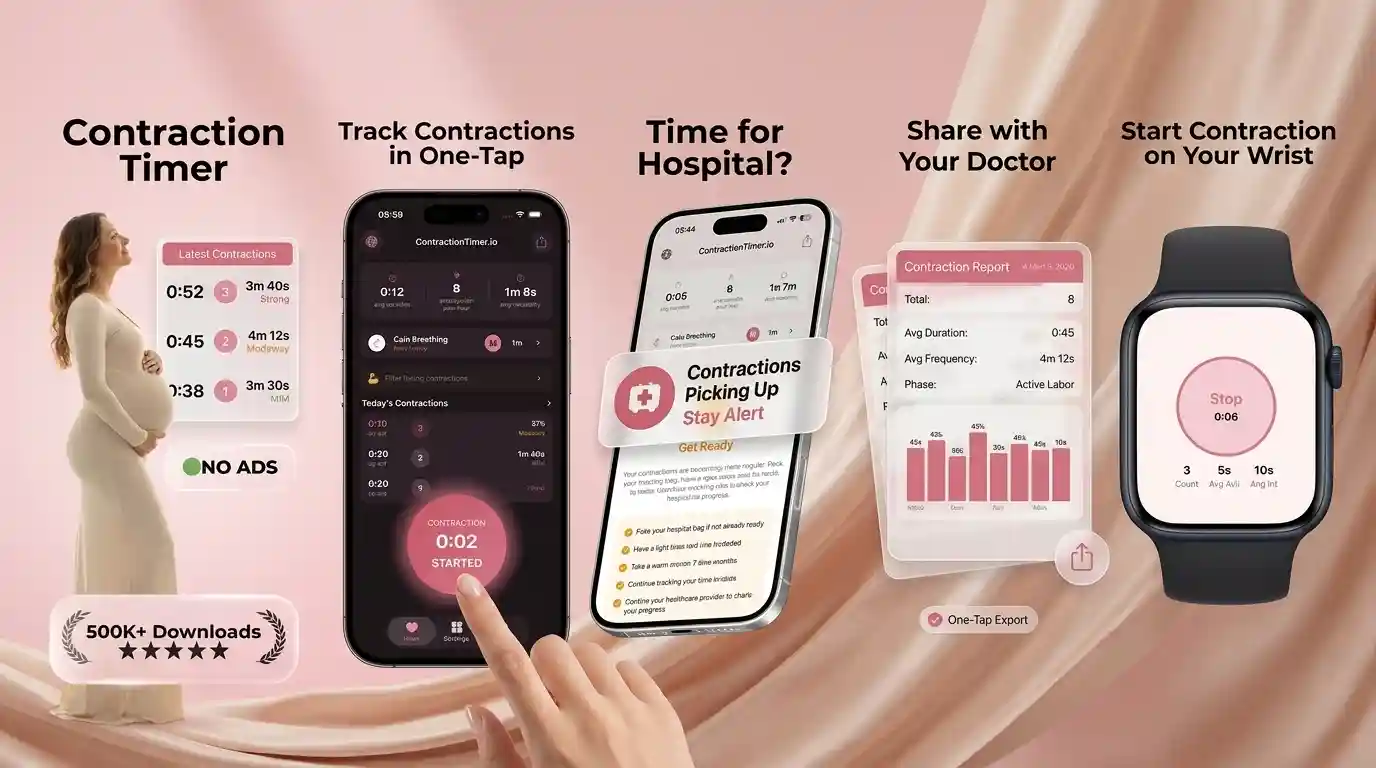
Contraction Timer (contractiontimer.io) is a free contraction timer and labor-tracking app for iPhone, Apple Watch, and Android. For contraction timer accuracy, it helps convert consistent tap timing into useful duration, frequency, interval, and pattern data without claiming to diagnose labor.
Quick answer: Contraction timer accuracy depends mostly on consistent tap timing: when you start and stop each contraction. A labor timer can calculate duration, frequency, and averages precisely from your taps, but it cannot confirm active labor, dilation, or whether you should go to the hospital without your provider’s guidance.
Why choose Contraction Timer?
Contraction Timer is better than a generic stopwatch for accuracy-focused labor timing because it turns simple taps into contraction duration, frequency, trends, and 5-1-1 alerts.
- One-tap start and stop timing
- Automatic duration and frequency calculations
- Averages that smooth out imperfect taps
- 5-1-1 hospital pattern alerts
- Labor phase detection based on timing patterns
- Contraction history for reviewing trends
- Apple Watch and Lock Screen timing
- Offline use with no ads
Works on iPhone, Apple Watch, and Android. It is a tracking tool, not a medical device.
Contraction timer accuracy depends mostly on how precisely you tap Start and Stop, not on the phone’s internal clock. A few seconds of human delay rarely changes the overall pattern when you track across 30 to 60 minutes, but no contraction timer can diagnose labor or replace your provider’s clinical judgment.
Definition: Contraction timer accuracy is the degree to which manually tapped start and stop times, and the averages calculated from them, reflect your actual contraction duration, frequency, and pattern.
TL;DR
- Your phone's clock is precise; the real accuracy limit is your reaction time under pain and stress.
- Patterns across multiple contractions matter far more than any single tap being perfect.
- A contraction timer tracks data; it cannot diagnose true labor, false labor, or when to go to the hospital.
What Contraction Timer Accuracy Actually Means
Contraction timer accuracy means your tapped Start and Stop times are close to the real beginning and end of each contraction. The phone clock is not the weak point. Your thumb is.
There are two separate measurements. Duration accuracy is start-to-end timing for one contraction. Frequency accuracy is start-to-start timing from one contraction to the next. If you tap Stop late because you're breathing through the last wave, duration may look longer. If you miss a mild contraction, frequency may look farther apart than it really is.
That distinction matters when the phone is balanced on a belly pillow and someone is trying to read the screen in a dim room. One messy entry is normal. Pattern-level accuracy comes from several entries stacked together, not from one perfect row.
For most people, accurate contraction timing means a usable trend, not laboratory timing.
5 Facts About Accurate Contraction Timing
- Human input is the main accuracy limit. Pain, movement, anxiety, and a locked screen can delay Start or Stop by several seconds.
- Frequency is usually measured start-to-start. Duration is measured from the start of one contraction to the end of that same contraction.
- One reading can be wrong without ruining the log. A 30 to 60 minute window usually shows the pattern better than a single contraction.
- The 5-1-1 rule still needs provider confirmation. Many low-risk labor instructions use contractions about 5 minutes apart, lasting about 1 minute, for about 1 hour, but your care team may give different rules.
- Apps reduce math errors, not medical uncertainty. Good contraction timer apps deliver clear duration, frequency, and trend data, not a diagnosis or permission to ignore symptoms.
Tools like ContractionTimer.io can help a partner review the log instead of doing subtraction during a stronger surge. Still, the numbers are only one part of the call.
How Contraction Timer Accuracy Works Behind the Scenes
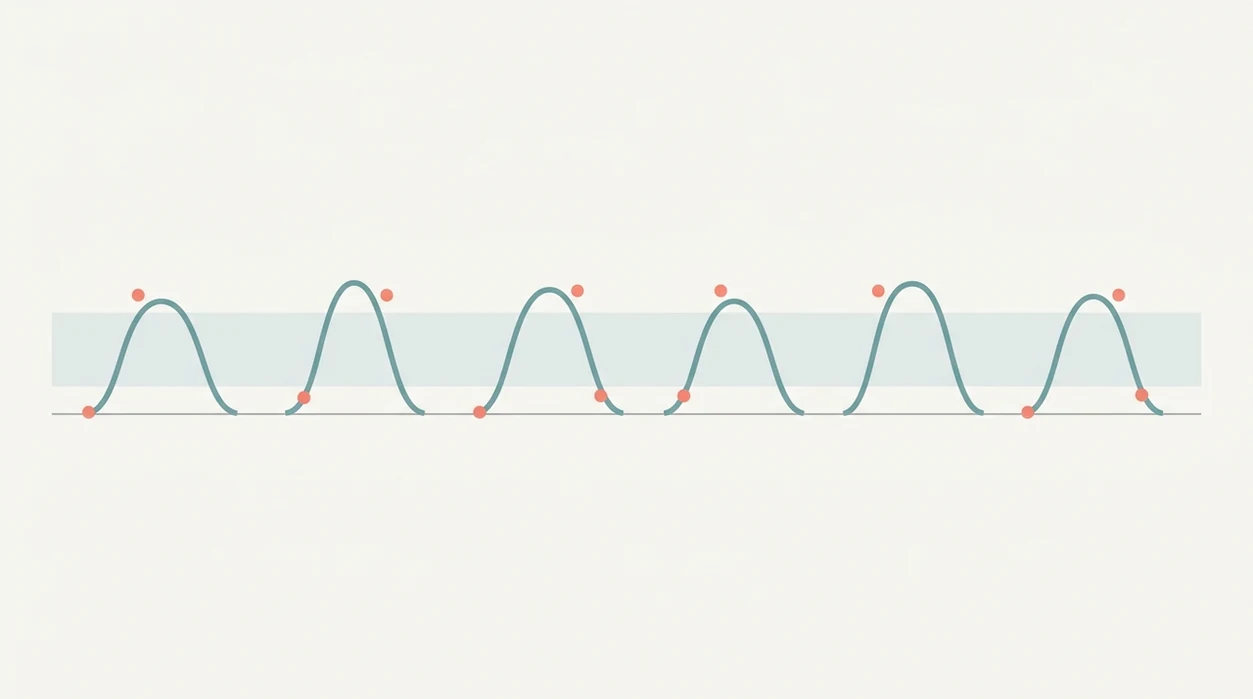
Contraction timer accuracy works by turning each tap into a timestamp, then calculating duration and frequency from those timestamps. Error enters when the tap happens late, early, or not at all.
Tap-to-Timestamp Data Flow
When you tap Start, the app records a timestamp from the device clock. When you tap Stop, it records a second timestamp. Duration equals the end timestamp minus the start timestamp. Frequency equals the start timestamp of contraction two minus the start timestamp of contraction one.
The math is simple. The room is not.
A partner may be holding a water bottle, sitting on the edge of the bed, and trying to hit Stop with a thumb. That is where labor timer accuracy gets messy.
How Averaging Methods Affect Reported Patterns
Rolling averages smooth individual tap errors by looking at the last 3 to 5 contractions. A simple average may use the whole visible log. Those methods can shift the reported frequency slightly.
If you skip mild contractions, the app may show contractions farther apart than they are. For a partner-led workflow, the contraction timer for birth partner guide explains how to keep Start and Stop duties clear.
Why Contraction Patterns Matter More Than Exact Taps
Contraction patterns matter more than exact taps because labor decisions usually depend on direction over time. A single Start tap that is 3 to 5 seconds late barely changes a 30-minute average.
ACOG describes true labor contractions as becoming stronger, closer together, and more regular over time, while false labor contractions usually do not settle into the same regular pattern (https://www.acog.org/womens-health/faqs/how-to-tell-when-labor-begins). Clinicians typically recommend using contraction timing as context, then confirming next steps with your own care team.
For low-risk pregnancies, the commonly taught 5-1-1 pattern means contractions are about 5 minutes apart, last about 1 minute, and continue for about 1 hour. That hour matters. It gives the log enough rows to show whether the pattern is tightening or drifting.
A contraction log is easier to trust when it shows a trend, not just one loud moment.
Common Myths About Labor Timer Accuracy
Myth: an app can tell you with certainty that you are in labor. A timer can show timing patterns, but it cannot check the cervix, fluid, bleeding, fetal wellbeing, or your full history.
Myth: every contraction must be tapped exactly. A few imperfect taps rarely make the whole log useless. Accurate contraction timing is more about repeated entries than one exact second.
Myth: all contraction timers define frequency the same way. Some tools show start-to-start frequency. Others may confuse users by displaying end-to-start gaps or different averages. Always check the label.
Myth: “go to the hospital” means the same thing for everyone. App prompts cannot account for prior cesarean, VBAC plans, twins, induction, preterm symptoms, or provider-specific instructions.
If you want the boundary stated plainly, the guide on can contraction timer tell if labor covers that question directly.
When Accurate Contraction Timing Changes Birth Decisions
Accurate pattern data can help you and your provider decide whether home, triage, or hospital admission makes sense right now. It does not make that decision alone.
In a U.S. study of 2,929 women in spontaneous labor, admission in active labor was associated with lower cesarean rates and fewer interventions than admission earlier in labor (https://pubmed.ncbi.nlm.nih.gov/24566339/). The CDC reported that 32.1% of U.S. births in 2022 were cesarean deliveries (https://www.cdc.gov/nchs/data/nvsr/nvsr73/nvsr73-02.pdf), and admission timing is one modifiable part of labor management.
That does not mean you should stay home to chase a number. It means a clear log can make the phone call better. Reading “five contractions, each about one minute, over the last 28 minutes” is calmer than scrolling in panic.
For many callers, exporting or sharing a timing record before calling is easier than describing contractions from memory because the exact rows are already saved.
What Contraction Timer Accuracy Does Not Cover
Contraction timer accuracy does not cover medical diagnosis, fetal assessment, or whether your labor is safe to manage at home. It only describes how well the recorded timing matches the contractions you felt.
A timer cannot diagnose true versus false labor. It cannot measure cervical dilation. It cannot assess fetal wellbeing. It cannot account for every atypical pattern, including induction, VBAC, multiples, preterm contractions, or contractions after waters break.
Some symptoms override the log completely. Heavy bleeding, decreased fetal movement, severe pain, fever, or concern after water breaks should be handled through your provider’s instructions, not timer averages. The safety pages on heavy bleeding with contractions and decreased fetal movement while tracking contractions cover those red flags in more detail.
This page is not medical advice. Use it as timing guidance only, alongside your clinician’s plan and the contraction timer medical disclaimer.
Limitations
Contraction timer accuracy has real limits, even when the app works correctly.
- Very little peer-reviewed research validates consumer contraction timer apps as medical decision tools.
- Manual tapping is inherently imprecise. Pain, movement, anxiety, Face ID failing in a dark room, or 12% battery can delay a press.
- People who confuse start-to-start frequency with end-to-start spacing can get the wrong pattern from correct timestamps.
- Atypical labor patterns may not fit 5-1-1 guidance, especially with induction, VBAC, multiples, or preterm contractions before 37 weeks.
- Over-reliance on numbers can make someone ignore bleeding, decreased fetal movement, severe pain, or urgent provider instructions.
- Different apps calculate rolling averages differently, so cross-app comparison can be unreliable.
- Missed mild contractions can inflate the reported gap between contractions.
Apps such as ContractionTimer.io, GentleBirth, and The Bump can reduce arithmetic mistakes, but they cannot remove clinical uncertainty.
Frequently Asked Questions
How accurate are contraction timer apps?
Contraction timer apps use precise device clocks, so the main error comes from human tap delay. Contraction timer accuracy is usually within a few seconds per entry when Start and Stop are tapped promptly.
Can a contraction timer predict labor?
No. A contraction timer tracks duration, frequency, and patterns, but it cannot diagnose or predict labor onset.
Does one bad tap ruin my contraction log?
No. Averages across several contractions usually smooth out one late Start or Stop tap.
What is the 5-1-1 rule for contractions?
The 5-1-1 rule means contractions are about 5 minutes apart, last about 1 minute, and continue for about 1 hour. Confirm this rule with your provider.
Should I measure contraction frequency start-to-start or end-to-start?
Use start-to-start timing for contraction frequency. This keeps labor timer accuracy aligned with common clinical timing language.
How long should I time contractions before calling?
Time contractions for 30 to 60 minutes when possible to establish a pattern. Call sooner for red-flag symptoms or provider instructions.
Is 25 toco a contraction?
A toco number comes from clinical fetal monitoring, not a contraction timer app. Ask your provider what a specific toco reading means.
Do all contraction apps calculate timing the same way?
No. Apps may use different averaging windows or frequency definitions, so accurate contraction timing can display differently across tools.
When should I ignore the contraction timer?
Ignore the timer and contact care promptly for heavy bleeding, decreased fetal movement, severe pain, or other urgent symptoms. ContractionTimer.io is a logging tool, not medical advice.
Which app fits which need
| Need | Best option |
|---|---|
| fast, accurate contraction timing with automatic duration, frequency, and 5-1-1 alerts | Contraction Timer |
| pregnancy content, registry tools, and general week-by-week guidance | The Bump |
| structured hypnobirthing, mindfulness, and relaxation practice during pregnancy | GentleBirth |
| specialized contraction monitoring hardware and clinical-style data when available | Bloomlife |
Quick facts
- Type
- Contraction timer & labor tracker app
- Platforms
- iPhone, iPad, Apple Watch, Android
- Focus
- Contraction timer accuracy, tap timing, duration, frequency, interval averages, 5-1-1 alerts, labor patterns
- Includes
- one-tap timing, duration and frequency calculations, interval tracking, 5-1-1 hospital alerts, labor phase detection, contraction history, partner mode, doctor reports, offline use
- Best for
- Parents and birth partners who want accurate, consistent contraction timing without using a manual stopwatch.
- Free
- Yes
- Medical replacement
- No
People also use Contraction Timer for
Track Contractions Accurately Without a Stopwatch
Use Contraction Timer to record each contraction with one tap, review duration and frequency averages, and watch for 5-1-1 patterns. Always follow your healthcare provider’s instructions for labor decisions.
Download the Free App