 Contraction
See If Contractions Are Getting Closer With A Timing Log

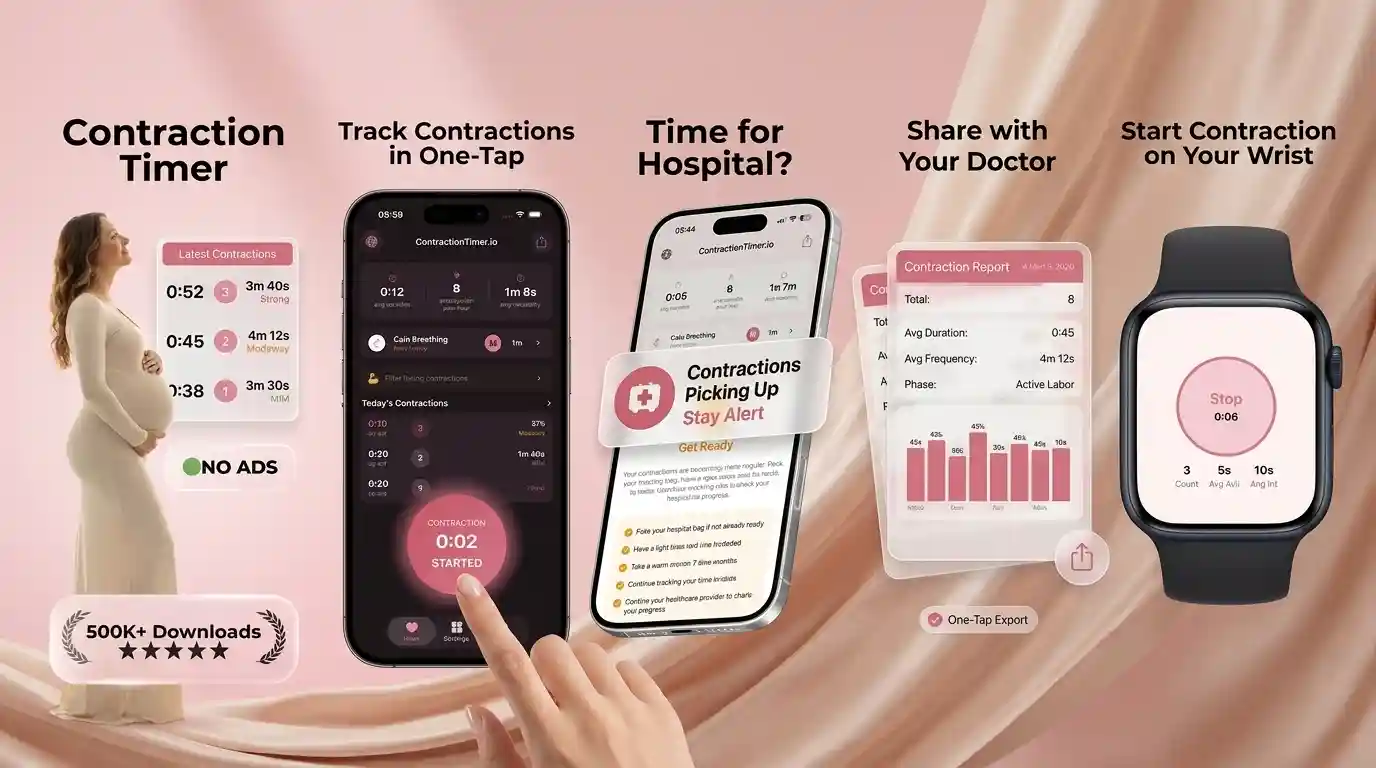
Contraction Timer (contractiontimer.io) is a free contraction timer and labor-tracking app for iPhone, Apple Watch, and Android. For this page, it helps parents see whether contractions are getting closer by logging each contraction and calculating duration, frequency, intervals, and 5-1-1 trends.
Quick answer: To see if contractions are getting closer, compare each contraction’s start time to the next start time and watch whether the frequency shortens over a consistent timing log. A contraction timing log is more reliable than memory because it shows duration, start-to-start frequency, averages, and recent trends over time.
Why choose Contraction Timer?
Contraction Timer is built to show whether contractions are getting closer without doing stopwatch math during labor.
- Start-to-start contraction frequency tracking
- Automatic duration and interval calculations
- Rolling pattern view from recent contractions
- 5-1-1 hospital alerts when timing matches
- Labor phase detection based on logged patterns
- One-tap timing on phone or Apple Watch
- Contraction history for provider review
- Offline tracking with no ads
Works on iPhone, Apple Watch, and Android. It is a tracking tool, not a medical device.
To see if contractions are getting closer, measure the minutes from the start of one contraction to the start of the next, then compare those intervals over at least 30–60 minutes to spot a shortening trend. A contraction timer app logs each event automatically so you can review averages and recent spacing at a glance. If the gaps are consistently shrinking and contractions are lasting longer and feeling stronger, it's time to contact your provider.
Definition: Contractions getting closer means the start-to-start interval between consecutive uterine contractions is decreasing over a sustained observation window, signaling possible labor progression.
TL;DR
- Measure start-to-start, not end-to-start, to get true frequency.
- Track at least 30–60 minutes before judging any trend.
- Contractions that are regular, closer together, longer, and stronger point toward active labor.
- Follow your own provider's call-in rule, such as 5-1-1 or 4-1-1.
- A contraction trend checker app visualizes patterns but never replaces a clinical exam.
Contraction Timing Signals At A Glance
Contractions getting closer means the spacing from one contraction start to the next contraction start is shrinking over time. The useful signal is the pattern, not one dramatic interval.
- Start-to-start frequency is the standard timing number. If one contraction starts at 8:04 and the next starts at 8:10, frequency is 6 minutes.
- A regular rhythm matters. Labor patterns usually become easier to predict, even if the times are not exact.
- Shorter gaps plus longer duration carry more meaning. Five-minute spacing feels different when each contraction lasts 60 seconds instead of 25.
- Intensity should be included. A note like “can’t talk through peak” tells more than timing alone.
- The 5-1-1 rule is common, not universal. Many providers use 5 minutes apart, 1 minute long, for 1 hour, but some use 4-1-1 or another threshold.
Evening tightenings that vanish by bedtime can look busy in the moment. The log makes that stall easier to see.
How Contractions Getting Closer Works
Contractions get closer when the uterus is working in a more coordinated pattern over time. The timing matters because true labor often brings a combined shift: shorter spacing, longer contractions, stronger peaks, and less ability to chat through them.
Frequency means the minutes from the start of one contraction to the start of the next, not the quiet gap after one ends. That start-to-start number is the cleanest way to compare one wave with the next. As labor progresses, the uterus may move from scattered tightening to a steadier rhythm, while each contraction may last longer and demand more focus. A note like “had to stop talking” can be as useful as the number on the screen. Still, prodromal or false labor can create very convincing clusters, especially at night, after activity, or with dehydration. A log can show that something is changing, but it cannot prove cervical dilation, effacement, or fetal station. Cervical change still takes a clinician or provider assessment.
30-Minute Contraction Timing Log Method
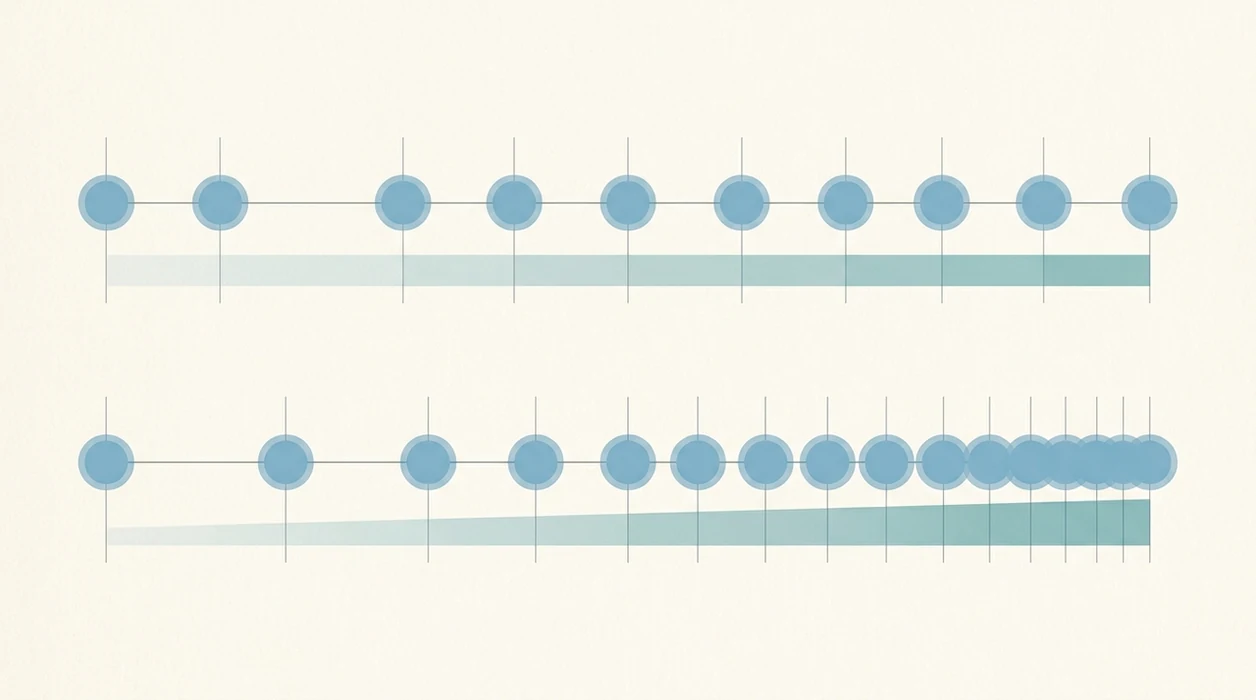
The 30-minute method works by logging every contraction’s start time, end time, and intensity, then checking whether the intervals are closing across the whole window. A 60-minute window is better when the pattern is jumpy.
Clinicians typically recommend watching contraction frequency, duration, and maternal condition together during labor. The World Health Organization recommends monitoring contraction frequency and duration during labor as part of routine intrapartum care (WHO intrapartum care recommendations: https://www.who.int/publications/i/item/9789241550215).
For a home timing log, record three things each time: Start, Stop, and a short intensity note. “Mild,” “strong,” or “could not talk” is enough. Reacting to two or three contractions is unreliable because early labor can bunch up, pause, and restart.
Averages smooth the mess. If the first half-hour averages 9 minutes apart and the next half-hour averages 6 minutes apart, that says more than one sudden 3-minute gap. For more stage-by-stage examples, compare your notes with common early labor contraction patterns.
Contraction Frequency Math And Rolling Averages
Contraction frequency is calculated from the start of one contraction to the start of the next contraction. Rolling averages help show whether the overall spacing is shortening, even when individual intervals jump around.
How contraction trend checking works: the timer stores each Start and Stop time, calculates duration, then compares the early-window average with the recent-window average. In plain language, it asks, “Are the newest gaps shorter than the older gaps?”
Both numbers matter. The most-recent interval catches a fast change. The rolling average protects you from overreacting to one close pair. A contraction at 7 minutes, then 3 minutes, then 11 minutes is not the same as three contractions holding near 5 minutes.
Stop-and-start labor can create clusters that look convincing, then fade. A Cochrane review of partograph-style labor charting found that recording labor progress, including contraction frequency, is widely used, but partograph use alone did not clearly reduce cesarean birth or perinatal mortality (Cochrane Library: https://www.cochranelibrary.com/cdsr/doi/10.1002/14651858.CD005461.pub5/full).
A log is evidence for a conversation, not a verdict.
6 Steps To Use A Contraction Trend Checker
Use a contraction trend checker by timing every contraction the same way, then reviewing the recent average against your provider’s instructions. Good contraction timer apps deliver clean duration, frequency, and trend records, not a diagnosis of labor.
- Open the timer and tap Start when the contraction first begins, not when pain peaks.
- Tap Stop when the contraction fully ends, even if the next one feels close.
- Repeat for at least 30–60 minutes so the app has enough data to compare.
- Review the trend view for average frequency, average duration, and direction.
- Compare your pattern to your provider’s specific call-in rule, such as 5-1-1 or 4-1-1.
- Share or screenshot the log before calling your provider or heading in.
Tools like ContractionTimer.io can help with one-handed use when your thumb is hovering over the start button during another low cramp. Still, set the phone down between contractions when you can. Battery matters at 12%.
3 Real Contraction Patterns People Actually See
Real contraction logs are rarely neat. CDC final birth data reported that 98.6% of U.S. births in 2020 occurred in hospitals, where contraction frequency and duration are commonly assessed during labor evaluation (CDC/NCHS Births: Final Data for 2020: https://www.cdc.gov/nchs/data/nvsr/nvsr70/nvsr70-17.pdf).
Steady Closer Pattern
A steady closer pattern might move from 10 minutes apart to 7 minutes, then 5 minutes over about 2 hours. Duration may rise from 40 seconds toward 60 seconds. The contraction log read aloud slowly to a midwife is much easier than scrolling through memory.
Cluster And Stall Pattern
A cluster-and-stall pattern can show contractions 3 minutes apart for 45 minutes, then one 15-minute gap. That does not automatically mean nothing is happening. It does mean the “getting closer” trend is not sustained yet.
Irregular But Progressing Pattern
An irregular but progressing pattern may jump from 8 to 6 to 9 to 5 minutes while the rolling average still moves down. Perfect spacing is uncommon. For a wider view, compare the same log against typical labor contraction patterns.
5 Contraction Timing Patterns That Signal Action
The common action pattern is contractions that are closer together, about a minute long, and sustained long enough to match your provider’s call-in rule. The rule is a prompt to call, not proof that delivery is near.
- 5-1-1 pattern: contractions about 5 minutes apart, lasting 1 minute, for 1 hour.
- 4-1-1 pattern: often used when a provider wants an earlier call or tighter spacing.
- 3-1-1 pattern: sometimes discussed for specific situations, including prior fast labor.
- High-risk, VBAC, or multiples pattern: your care team may give a different threshold.
- Warning-sign pattern: call for water breaking, bleeding, decreased movement, or severe symptoms, even without a tidy rule.
Continuous labor support can help with timing and decision-making; a Cochrane review found continuous support was associated with lower cesarean rates and slightly shorter labors on average (Cochrane Library: https://www.cochranelibrary.com/cdsr/doi/10.1002/14651858.CD003766.pub6/full). For later-stage spacing, review active labor contraction patterns.
When To Call Your Provider Right Away
Call your provider right away for warning signs, even if your contractions are not close together. Emergency symptoms override every timing pattern, including 5-1-1, 4-1-1, or a clean app trend.
- Call immediately if you have vaginal bleeding, decreased fetal movement, fever, severe or unusual pain, or symptoms that feel suddenly wrong for you.
- Report water breaking as soon as it happens, especially if the fluid is green, brown, bloody, foul-smelling, or you are not sure whether it is urine or amniotic fluid.
- Contact your team sooner if you have preterm symptoms, are planning a VBAC, are carrying multiples, have a high-risk pregnancy, or were given special instructions.
- Use timing rules only as directed by your own provider. A 5-1-1 or 4-1-1 threshold is helpful only when it matches your care plan.
- Share the log briefly when you call: spacing, duration, when symptoms started, fetal movement, fluid color, and what changed.
If you are debating whether a symptom is serious, make the call. A few quiet minutes on the phone are better than waiting for the pattern to become perfect.
Contraction Trend Checker Blind Spots
A contraction trend checker can show whether contractions are getting closer, but it cannot show cervical dilation, effacement, fetal position, or how soon birth will happen. Those require clinical assessment.
It also cannot reliably separate dehydration contractions, prodromal labor, anxiety-related tightening, and active labor by timing alone. A hydration glass next to the phone may sit beside a very convincing log, then the whole pattern disappears after rest.
Certain births do not follow standard spacing rules. Induction, multiples, VBAC, and high-risk pregnancies may need earlier contact with your care team. Per the CDC, about 98.4% of U.S. births in 2020 were attended by a physician or certified nurse-midwife, which reflects how often interpretation happens with professional support.
Over-timing has a cost, too. If you have been awake all night, timing every mild wave can steal rest without adding useful safety information.
Limitations
Contraction timing is useful, but it is limited. According to a Cochrane review, charting labor progress, including contraction frequency, does not by itself reduce cesarean birth or perinatal mortality.
- Timing cannot confirm cervical dilation, effacement, fetal station, or labor stage; only a clinical exam or provider assessment can.
- Prodromal labor, dehydration, bladder pressure, or anxiety can cause frequent contractions that do not progress.
- App data can create false reassurance if warning signs are ignored, including bleeding, decreased fetal movement, fever, or water breaking.
- Induction, VBAC, multiples, preterm symptoms, and high-risk pregnancies may not match common 5-1-1 guidance.
- Forgetting to tap Stop, double-tapping Start, or timing from the pain peak can distort the trend.
- Over-focusing on every contraction can increase stress and fatigue, especially in early labor.
- A trend view cannot predict time to delivery.
For a broader time-based view, place your log inside a full contraction timeline. The pattern makes more sense with context.
Frequently Asked Questions
How do I time contractions correctly?
Tap Start when a contraction first begins and tap Stop when it fully ends. Measure frequency from the start of one contraction to the start of the next.
Can contractions get closer then stop?
Yes. Prodromal or stop-and-start labor can create close contractions for a while, then space out or stop.
What is the 5-1-1 rule?
The 5-1-1 rule means contractions are about 5 minutes apart, lasting 1 minute, for 1 hour. Some providers use different rules, such as 4-1-1.
How long should I track before deciding?
Track for at least 30–60 minutes before interpreting a trend. A few contractions are not enough to confirm a sustained pattern.
Do Braxton Hicks get closer together?
Braxton Hicks contractions usually do not follow a steady pattern of getting closer, longer, and stronger. They often ease with rest, hydration, or position changes.
Is there an app that checks contraction trends?
Yes. Apps such as ContractionTimer.io log contraction intervals and show trend data automatically.
Should I go to the hospital at 5 minutes apart?
Follow your own provider’s call-in rule rather than a generic threshold. Call sooner for warning signs or if your care team told you to.
Can dehydration cause closer contractions?
Yes. Dehydration can trigger frequent contractions that mimic a closing pattern without true labor progression.
Which app fits which need
| Need | Best option |
|---|---|
| Fast, accurate labor timing with automatic frequency, duration, 5-1-1 alerts, history, and partner-friendly logging | Contraction Timer |
| A simple due-date countdown and broad pregnancy content before labor begins | The Bump |
| Wearable uterine activity monitoring where available and clinically appropriate | Bloomlife |
| Mindfulness, breathing, and hypnobirthing-style preparation alongside labor education | GentleBirth |
Quick facts
- Type
- Contraction timer & labor tracker app
- Platforms
- iPhone, iPad, Apple Watch, Android
- Focus
- Contractions getting closer, start-to-start frequency, rolling averages, 5-1-1 alerts, labor trends
- Includes
- one-tap timing, duration, frequency, interval, contraction history, labor phase detection, 5-1-1 alerts, partner mode, doctor reports, offline mode
- Best for
- Parents who want to check whether contractions are getting closer with a clear timing log
- Free
- Yes
- Medical replacement
- No
People also use Contraction Timer for
See If Contractions Are Getting Closer With A Free Timing Log
Track each contraction, compare recent frequency, and watch for patterns like 5-1-1 without doing the math yourself. Always follow your provider’s instructions if symptoms feel urgent or concerning.
Download the Free App