
Decreased Fetal Movement While Tracking Contractions: When to Stop Timing and Call Now




Decreased fetal movement while tracking contractions is a call-now concern, not something to monitor at home with extra kick counts, cold drinks, or waiting for a clearer contraction pattern. Your baby should maintain their usual movement pattern even during active contractions, and any noticeable drop, change, or sudden frantic burst of movement means you should stop timing contractions and contact your maternity unit immediately for in-person fetal monitoring.
> Definition: Decreased fetal movement while tracking contractions means a pregnant person notices fewer, weaker, or absent kicks, rolls, or squirms from the baby during a period when they are also timing uterine contractions with an app or watch.
TL;DR
- Babies should keep their normal movement pattern right through labor, less movement is never “just because contractions started.”
- No contraction timer app, home Doppler, or cold-drink trick can rule out fetal distress; only in-person CTG/NST monitoring can.
- Both a clear drop in movements and a sudden wild increase during contractions can signal compromise; any big pattern change needs urgent medical review.
What Decreased Fetal Movement During Contractions Actually Means
Decreased fetal movement during contractions means the baby is moving less, differently, or not at all while contractions are also happening. That can include fewer kicks, weaker rolls, a quiet spell that feels unlike your baby, or a sudden burst of frantic movement.
Babies should maintain their usual pattern of movement in late pregnancy and during labor. A contraction may distract you, and pain can make it harder to separate a tightening uterus from a kick. Still, the overall pattern matters. If the baby normally rolls after you sit down and now there is nothing between contractions, treat that as a change.
The thumb hovering over the Start button can wait.
A sudden wild increase also matters. People often expect only “less movement” to be risky, but a sharp change in either direction can be a warning sign. Clinicians typically recommend contacting maternity triage or labor and delivery immediately for reduced, absent, weaker, or suddenly frantic fetal movement.
5 Critical Facts About Fetal Movement and Contractions
- Normal movement should continue. Your baby’s typical movement pattern should carry through late pregnancy and labor, even when contractions become regular.
- Reduced movement during contractions needs same-day assessment. A clear drop in fetal movement contractions can signal fetal distress and should be checked urgently, not watched for hours at home.
- Home tools cannot rule out trouble. A timer, watch, phone app, or home Doppler cannot assess oxygen levels, fetal wellbeing, or placental function.
- Cold drinks are not a safety test. Do not delay by trying juice, ice water, sugar, or repeated kick-count sessions if movements have changed.
- Frantic movement can also be concerning. Sudden, unusually wild movement around contractions can also signal fetal compromise and deserves the same urgent call.
If your partner is reading intervals to the midwife, add the movement change first. The contraction spacing is useful, but the baby’s changed movement pattern changes the priority.
How Fetal Movement and Contraction Patterns Interact
Contractions temporarily reduce blood flow through the placenta during each tightening. In a healthy labor pattern, babies usually compensate for that brief squeeze and keep their normal movement pattern between contractions.
The mechanism is about placental reserve. That means the placenta’s extra capacity to keep oxygen delivery steady during stress. If reserve is limited, contractions may push oxygen delivery below the baby’s comfort threshold. A movement change may be the earliest sign the pregnant person can feel before a monitor shows a pattern.
Perception is imperfect. An anterior placenta can muffle kicks. Baby position, pain, breathing, and the noise of timing contractions can all change what you notice. Warm shower steam on the mirror can make everything feel blurred and loud.
For many people, noticing the baby’s usual pattern is more useful than chasing a fixed kick number because the concern is the change from normal.
5 Evidence Findings on Kick Changes During Contractions
- A single episode of reduced fetal movement after 28 weeks approximately doubles stillbirth risk, with an estimated risk around 0.6%, or about 1 in 166 pregnancies, according to a 2015 study. Source: Heazell et al. reported increased stillbirth risk after reduced fetal movement presentations in a 2015 cohort study: Heazell et al. on reduced fetal movement.
- Recurrent reduced-movement presentations carry higher risk. In the same dataset, more than two presentations after 28 weeks were linked with an estimated stillbirth risk around 1.4%, or about 1 in 71 pregnancies.
- A large registry study recorded decreased fetal movement in 13.3% of pregnancies ending in stillbirth, compared with 2.7% of live-birth pregnancies.
For broader population context, see the Stillbirth Collaborative Research Network findings on symptoms reported before stillbirth: Stillbirth Collaborative Research Network findings.
- Small-for-gestational-age risk can rise with recurrent reduced-movement presentations. One study reported about 10% after a single episode and over 40% with recurrent episodes.
- Reduced fetal movement is a common reason for urgent antenatal assessment, accounting for up to 15% of unscheduled visits in some study populations.
Those numbers are not there to scare you into reading a chart. They explain why the advice is simple: call now, then let the maternity unit decide what monitoring is needed.
Common Myths About Fetal Movement and Contractions
The first myth is that babies move less near the due date because they “run out of room.” They may move differently as space gets tighter, but their usual pattern should not fade away or stop. NHS guidance also says babies do not normally move less near the end of pregnancy and advises calling a midwife or maternity unit immediately if movements slow, stop, or change: NHS guidance on your baby's movements.
The second myth is that a home Doppler makes reduced movement safe. Hearing a heartbeat at one moment does not prove oxygen delivery is normal, and it does not replace CTG, NST, ultrasound, or clinical assessment.
Another myth is the cold-drink test. Ice water, juice, sweets, or lying down can sometimes make movement easier to notice, but they should not be used to delay a call when movement has clearly changed.
Finally, a contraction timer cannot grade fetal risk. If you are also worried about whether the contraction pattern itself means labor, the separate question is covered in can contraction timer tell if labor. Movement changes sit in a higher-priority safety lane.
Specific Guarantees a Contraction Timer App Cannot Make About Fetal Movement
A contraction timer tracks duration, frequency, and patterns of contractions only. It cannot assess fetal heart rate, oxygen levels, placental reserve, or whether the baby is coping well.
Good contraction timer apps deliver a clean contraction record, not a fetal wellbeing verdict. Tools like ContractionTimer.io can help you tap Start, tap Stop, review the log, and share timing details when you call, but the movement concern comes first.
If you notice decreased movement, stop timing and call labor and delivery or your maternity unit. The log can still help. A partner can read the last few start times clearly instead of scrolling in panic with a charger cable stretched across the sofa.
Apps cannot replace CTG/NST monitoring, ultrasound, or clinical judgment. They are context tools, not diagnostic tools.
Scope Boundaries for Decreased Fetal Movement While Tracking Contractions
This page does not diagnose fetal distress, placental problems, labor stage, or any medical condition. It gives a safety-first action threshold for people who notice movement changes while timing contractions.
It also does not cover normal fetal sleep cycles or stand-alone kick-count protocols in detail. Those topics are different from a clear movement change happening alongside contractions. If contractions begin before term, the broader safety context is different; read about preterm contractions before 37 weeks and contact your care team.
This guide does not replace prenatal care, midwifery advice, obstetric evaluation, CTG/NST monitoring, or ultrasound. It also does not address movement concerns before 28 weeks in depth, and it does not cover post-delivery concerns.
If your local maternity unit gives different instructions, follow their advice first. Emergency thresholds can vary by gestational age, risk factors, and your pregnancy history.
Plain boundary: call the clinicians who can assess the baby.
Sources and Clinical Review Standard
This page uses a safety-first reading of maternity guidance: changed fetal movement during contractions should trigger urgent clinical contact, not home reassurance. NHS advice, RCOG patient safety materials, ACOG-style obstetric triage principles, and local maternity-unit instructions all point in the same direction: assessment beats guessing.
The practical standard is simple when movement changes and contractions are also happening:
- Use authoritative guidance first. Follow the urgent number, triage pathway, or reduced-movement leaflet from your own maternity unit if it differs from general advice.
- Treat home tests as insufficient. Do not use a cold drink, sugar, a timer log, or a home Doppler to decide the baby is safe.
- Use research as risk context. Study data explains why clinicians take reduced or suddenly frantic movement seriously, but it cannot diagnose one baby from a phone screen.
- Update the page when guidance changes. This content should be reviewed when major NHS, RCOG, ACOG, or local maternity guidance is revised, and during routine clinical-content checks.
That review standard is why the message stays blunt: call, describe the movement change, and let the maternity team decide the next monitoring step.
How to Escalate When You Notice Decreased Fetal Movement During Contraction Tracking
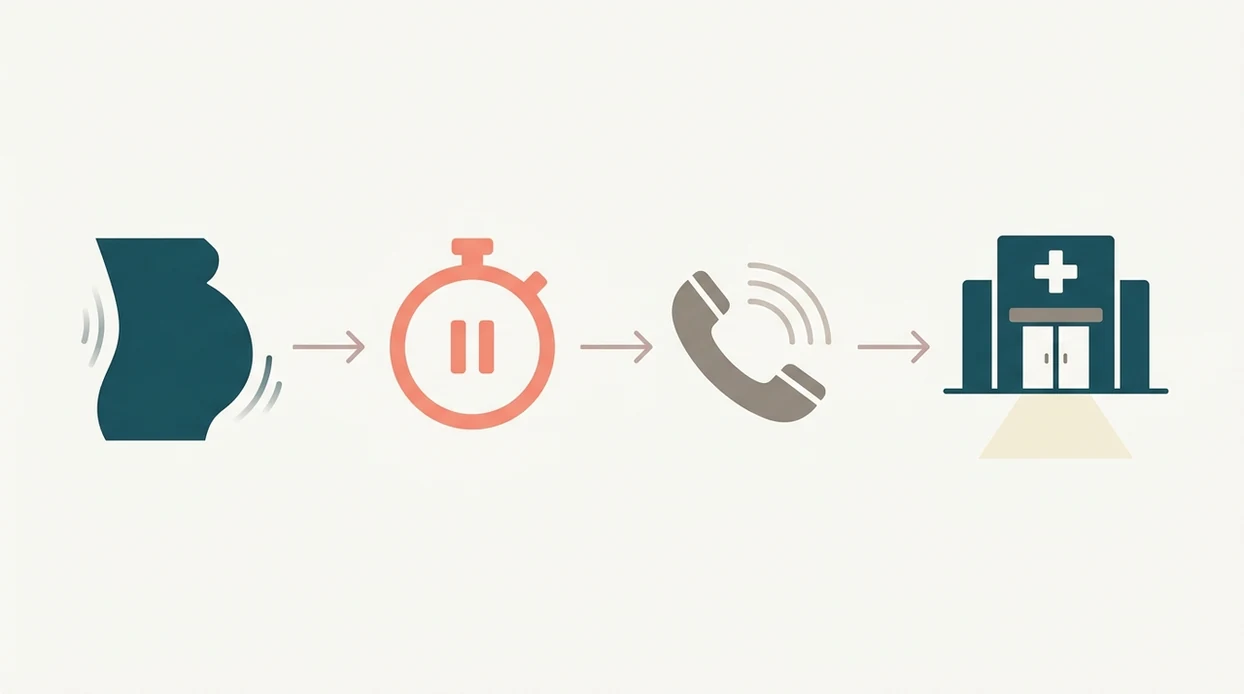
Use this process when fetal movement changes during contraction tracking. Do not substitute cold drinks, sugar, lying on your side, or another kick-count session for calling.
- Stop timing contractions. Put the timer down and focus on what the baby is doing for a few minutes.
- Note the time and change. Say whether movements are fewer, weaker, absent, different, or suddenly frantic.
- Call your maternity unit or labor and delivery triage immediately. Use the urgent number your care team gave you.
- Share your contraction log and movement observations. Read the last few contraction times, then describe the movement change clearly.
- Go in for fetal monitoring if advised. If you are told to come in, do not wait for a prettier pattern or a stronger contraction rhythm.
The most common medically supported way to assess reduced fetal movement near labor is in-person fetal monitoring combined with clinician review. If there is also heavy bleeding with contractions or contractions after water breaks, say that at the start of the call.
Limitations
Movement monitoring during contraction tracking is important, but it has limits.
- Maternal perception is subjective. Baby position, placenta location, body size, pain, fear, and distraction can all change what you feel.
- An anterior placenta can muffle movement. It may make kicks feel softer, but it does not remove the need to know your baby’s usual pattern.
- Kick counts and app logs cannot separate sleep from compromise. A quiet baby may be fine, but home tracking cannot prove that.
- Not every reduced-movement episode means danger. Many hospital checks are reassuring, and that outcome is still worth the trip.
- CTG/NST and ultrasound are not flawless. False positives and false negatives happen, so repeated monitoring may be needed.
- Evidence is limited on minute-by-minute kick changes during late labor. Most research looks at reduced movement episodes, not every contraction-by-contraction interaction.
- Safety-first thresholds create reassurance visits. That is appropriate, not wasted care.
ContractionTimer.io contraction timer app can store the timing record, but decisions about reduced movement belong with your maternity team. For safety framing around app limits, read the contraction timer medical disclaimer.
FAQ
These answers address common questions from people noticing movement changes while timing contractions. Reduced, absent, weaker, or suddenly frantic fetal movement should prompt immediate contact with maternity triage or labor and delivery.
FAQ answers do not replace individualized medical advice, CTG/NST monitoring, ultrasound, or clinician assessment. Use your contraction log only as supporting information when speaking with the care team; the movement change is the main reason to call.
Is decreased fetal movement an emergency?
Decreased fetal movement is an urgent same-day concern, especially after 28 weeks or during contractions. Contact maternity triage or labor and delivery immediately rather than waiting to see if movement returns.
How long is too long without movement?
Guidelines generally advise calling immediately when you notice reduced, absent, or clearly changed movement, not waiting a set number of hours. Do not delay for another kick count if the pattern feels wrong.
Do babies move less during contractions?
A baby may pause briefly during a contraction, but the usual movement pattern should continue between contractions. Less movement is not automatically normal just because contractions have started.
Can a contraction timer detect fetal distress?
No. Contraction timer apps, including ContractionTimer.io, track contraction duration, frequency, and patterns only; they cannot assess fetal wellbeing.
Should I try cold water before calling?
No. Cold water, juice, sugar, or lying on your side should not be used as a substitute for contacting your maternity unit about reduced movement.
Does an anterior placenta hide movement?
An anterior placenta can muffle movement and make kicks feel softer. You should still learn your baby’s usual pattern and call if that pattern clearly changes.
Is frantic movement also a warning sign?
Yes. A sudden wild increase in movement can also be a warning sign, especially if it is very different from the baby’s usual pattern.
When should I go to hospital for reduced movement?
Call maternity triage or labor and delivery immediately when movement is reduced, absent, weaker, or suddenly frantic. Go in promptly if they advise assessment, and do not wait for a contraction pattern to develop.
Does reduced movement always mean stillbirth risk?
No. Most reduced-movement episodes are checked and resolve safely, but the potential risk is serious enough that every clear change should be assessed.
What to Tell Labor and Delivery About Decreased Fetal Movement
Call promptly rather than waiting to assemble a perfect record. Tell the clinician how many weeks pregnant you are, when you last noticed your baby’s usual movement, and what has changed - for example, movements feel weaker, less frequent, or absent. Also report vaginal bleeding, leaking fluid, severe or constant abdominal pain, fever, dizziness, an urge to push, or any other symptoms. Mention relevant instructions or complications from your pregnancy care team.
If available, share the start time, duration, and spacing of recent contractions, but do not let timing delay the call. A contraction history can provide context, yet it cannot show whether your baby is well. Follow the clinician’s instructions about whether to come in, continue observing movement, or call emergency services. Do not drive yourself if you feel faint, have heavy bleeding, feel an urge to push, or have been advised to use emergency transport. If you cannot reach your usual provider, contact your labor and delivery unit or local emergency service.
Stop timing and call maternity services
A new decrease, absence, or change in your baby’s usual movement pattern is a red flag - stop timing contractions and seek assessment. After 24 weeks, contact maternity services at any time, day or night; do not wait for contractions to become regular.
Movement has no universal numeric definition, so your perception of a change matters. NICE antenatal care guidance supports contacting maternity services for reduced movement after 24+0 weeks.
- 24+0 weeks: contact maternity services for reduced movement.
- 10 movements in 2 hours: a practical prompt, not a diagnostic cutoff.
- 13 per 1,000: estimated stillbirth rate per reduced-movement episode reported by ACOG.