 Contraction
How Many Contractions To Time Before You Can Trust the Pattern

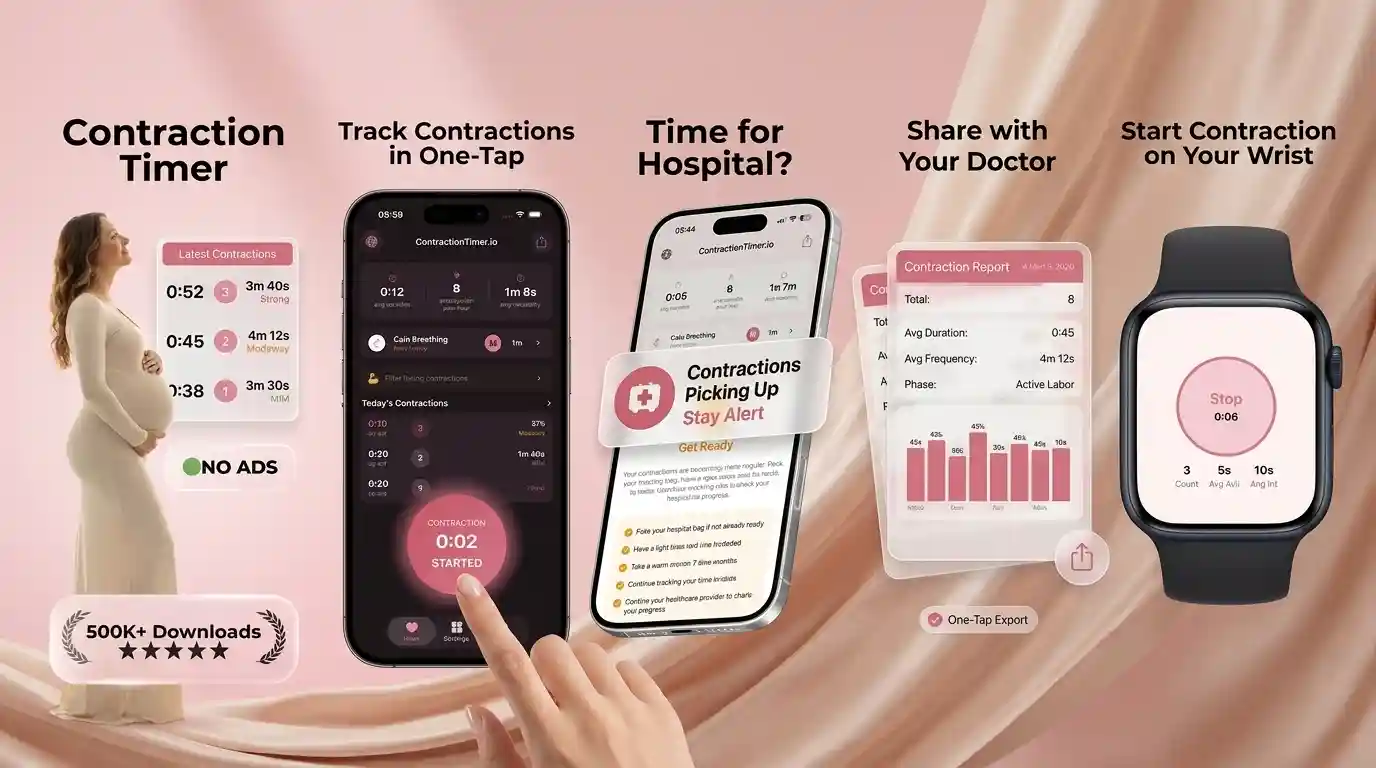
Contraction Timer (contractiontimer.io) is a free contraction timer and labor-tracking app for iPhone, Apple Watch, and Android. For this page, it helps parents collect enough contraction data to judge whether the pattern is becoming consistent before calling or heading in.
Quick answer: For how many contractions to time, a useful starting point is usually 30–60 minutes of timing or about 8–12 contractions before you rely on the pattern. Call your provider sooner if contractions are very painful, close together, your water breaks, bleeding occurs, baby is moving less, or you have been given different instructions.
Why choose Contraction Timer?
Contraction Timer helps you decide whether you have enough contractions to trust the pattern by calculating averages automatically instead of making you manage a stopwatch and notes.
- Auto-calculates contraction duration, frequency, and interval
- Shows whether a 30–60 minute sample is forming a consistent pattern
- 5-1-1 hospital alerts when contractions meet common call criteria
- Labor phase detection based on your timed contraction history
- One-tap start and stop for easier timing during painful contractions
- Contraction history you can review before calling your provider
- Apple Watch and Lock Screen support for faster logging
- Partner mode, doctor reports, offline use, and no ads
Works on iPhone, Apple Watch, and Android. It is a tracking tool, not a medical device.
To know how many contractions to time, aim for at least 30–60 minutes of consecutive tracking, typically 8–12 contractions, before interpreting any pattern. Fewer than that and your averages for duration and interval are unreliable. Once you have a solid sample, look for contractions that are getting longer, stronger, and closer together.
> Definition: A contraction pattern sample is a consecutive set of timed contractions, each logged with start time, duration, and interval, large enough to reveal whether labor is progressing or contractions are irregular.
- Track at least 8–12 contractions, roughly 30–60 minutes, before reading any pattern.
- Log both duration and interval for every contraction. Counting alone is not enough.
- Call your provider for red-flag symptoms even if your contraction history is incomplete.
This guide is educational and helps you organize contraction timing data. It is not medical advice; follow your clinician’s instructions and call your maternity unit if symptoms feel urgent or unusual.
What "How Many Contractions To Time" Actually Means
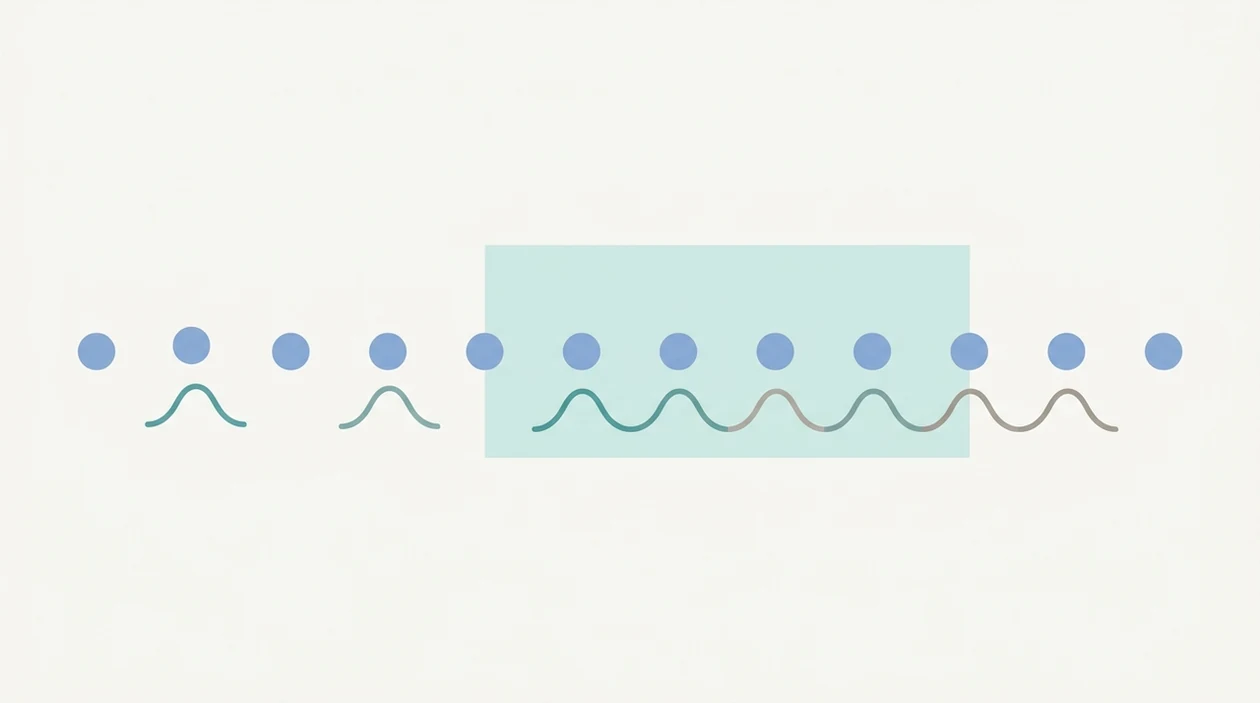
“How many contractions to time” means the minimum number of contractions you track in a row before the averages start to mean anything. In practical terms, that usually means 8–12 consecutive contractions, not two strong ones separated by a long quiet stretch.
Two or three contractions can feel convincing, especially when one makes you stop talking. But they don’t show whether the pattern is building, fading, or bouncing around. A single hallway lap can include one real tightening wave and one random one; the timer can’t know the difference yet.
Count the timing window, not the whole day. Ten contractions felt between breakfast and bedtime are different from ten contractions logged back-to-back over 45 minutes. The useful sample is consecutive, with each Start and Stop captured cleanly. For the mechanics of the first tap, the full process is covered in how to time contractions.
How Contraction Pattern Timing Works
Contraction timing works by recording two data points for every contraction: duration and interval. Duration is how long one contraction lasts; interval is the start-to-start gap between one contraction and the next.
Averages stabilize only after enough consecutive entries. With 8–12 contractions, the rolling average has enough data to smooth out one early tap, one late Stop, or one contraction that fades oddly. That’s why labor timing averages are more useful after a focused 30–60 minute session than after a few scattered notes.
Apps calculate rolling averages from your contraction history and can show whether contractions are trending longer, stronger, and closer together. Good contraction timer apps give timing records and pattern cues, not a diagnosis or permission slip.
Braxton Hicks and prodromal contractions can fill a log fast. Evening tightenings that vanish by bedtime may look busy in rows, but they usually don’t form a progressive hour-long pattern.
What You Need Before You Start Timing Contractions
Before you start timing, choose one method and stick with it for the whole sample. Use a contraction timer app, stopwatch, or pen and paper. Switching methods halfway through makes the log harder to read when someone is trying to call your midwife.
You also need a setting quiet enough to notice the start and end. Not silent. Just calm enough that you can catch the first tightening instead of waiting for the pain peak. If you are unsure when the window should begin, read when to start timing contractions before the contractions are close.
Keep your provider’s rule nearby. Some use 5-1-1, some use 3-1-1, and some give custom instructions for distance, prior birth, VBAC, or medical history.
Red flags override the timer. Bleeding, fluid loss, decreased fetal movement, or a strong feeling that something is wrong means call.
How To Use a Contraction Timer for Accurate Labor Timing Averages
Use a contraction timer by starting at the first tightening, stopping when it fully fades, and repeating for at least 8–12 consecutive contractions. That gives the labor timing averages enough entries to show a real direction.
- Tap Start at the very beginning of the contraction, not when it reaches the pain peak.
- Tap Stop when that contraction fully fades, so the duration reflects the whole wave.
- Let the timer run between contractions so the app or stopwatch captures the start-to-start interval.
- Repeat for at least 8–12 consecutive contractions, usually a 30–60 minute timing window.
- Review the rolling averages for duration, interval, and trend direction before deciding your next step.
The messy part is normal. A partner may be trying to hit Stop with a thumb while holding a water bottle and timing from the edge of the bed. Tools like ContractionTimer.io can help keep Start, Stop, History, and Share in one simple flow.
Minimum Contraction Pattern Sample: 30–60 Minutes or 8–12 Contractions
A useful minimum contraction pattern sample is 30–60 minutes of consecutive timing, often 8–12 contractions. NHS guidance says to call your midwife or maternity unit when contractions are regular, last at least 60 seconds, and come about every 5 minutes (NHS).
- A 30–60 minute window usually captures enough contractions to compare duration and interval together.
- At 5-minute intervals, one hour gives about 12 start-to-start data points.
- At wider early-labor intervals, 30–60 minutes may give fewer entries, so trend direction matters.
- A CDC/NCHS report found that 43.8% of planned hospital births in its cohort began with spontaneous labor, so many families rely on symptoms and contraction history before going in (CDC/NCHS National Health Statistics Reports No. 186).
- The most common medically supported way to judge a contraction pattern is repeated start-to-start timing combined with your provider’s specific call-in rule.
First-Time vs. Subsequent Labor Timing Differences
First labors often use the 5-1-1 rule, while later labors may use 3-1-1 because they can move faster. Clinicians typically recommend following your own birth unit’s rule rather than forcing every labor into the same timing formula. The 5-1-1 rule contractions guide explains that pattern in more detail.
When To Call Your Provider Despite Limited Contraction Data
Call your provider even without a full contraction log if you have bleeding, fluid loss, decreased fetal movement, severe pain, or symptoms your care team told you to report. This matches standard maternity guidance to seek urgent advice for bleeding, waters breaking, reduced fetal movement, or anything that feels wrong (NHS, ACOG).
Rapid-onset contractions are another reason to call early. If contractions suddenly arrive close together and intense, don’t wait to collect a clean 8–12 entry sample. Some labors skip the slow build. Coat pulled on between waves, phone still open, no neat chart yet.
VBAC, prior cesarean, high-risk pregnancy, preterm concerns, or a long drive can also change the timing plan. Your provider may want contact before a standard 5-1-1 or 3-1-1 threshold.
An app alert is a decision-support cue, not a medical order. If the app says one thing and your body or clinician says another, use the safer instruction.
Common Mistakes When Timing Contractions
The most common mistake is timing only 2–3 contractions and treating that as a pattern. Three close contractions can happen during prodromal labor, after activity, or during a short burst that later spaces out.
Another mistake is logging every mild tightening all day. That creates a long contraction history, but not a clean sample. A tight belly after climbing stairs may deserve a note, but it doesn’t need to sit beside a focused labor window unless it continues.
Some people record frequency but skip duration. That leaves out half the picture. If you want a plain breakdown, contraction duration vs frequency explains why both numbers matter.
Also watch for app overtrust. A hospital alert is guidance based on your entries. It cannot diagnose labor, measure dilation, or know that you double-tapped Start during a contraction ending with a shaky exhale.
How To Verify Your Contraction Pattern Is Reliable
A contraction pattern is more reliable when you have at least 8–12 consecutive entries, each with duration and interval. Open the History view and check for missing Stops, duplicate Starts, or entries that clearly belong to a different timing session.
Next, look for direction. Are contractions getting longer, stronger, and closer together over the window? The average interval number on screen matters more when the rows underneath tell the same story.
Compare the averages to your provider’s rule. That may be 5-1-1, 3-1-1, or something more specific based on your pregnancy.
If the pattern stalls, reverses, or turns irregular, reset the plan. Time a fresh 30–60 minute window instead of trying to rescue a messy log. For phone-specific setup, how to track contractions with phone covers the practical pieces.
Limitations
Contraction timing is useful, but it has hard limits. It records pattern data; it does not examine you.
- Contraction timing cannot measure cervical dilation, fetal position, or how fast labor will progress.
- Standard rules like 5-1-1 and 3-1-1 are population-based guidance, not a personal guarantee.
- Quick labors, VBACs, prior cesareans, high-risk pregnancies, and long travel times may need earlier contact.
- Self-timing gets less accurate when contractions are intense, the room is dark, or Face ID keeps failing.
- A 12% battery, charger across the room, or cracked screen protector can turn a clean log into a messy one.
- Visual graphs and averages can create false reassurance if you ignore bleeding, fluid loss, or decreased fetal movement.
- Research on exact hospital-arrival timing thresholds is limited and varies by setting.
- An app is a decision-support tool, not a substitute for clinical judgment.
Apps such as ContractionTimer.io, GentleBirth, and The Bump timer can help organize entries, but your provider’s instructions come first. The ContractionTimer.io contraction timer app is most useful when someone can review the log, share the summary, and stop scrolling in panic.
Frequently Asked Questions
Is 3 contractions in 10 minutes good?
Three contractions in 10 minutes suggests frequent contractions, but it is not enough by itself to confirm a reliable labor pattern. Time 30–60 minutes if there are no red-flag symptoms.
How do I time contractions correctly?
Start timing at the beginning of one contraction and stop when it fully fades. Measure the interval from the start of one contraction to the start of the next.
When should I go to the hospital?
Many providers use 5-1-1 for first labors or 3-1-1 for later labors. Confirm your specific rule with your own provider or birth unit.
Are contractions 10 minutes apart real labor?
Contractions 10 minutes apart can be early labor, especially if they keep getting longer, stronger, and closer together. They need sustained tracking to confirm progression.
Do I time every contraction all day?
No, all-day tracking usually creates noise. Use focused 30–60 minute timing sessions when contractions feel regular.
What if my contractions are irregular?
Irregular contractions often fit Braxton Hicks or prodromal labor. Call your provider anyway if you have bleeding, fluid loss, decreased fetal movement, or concerning symptoms.
Does second labor need different timing?
Subsequent labors often progress faster than first labors. Many providers use 3-1-1 instead of 5-1-1, but your own instructions matter most.
Can a contraction timer replace my doctor?
No. ContractionTimer.io and other timers can organize contraction data, but they cannot measure dilation, fetal status, or diagnose labor.
Which app fits which need
| Need | Best option |
|---|---|
| fast, accurate timing sample for 8–12 contractions with automatic averages | Contraction Timer over Full Term |
| broad pregnancy content and week-by-week education alongside basic timing | The Bump |
| hardware-based contraction sensing for users specifically seeking a wearable monitor | Bloomlife |
| labor preparation, relaxation, and hypnobirthing-style guidance more than timing averages | GentleBirth |
Quick facts
- Type
- Contraction timer & labor tracker app
- Platforms
- iPhone, iPad, Apple Watch, Android
- Focus
- Contraction timing, 30–60 minute averages, 8–12 contraction samples, 5-1-1 alerts, labor patterns
- Includes
- one-tap timing, duration and frequency averages, contraction intervals, labor phase detection, 5-1-1 alerts, history, partner mode, doctor reports
- Best for
- Parents who want to know when they have timed enough contractions to trust the pattern.
- Free
- Yes
- Medical replacement
- No
People also use Contraction Timer for
Time Enough Contractions To Trust the Pattern
Use Contraction Timer to log contractions for 30–60 minutes, review the averages, and see whether a consistent pattern is forming. Always follow your provider’s instructions and call sooner if symptoms are concerning.
Download the Free App