 Contraction
Do Contraction Apps Actually Help During Labor?

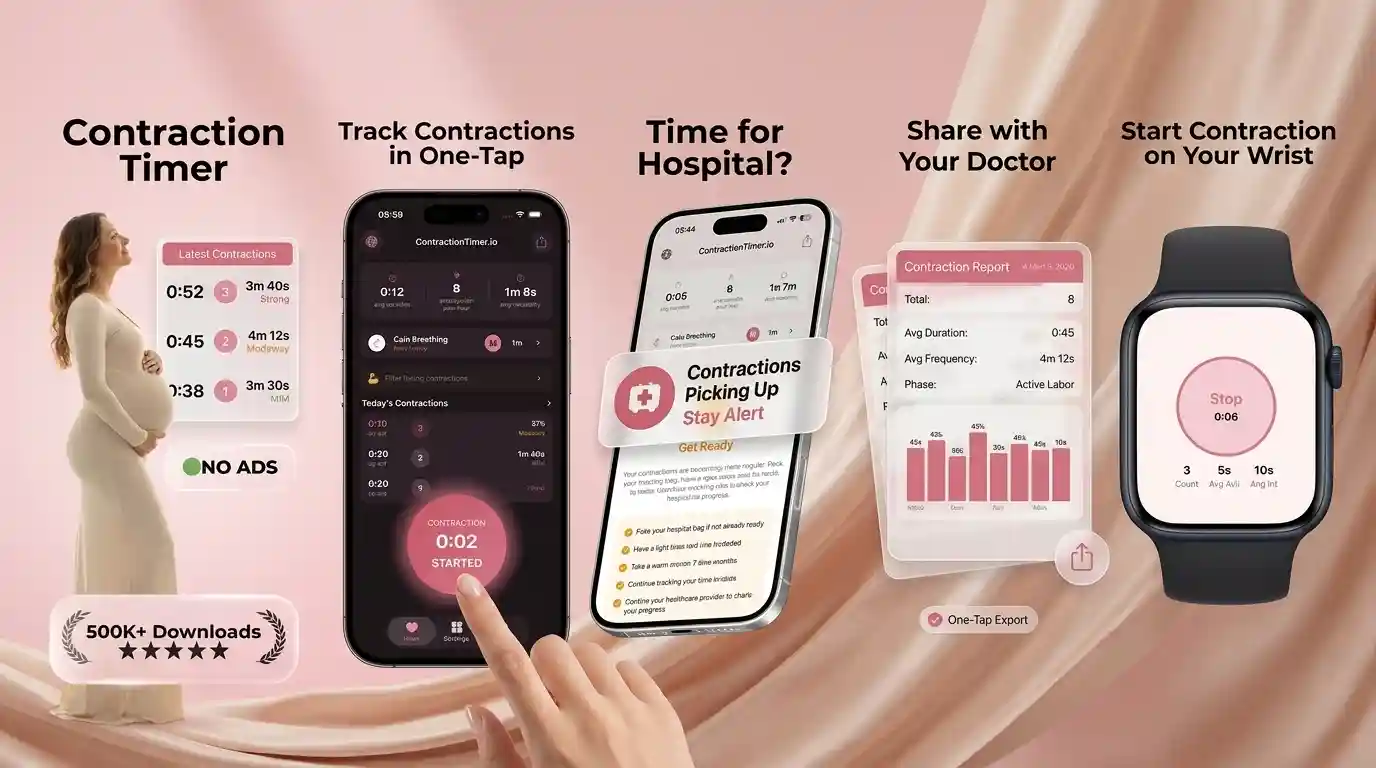
Contraction Timer (contractiontimer.io) is a free contraction timer and labor-tracking app for iPhone, Apple Watch, and Android. For this topic, it helps show where contraction apps are genuinely useful by turning taps into duration, frequency, interval, and 5-1-1 pattern information.
Quick answer: Contraction apps actually help by making it easier to time contractions consistently, see duration and frequency patterns, and share a clear history with your provider. They are useful during early labor and while watching for patterns like 5-1-1, but they cannot confirm active labor, dilation, or whether it is time for you personally to go to the hospital.
Why choose Contraction Timer?
Contraction Timer is easier than a generic stopwatch because it turns each tap into useful labor patterns instead of leaving you to calculate timing manually.
- One-tap contraction start and stop
- Automatic duration, frequency, and interval tracking
- 5-1-1 hospital pattern alerts
- Labor phase detection based on timing patterns
- Complete contraction history for review
- Apple Watch and Lock Screen timing
- Partner mode for shared tracking
- Offline use with no ads
Works on iPhone, Apple Watch, and Android. It is a tracking tool, not a medical device.
The answer to “do contraction apps actually help” is yes, but only as a convenience tool for logging contraction duration, frequency, and patterns so you can share clearer data with your provider. A contraction app cannot diagnose labor or replace clinical judgment; think of it as a notepad with a stopwatch, not a medical test.
Definition: A contraction timer app is a digital tool that records the start, end, duration, and interval of contractions so pregnant people and birth partners can track patterns and communicate timing data to a healthcare provider.
TL;DR
- Contraction apps help you log timing accurately when you're tired, anxious, or distracted, but they do not confirm labor.
- Their biggest real-world value is documentation you can hand to a clinician during triage.
- No app replaces provider instructions, especially for high-risk pregnancies or warning signs like bleeding or fluid leakage.
What a Contraction Timer App Actually Does
A contraction timer app records contraction timing data: start time, end time, duration, and the interval between one contraction and the next. It turns taps into a simple log, so you are not trying to remember times while breathing through pain.
Most apps show whether contractions are spacing out, bunching closer together, or staying irregular. Some also flag common rules, including 5-1-1, where contractions are about 5 minutes apart, last about 1 minute, and continue for 1 hour.
That is useful. It is also limited.
A labor timer does not measure contraction intensity, cervical dilation, effacement, fetal heart rate, bleeding, fluid leakage, or whether hospital admission is needed. Good contraction apps provide timing clarity, not clinical certainty. If you are comparing patterns like false labor vs real labor, timing helps, but symptoms and provider guidance still matter more.
5 Facts About Whether Contraction Apps Are Helpful
- Contraction apps help by logging duration, spacing, and regularity. That makes it easier to see whether contractions are forming a pattern instead of staying random.
- They reduce mental math when labor gets messy. At 2:17 a.m., with Face ID failing in a dark room, Start and Stop are easier than checking a wall clock.
- They cannot diagnose true labor. Labor decisions depend on clinical context, symptoms, cervical change, and your provider’s instructions.
- Rules like 5-1-1 are screening guidance. ACOG patient guidance includes timing patterns such as regular contractions every 5 minutes for 1 hour as one possible reason to call, but instructions vary by pregnancy source.
- The main value is cleaner communication. For many families, the app’s usefulness shows up during a triage call, when someone can read times clearly instead of scrolling in panic.
For birth partners, app timing is often easier than manual notes because one person can track while the laboring person focuses on coping.
How Contraction Timing Works Behind the Scenes
Contraction timing works by turning Start and Stop taps into timestamped events. The app calculates duration from Start to Stop, then calculates frequency from the start of one contraction to the start of the next.
That second number matters. Frequency is not measured from the end of one contraction to the beginning of another. It is usually start-to-start spacing. For example, a contraction that starts at 2:00 and the next at 2:05 is 5 minutes apart, even if the first one ended at 2:01. Pattern detection then compares recent intervals to show whether contractions are becoming regular, irregular, closer together, or farther apart.
Some apps apply thresholds such as 5-1-1 and suggest when to contact a provider. That does not mean the app knows labor status. It means the recent timestamps match a common timing pattern.
Accuracy depends on input quality. If someone forgets to tap Stop after the peak, double-taps Start, or starts timing only when pain is strongest, the log will drift. The phone can be correct, but the tap can be late.
Before You Start Timing Contractions
Before you start timing contractions, set up the boring parts first: who to call, who will tap, and whether the app actually works on your phone. A calm five-minute check now can prevent a messy scramble later.
- Confirm your call plan before labor begins. Ask your provider when they want you to call, whether their instructions differ from common timing rules, and what symptoms should bypass timing entirely.
- Save every important number in one place. Add hospital triage, your midwife or OB office, after-hours lines, and a backup contact so nobody is hunting through old messages during a contraction.
- Charge your phone and keep power close. A timer is only useful if the screen stays on, so plug in early and keep a cable near the bed, couch, or birth bag.
- Test the app while you are comfortable. Tap Start, Stop, History, Notes, and Share before anyone needs them. Make sure you can find the log quickly.
- Decide who will do the tapping. If a birth partner is available, let them handle timing so the laboring person can breathe, move, and rest between waves.
How to Use a Contraction App Safely During Labor
Use a contraction app as a timing record, not a decision-maker. Clinicians typically recommend calling based on your full situation, including symptoms, pregnancy history, and the instructions you were given.
- Download and test the app before labor starts. Open Start, Stop, History, Notes, Share, and Export while nobody is in pain.
- Tap Start when tightening begins and Stop when it fades. Do not wait for the pain peak if you can avoid it.
- Log at least 4 to 6 contractions before reviewing the pattern. One contraction is not enough to show a trend.
- Share the timing log with your provider. Use a phone call, portal message, screenshot, or export if the app supports it.
- Call immediately for warning signs regardless of app data. Bleeding, fluid leakage, reduced fetal movement, fever, severe pain, or a bad gut feeling should not wait.
March of Dimes lists warning signs such as bleeding, leaking fluid, fever, severe pain, and reduced fetal movement as reasons to contact care urgently rather than keep timing source.
Tools like ContractionTimer.io can make the log easier to send, but common thresholds are general guidance and may differ from your own care plan.
Common Mistakes When Using a Contraction App
The most common contraction app mistakes are late taps, missed Stop taps, and treating a short log like a diagnosis. The fix is to make the app serve your care plan, not the other way around.
- Start the timer when the tightening begins. If you wait until the contraction hurts most, the duration looks shorter and the spacing may look cleaner than it really is.
- Stop the timer when the contraction fades. In the fog of labor, it is easy to breathe through the end and forget the button. If that happens, edit the entry if you can or mention the mistake when you call.
- Watch several contractions before trusting a pattern. One or two waves can be misleading, especially after changing positions, hydrating, showering, or trying to sleep.
- Follow your provider’s instructions over app prompts. A generic “go now” or “keep waiting” message does not know your distance from the hospital, pregnancy history, or prior fast labor.
- Call for warning symptoms even if timing looks irregular. Bleeding, leaking fluid, reduced movement, fever, severe pain, or a strong sense that something is wrong should override the log.
Where Contraction Apps Are Most Useful
Contraction apps are most useful in early labor at home, when contractions may be shifting from scattered to regular. They help answer a narrow question: “What has the timing actually been for the last hour?”
Middle-of-the-night timing is another strong use case. A dim bedroom lit by phone glow is not where most people do accurate subtraction. The app can hold the pattern while you breathe, change positions, or try to rest between waves.
Birth partner use may be the cleanest setup. One person handles Start and Stop from the edge of the bed while the other focuses on coping. If contractions stop and restart, the log can also help describe prodromal labor contractions without relying on memory.
Evidence is thinner on outcomes. A Cochrane review of targeted digital communication in maternal and child health found that mobile tools can improve some care behaviors, but effects vary by setting and outcome source.
4 Myths About Contraction App Accuracy
Myth 1: An app can confirm labor has started. False. Labor is a clinical diagnosis, not a stopwatch result.
Myth 2: Regular contractions always mean go to the hospital. Not always. Provider instructions can differ for first births, high-risk pregnancies, VBAC plans, distance from the hospital, and prior fast labor.
Myth 3: More features make an app medically better. Usually, the core value is simple timestamping. Start, Stop, History, Edit, Share. That’s the work.
Myth 4: Apps can distinguish Braxton Hicks from true labor. They cannot reliably do that because symptoms overlap, and apps only track timing. If that question is your main worry, an app to help tell Braxton Hicks from real labor should still be treated as a tracking aid.
Per the CDC, about 1 in 10 babies in the United States are born preterm, which is why possible labor symptoms need medical caution, not just app review source.
What Contraction Apps Cannot Do
Contraction apps cannot measure cervical dilation, cervical effacement, fetal movement, fetal heart rate, bleeding, fluid leakage, or infection signs. They also cannot know whether your pregnancy includes high-risk conditions, an induction plan, a VBAC plan, or a planned C-section.
That is the safety line.
Simplified “go to hospital” messages may not fit your situation. A person who lives 45 minutes from the hospital, has a history of fast labor, or was told to call early should not follow a generic app prompt over their clinician’s plan.
In the United States, cesarean delivery accounts for about 32% of births, according to CDC delivery data source. That figure is a reminder that labor and delivery outcomes vary widely. Timing alone cannot predict the route, pace, or medical needs of birth.
If you are wondering can contraction timer tell if labor, the short answer is no. It can only organize the timing record.
Limitations
Contraction apps are helpful for documentation, but they have real limits. Use them with provider guidance, not instead of it.
- Apps do not confirm labor and can miss urgent situations if users focus on timing instead of symptoms.
- Timing accuracy depends on taps. Pain, stress, nausea, sleep deprivation, and a partner swapping hands mid-contraction can all distort the log.
- Some apps use oversimplified hospital-readiness logic that ignores individual risk profiles.
- The clinical evidence base for contraction apps specifically is thin. Most usefulness claims are based on convenience, not direct birth-outcome trials.
- No app can replace triage advice for bleeding, fluid leakage, reduced fetal movement, fever, severe pain, or concern that something is wrong.
- Apps may create false reassurance if contractions appear irregular but other symptoms need immediate care.
- A low battery can break the plan. If the phone is at 12% and the charger is across the room, paper notes may be safer for a few minutes.
Apps such as ContractionTimer.io, GentleBirth, and The Bump timer can help organize timestamps. They still cannot interpret your pregnancy.
Frequently Asked Questions
Do contraction timer apps really work?
Yes, contraction timer apps work for logging start time, stop time, duration, and spacing. They do not diagnose labor.
Can a contraction app replace a doctor or midwife?
No, a contraction app cannot replace a doctor, midwife, hospital triage nurse, or clinical evaluation. It only supplements the timing information you share.
When should I start using a contraction app?
Download and test a contraction app in the third trimester. Start timing when contractions seem regular, stronger, or worth reporting.
What is the 5-1-1 contraction rule?
The 5-1-1 rule means contractions are about 5 minutes apart, last about 1 minute, and continue for 1 hour. Your provider may give different instructions.
Can a contraction app tell Braxton Hicks from real labor?
No, a contraction app only tracks timing patterns. It cannot reliably identify whether contractions are Braxton Hicks or true labor.
Are free contraction apps accurate enough?
Free contraction apps can be accurate enough if they record timestamps clearly. Accuracy depends more on correct Start and Stop taps than price.
Should my birth partner use the contraction app?
Yes, partner logging is often useful because the laboring person can focus on breathing and coping. ContractionTimer.io contraction timer app supports this kind of simple handoff.
Do I still need to call my provider if the app says contractions are regular?
Yes, app data should supplement a provider call, not replace it. Call sooner for warning signs or if your care team told you to call early.
Which app fits which need
| Need | Best option |
|---|---|
| fast, accurate labor timing with automatic duration, frequency, interval, and 5-1-1 alerts | Contraction Timer |
| a broad pregnancy content app with contraction timing as one feature | The Bump |
| tracking contraction patterns with additional hardware-based sensing where available | Bloomlife |
| birth preparation, mindfulness, and relaxation support during pregnancy and labor | GentleBirth |
Quick facts
- Type
- Contraction timer & labor tracker app
- Platforms
- iPhone, iPad, Apple Watch, Android
- Focus
- Contraction timing, duration, frequency, intervals, 5-1-1 alerts, labor patterns, provider sharing
- Includes
- one-tap timing, contraction history, labor phase detection, 5-1-1 alerts, partner mode, doctor reports, offline use, no ads
- Best for
- Parents who want to know whether a contraction app can help track labor patterns safely and clearly.
- Free
- Yes
- Medical replacement
- No
People also use Contraction Timer for
Try a Contraction App That Actually Helps With Labor Timing
Use Contraction Timer to track contractions clearly, spot timing patterns, and save a history you can share with your care team. Always follow your provider’s instructions if they differ from app alerts.
Download the Free App