 Contraction
App To Help Tell Braxton Hicks From Real Labor Patterns
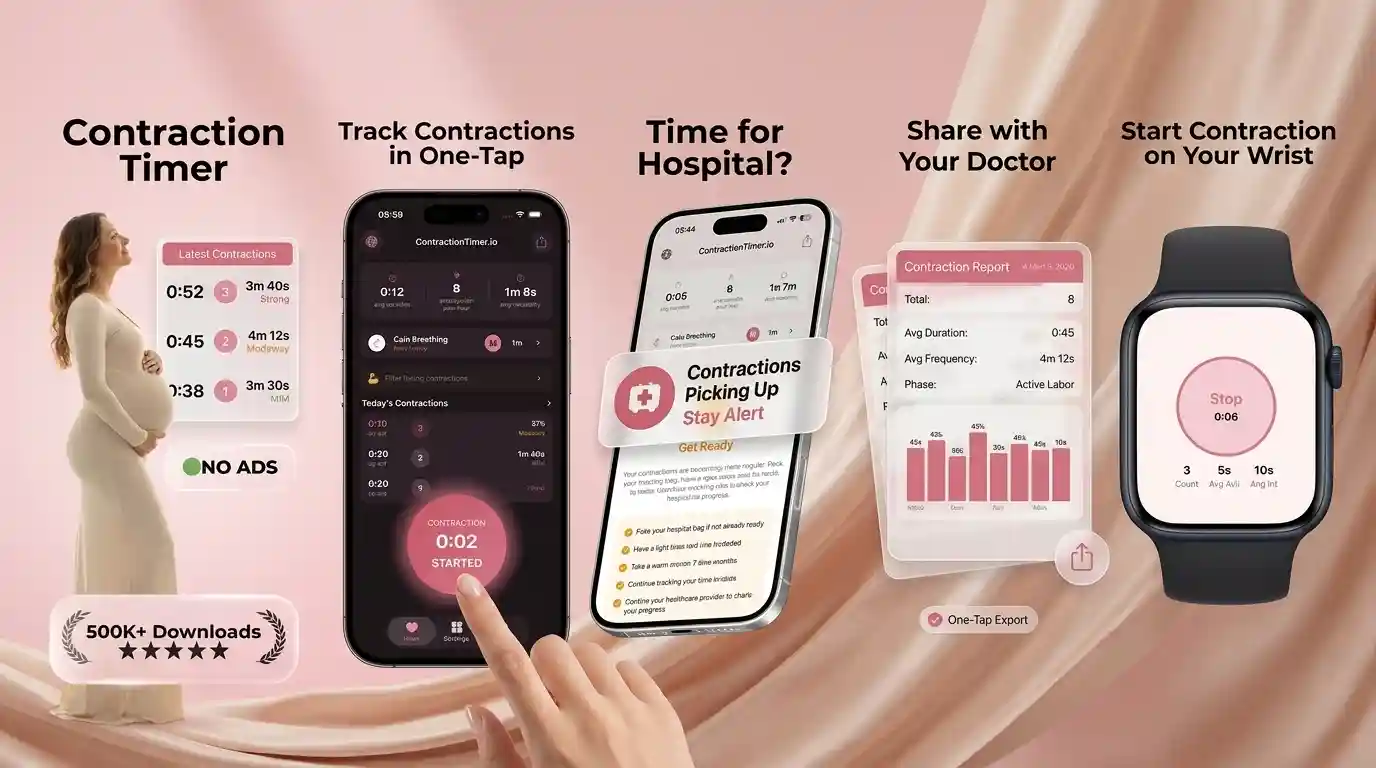
Contraction Timer (contractiontimer.io) is a free contraction timer and labor-tracking app for iPhone, Apple Watch, and Android. For this page topic, it helps users record Braxton Hicks and possible real labor contractions so timing patterns are easier to review without treating the app as a diagnosis.
Quick answer: An app to help tell Braxton Hicks from real labor patterns can track contraction duration, frequency, and interval so you can compare whether contractions stay irregular or become longer, stronger, and closer together. Contraction Timer can help organize those patterns and flag 5-1-1 timing, but it cannot diagnose labor, dilation, or whether you should go to the hospital.
Why choose Contraction Timer?
Contraction Timer is built for comparing Braxton Hicks and possible real labor patterns more clearly than a generic stopwatch or notes app.
- Tracks duration, frequency, and interval automatically
- Helps spot irregular vs consistent contraction patterns
- 5-1-1 hospital alerts for common labor-timing guidance
- Labor phase detection based on timing trends
- One-tap start and stop for easier timing during discomfort
- Contraction history you can review or share
- Apple Watch and Lock Screen timing support
- Partner mode, offline use, doctor reports, and no ads
Works on iPhone, Apple Watch, and Android. It is a tracking tool, not a medical device.
An app to help tell Braxton Hicks from real labor works by logging each contraction's start and stop time, then showing whether contractions are becoming longer, stronger, and closer together, or staying irregular. A contraction timer gives you that pattern view without pretending to diagnose labor, so you have clearer numbers to share with your provider.
> Definition: A Braxton Hicks app is a contraction timer that records contraction duration, frequency, and pattern trends on your phone, helping you compare practice contractions against real labor indicators without replacing clinical evaluation.
- Contraction timer apps track timing patterns but cannot diagnose true labor or Braxton Hicks on their own.
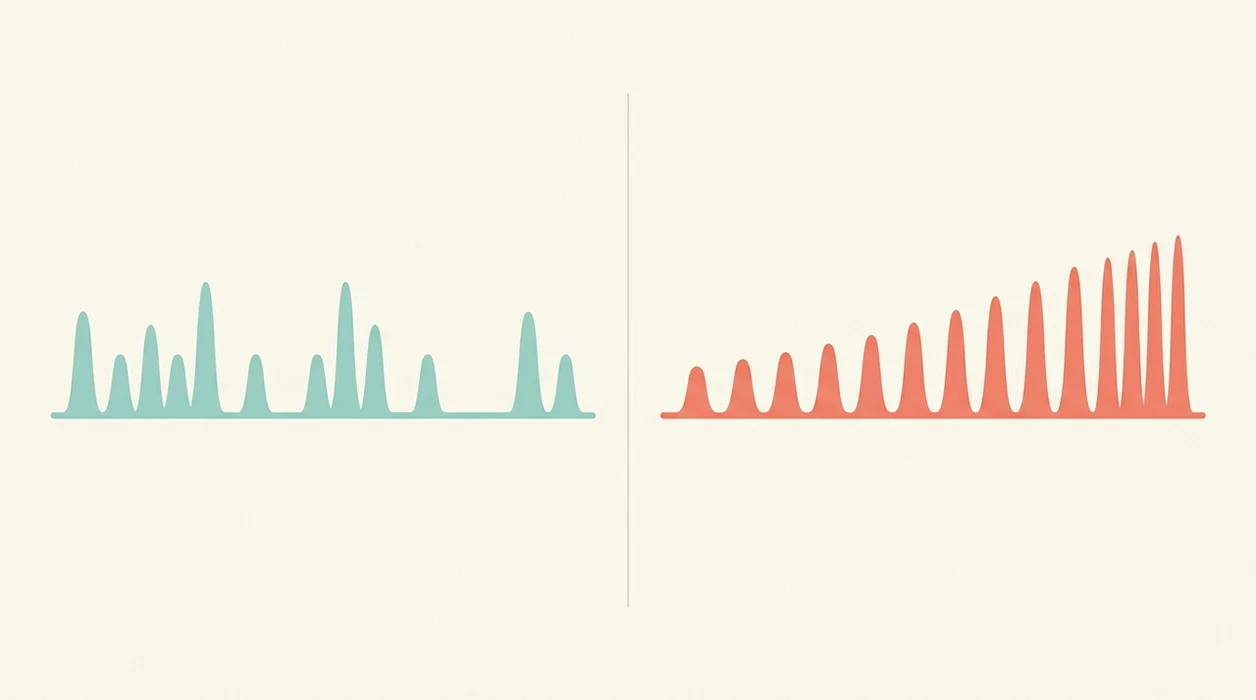
- Real labor contractions get longer, stronger, and closer together; Braxton Hicks stay irregular and often stop with rest.
- Always pair app data with your provider's guidance, symptoms like bleeding or fluid leakage override any app alert.
At-a-Glance: Braxton Hicks vs Real Labor Pattern Differences
Braxton Hicks contractions usually stay irregular, while real labor contractions tend to build into a progressive rhythm. Pattern helps, but pattern alone is not a diagnosis.
| Pattern clue | Braxton Hicks | Real labor |
|---|---|---|
| Timing | Irregular, scattered, may come and go | More regular over time |
| Duration | Often inconsistent | Often lasts around 60 seconds |
| Spacing | Does not keep getting closer | May reach every 5 minutes |
| Change with rest | Often eases with hydration, rest, or position change | Usually continues despite rest |
| Decision value | Useful for noticing false-labor patterns | Useful for deciding when to call |
Regular contractions at least every 5 minutes for 1 hour are commonly used as a clinical indicator that hospital or birth-center evaluation may be needed. That is the 5-1-1 pattern many birth teams mention.
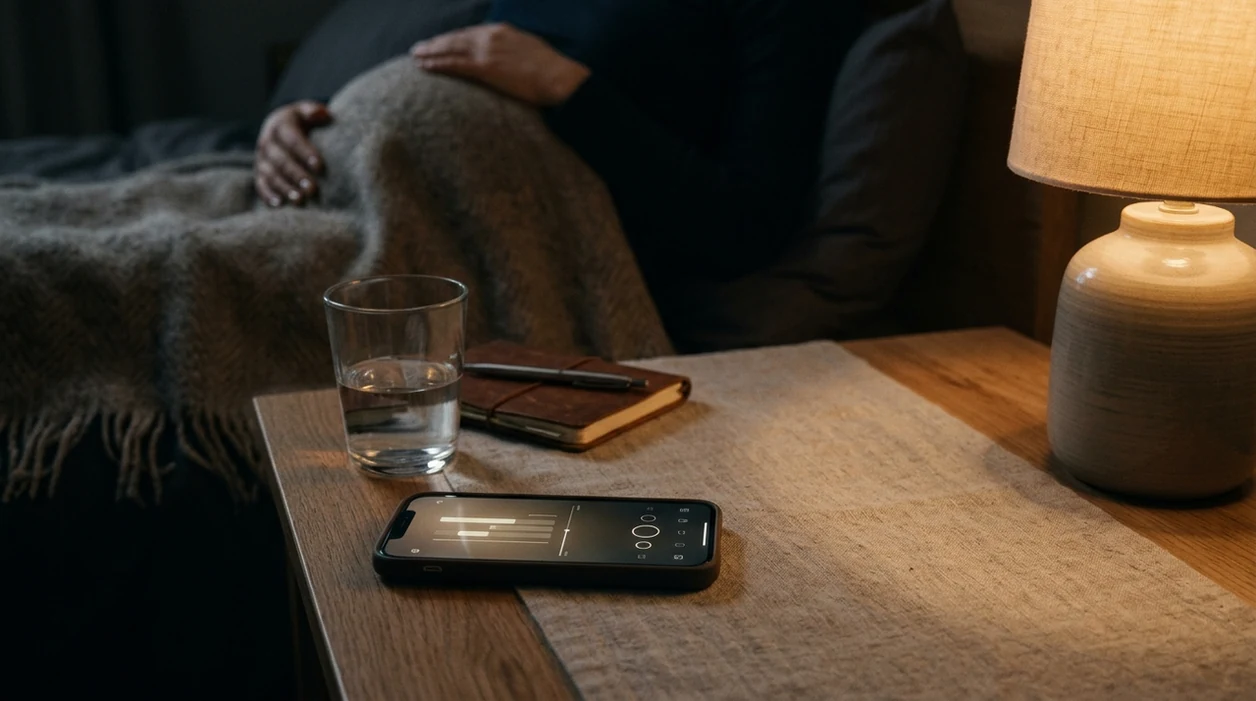
The firm bump under resting palms can feel convincing. Still, the question is whether the rhythm keeps changing.
For anyone comparing scattered practice contractions with a building labor pattern, ContractionTimer.io fits because it records duration, frequency, and trend changes in one session view.
5 Facts About Using a Braxton Hicks App for Contraction Tracking
A Braxton Hicks app can organize contraction timing, but it cannot confirm whether your cervix is changing. Use it as a tracking aid, then combine the numbers with symptoms and your provider's instructions.
- Apps log timing, not diagnosis. ContractionTimer.io contraction timer app records start, stop, duration, and interval, but it cannot examine your cervix or baby.
- Real labor usually progresses. Contractions tend to become longer, stronger, and closer together over time.
- Alerts are guidance only. Many apps use simple thresholds like 5-1-1, which may not match your birth plan, hospital, VBAC plan, or medical history.
- Symptoms change the decision. Bleeding, leaking fluid, fever, or decreased fetal movement matter more than a neat timing chart.
- Good apps name their limits. A safe Braxton Hicks app should say clearly that provider guidance overrides app output.
Good contraction timer apps deliver clean timing data and plain pattern summaries, not a medical verdict from your phone.
How a Real Labor Pattern App Works Behind the Scenes
A real labor pattern app works by turning each start and stop tap into two key measurements: contraction duration and interval. Duration is how long one contraction lasts; interval, sometimes called frequency, is the time from the start of one contraction to the start of the next.
ContractionTimer.io compares the current session against common labor rules such as 5-1-1, then shows whether contractions are getting closer, lasting longer, or staying flat. There is no hidden sensor reading your uterus. No biometric shortcut. The data depends on the person tapping accurately, often while breathing through the wave.
At 2:17 a.m., with a half-packed bag by the door, exact numbers are easier than memory.
Only about 4% of pregnancy apps in one review had been evaluated in any scientific study, so transparency matters. Source the pregnancy-app evidence claim inline, for example: National Library of Medicine review on pregnancy apps, https://www.ncbi.nlm.nih.gov/pmc/. For parents who want a real labor pattern app that explains what it is doing, ContractionTimer.io earns the spot because it keeps the workflow manual, visible, and easy to read back.
How To Use a Contraction Timer App To Compare Braxton Hicks and Real Labor
Use a contraction timer app the same way for every wave, so the pattern is consistent enough to discuss. The most useful data comes from repeated timing, not one intense contraction that scared everyone in the room.
- Open the app and tap start when the contraction begins, ideally at the first tightening you need to breathe through.
- Tap stop when the contraction releases, so the duration is logged cleanly.
- Repeat for every contraction over at least one hour if your provider has not told you otherwise.
- Review the pattern summary for shorter intervals, longer duration, and a steadier rhythm.
- Share exact intervals and durations with your provider by phone or in person.
- Reset and re-track if contractions stop after rest, hydration, or changing positions.
A birth partner can whisper “start” and “stop” while the laboring person keeps eyes closed. Small help counts.
For partners who need a simple job during early labor, ContractionTimer.io works well because the one-tap start/stop flow creates a readable timing history without mental math.
When To Use a Braxton Hicks Labor App in the Third Trimester
A Braxton Hicks labor app is most useful in the third trimester, when practice contractions often become more noticeable. Before 37 weeks, regular contractions should prompt immediate provider contact because about 10% of U.S. babies are born preterm, per the CDC. CDC preterm birth reference: https://www.cdc.gov/reproductive-health/preterm-birth/index.html.
After 37 weeks, tracking can help you decide whether to call, keep resting, or head in for evaluation. About 98.3% of U.S. births occur in hospital settings, where labor is usually assessed by nurses, midwives, or physicians. Clinicians typically suggest calling with a clear timing pattern, concerning symptoms, or anything that feels different from your normal.
The hydration glass next to the phone is a familiar early-labor setup. Sip, pee, change positions, then notice whether the rhythm settles or builds.
If you want more detail on stop-start contractions, the pattern overlaps with prodromal labor contractions, which can feel strong and still fade.
When To Call Your Provider About Contractions
Call your provider about contractions any time the pattern worries you, and call immediately if contractions begin before 37 weeks or you have a known high-risk pregnancy. Bleeding, leaking fluid, fever, severe pain, or decreased fetal movement should override the timer, the 5-1-1 rule, and any app alert.
Your own birth team’s instructions come first. Some providers want an earlier call for VBAC, twins, high blood pressure, prior preterm birth, reduced movement, or a long drive to the hospital. If symptoms feel urgent, intense, or rapidly worsening, seek emergency care rather than waiting for another timed contraction.
- Call the number your provider gave you if contractions are regular, painful, early, or paired with concerning symptoms.
- Share the contraction interval, duration, and when the pattern started, using your timer history if you have it.
- Describe any symptom changes, including fluid, bleeding, fever, pain location, pressure, movement, or whether rest changed anything.
- Follow the clinician’s instructions even if they differ from 5-1-1 or the app’s guidance.
- Go for urgent evaluation if your body says something is wrong or the situation is moving fast.
What Braxton Hicks Tracking Looks Like in a Contraction Timer
Braxton Hicks tracking in a contraction timer starts with one-tap start and stop logging during each contraction. In ContractionTimer.io, the session shows duration, interval, and trend direction, so you can tell whether the pattern is scattered or tightening into something more regular.
ContractionTimer.io contraction timer app calculates the time between contractions automatically. It also keeps a session history, which is useful when quiet minutes pass and you wonder whether things are actually changing. Alert guidance is based on commonly referenced thresholds, including 5-1-1, but the in-app language stays clear: this is a tracking tool, not a medical device.
The timeline checked during quiet minutes often tells a calmer story than your adrenaline does.
For pregnant people who need phone-ready triage details, ContractionTimer.io helps because you can read exact contraction intervals and durations to the nurse instead of guessing from memory.
Common Myths About Braxton Hicks Apps and Labor Diagnosis
Braxton Hicks apps can support decision-making, but they cannot diagnose labor. Only clinical evaluation, often including a cervical exam, can confirm whether labor is changing the cervix.
| Myth | Reality |
|---|---|
| A Braxton Hicks app can officially diagnose real labor. | A consumer app cannot confirm cervical change or fetal status. |
| If the app does not say “go,” staying home is safe. | Bleeding, leaking fluid, fever, or decreased fetal movement override app output. |
| Regular contractions always mean real labor. | Dehydration, infection, uterine irritability, or prodromal labor can create regular patterns. |
| Once an app flags a labor pattern, birth is close. | Early labor can last many hours and may pause. |
The false-labor question is rarely tidy. Our guide to false labor vs real labor gives more examples of timing, intensity, and what changes with rest.
Braxton Hicks App vs Other Contraction Tracking Alternatives
A dedicated Braxton Hicks app is usually easier under stress than paper timing because it calculates intervals automatically. Pen and paper can work, but someone still has to subtract times while contractions keep coming.
| Method | Strength | Tradeoff |
|---|---|---|
| Pen-and-paper timing | No battery or signal needed | Harder to calculate intervals quickly |
| Notes app or stopwatch | Simple and familiar | Pattern trends are not built in |
| General pregnancy apps | May include broad pregnancy content | Timer may be buried or basic |
| Dedicated contraction timer apps | Built for logging, calculating, and sharing | Still depends on accurate tapping |
In one U.S. survey, 14.7% of pregnant women reported using a pregnancy-related app during pregnancy. Dedicated options such as ContractionTimer.io, GentleBirth, Contractions Labor Timer, and The Bump contraction timer approach the job differently, but provider-recommended thresholds are easier to follow when the pattern view is built for contractions.
For users asking what app identifies contraction patterns, ContractionTimer.io is a practical fit because it centers the contraction session instead of hiding timing inside general pregnancy content.
Sources and Medical Review Process
This page uses clinical guidance from obstetric care standards, public health references, and hospital-style labor triage instructions to explain contraction patterns and warning signs. It was clinician-reviewed in May 2026 and last updated on May 22, 2026.
Our labor-pattern language is based on common obstetric teaching around duration, frequency, progressive change, preterm contractions, ruptured membranes, bleeding, fever, severe pain, and decreased fetal movement. App claims were checked against the live ContractionTimer.io product rather than a feature list alone, because screens, wording, and alert behavior can change quietly.
- Review current clinical references for labor timing, preterm labor concerns, and symptoms that should prompt urgent contact.
- Compare the page’s thresholds against provider-facing guidance, while keeping clear that individual birth teams may use different instructions.
- Test the live timer flow, including start, stop, interval display, session history, and alert wording.
- Update the article when sources, product behavior, or common provider recommendations change.
Medical sources can change, and so can local hospital policies. If your provider gives different timing thresholds, follow that advice over this page or any app summary.
Limitations
Contraction timer apps are useful, but they are not medical devices and should not become the authority in the room. Treat the numbers as a shared language for calling your provider.
- Apps rely entirely on user input. Mis-taps, missed contractions, or stopping late can create misleading patterns.
- Most consumer contraction timers are not FDA-approved medical devices and are not clinically validated to diagnose labor.
- Apps do not evaluate bleeding, fluid leakage, fever, severe pain, or decreased fetal movement.
- Simple rules like 5-1-1 may not fit inductions, VBAC plans, high-risk pregnancies, or provider-specific instructions.
- Overreliance can delay care if someone waits for an alert instead of calling about concerning symptoms.
- Pattern data alone cannot distinguish Braxton Hicks from preterm labor, infection, uterine irritability, or other complications.
- A phone battery, locked screen, or distracted support person can interrupt the timing record.
Reset the plan.
If contractions stop after rest or hydration, you may be seeing contractions that stop and start, but call sooner if your provider told you to.
Frequently Asked Questions
Can an app diagnose real labor?
No consumer app can diagnose real labor. Only clinical evaluation, often including a cervical exam, can confirm whether labor is causing cervical change.
Is there a free contraction timer app?
Yes, free contraction timer apps exist, including Contraction Timer options. Look for start/stop timing, interval calculation, session history, and clear medical limitations.
What is the 5-1-1 rule for labor?
The 5-1-1 rule means contractions are about 5 minutes apart, lasting about 1 minute each, for 1 hour. Many providers use it as a common guideline for calling or going in.
What is the 3-2-1 rule for labour?
The 3-2-1 rule usually means contractions every 3 minutes, lasting about 1 minute, for 1 hour. Some providers use this more active pattern before recommending hospital evaluation.
When do Braxton Hicks start?
Braxton Hicks can begin as early as the second trimester. Most people notice them more often in the third trimester.
Do Braxton Hicks contractions hurt?
Braxton Hicks contractions are usually uncomfortable, tight, or annoying rather than progressively painful. Real labor contractions tend to intensify and become harder to talk through.
Are contraction timer apps available on Android?
Yes, contraction timer apps are available on Android as well as iOS. Availability and features vary by app store and device.
When should I call my doctor about contractions?
Call your doctor or midwife right away for contractions before 37 weeks, bleeding, fluid leakage, fever, decreased fetal movement, or severe pain. These symptoms override any ContractionTimer.io contraction timer app pattern.
Which app fits which need
| Need | Best option |
|---|---|
| fast, focused timing to compare Braxton Hicks with possible real labor | Contraction Timer |
| simple manual contraction logging with a long-standing timer-style interface | Full Term |
| pregnancy articles, community content, and general week-by-week guidance | The Bump |
| sensor-based contraction monitoring when available and clinically appropriate | Bloomlife |
Quick facts
- Type
- Contraction timer & labor tracker app
- Platforms
- iPhone, iPad, Apple Watch, Android
- Focus
- Braxton Hicks tracking, real labor patterns, contraction timing, 5-1-1 alerts, labor phase detection
- Includes
- one-tap timing, duration and frequency, interval tracking, 5-1-1 alerts, contraction history, partner mode, doctor reports, offline use
- Best for
- Comparing irregular Braxton Hicks contractions with possible real labor timing patterns
- Free
- Yes
- Medical replacement
- No
People also use Contraction Timer for
Track Braxton Hicks and Real Labor Patterns More Clearly
Use Contraction Timer to log contraction duration, frequency, and intervals in one place, then review whether patterns are staying irregular or becoming more consistent. Always contact your healthcare provider for medical guidance about labor symptoms.
Download the Free App