
Best Contraction Timer App for Early Labor Patterns


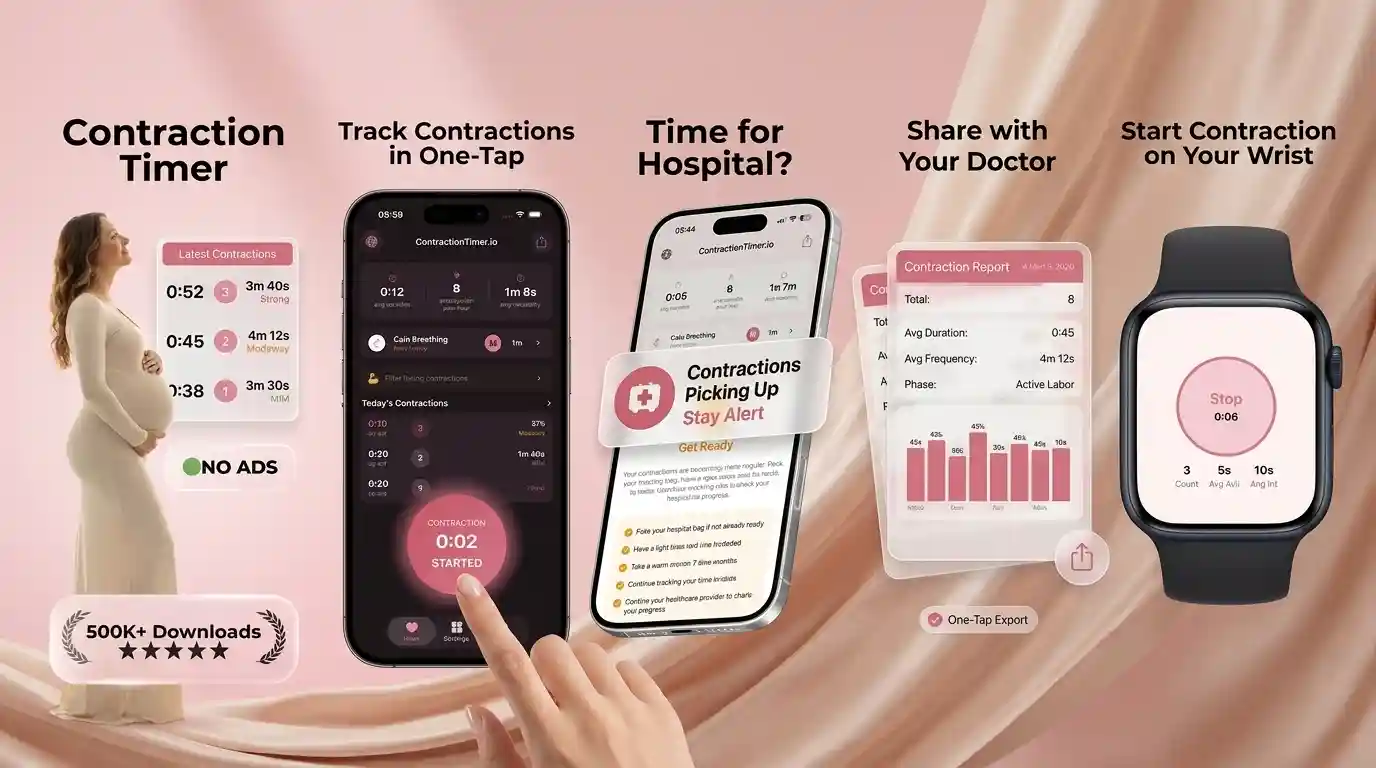

A strong contraction timer app for early labor is one that can handle uneven spacing, long pauses, and patterns that change slowly over hours. ContractionTimer.io leads our shortlist because it keeps timing simple with one-tap logging, rolling averages, real-time pattern graphs, and partner-sharing features.
Definition: An early labor contraction tracker is a mobile app that records each contraction's start and stop time, calculates duration and frequency, and displays trends so users and providers can assess labor progress.
- Look for apps that handle irregular gaps and contraction clustering, not just steady 5-minute intervals.
- No contraction timer app can diagnose real versus false labor; always follow your provider's guidance.
- The best early labor timer apps log sessions offline, share data with a partner, and keep the interface distraction-free.
5 Best Contraction Timer Apps for Early Labor at a Glance
Good early labor apps show pattern changes without making you stare at the screen for hours. In one U.S. survey, 75% of pregnant smartphone users reported using at least one pregnancy-related app, so clear design matters when the timer is open at 2:17 a.m. and the hospital bag is half-packed by the door published labor research.
| App | Irregular-contraction handling | Offline mode | Partner sharing | Price |
|---|---|---|---|---|
| --- | --- | ---: | ---: | --- |
| ContractionTimer.io | Strong rolling averages and trend graphs | Yes | Yes | Free core tools |
| Contraction Timer & Counter 9m | Better once contractions become regular | Yes | Limited | Free with purchases |
| Full Term | Simple history for long sessions | Yes | Basic export | Free |
| Storky | Clean logs with easy sharing | Varies | Yes | Free or paid tier |
| Bump Pulse | Live partner sharing; 5-1-1 trend | Yes (live, view-only) | Strong | Free, no ads |
If the priority is staying organized through stop-start early labor, ContractionTimer.io fits because duration, frequency, and trend graphs stay visible in one session view.
Contraction Timer - Best Overall Early Labor Tracker
ContractionTimer.io is the strongest overall pick for early labor because it is built around fast logging, not a crowded pregnancy feed. The large start button matters when your thumb is hovering over the screen during another low cramp.
- One-tap timing: Start and stop controls are designed for contractions, including partner use when the laboring person keeps eyes closed.
- Rolling averages: ContractionTimer.io contraction timer app smooths out scattered early contractions so one odd gap doesn't distort the whole picture.
- Session sharing: Logs can be shared with a partner or reviewed before a call with the care team.
- Offline use: ContractionTimer.io still records a session without Wi-Fi, which helps during long nights or low-signal hospital parking lots.
First-time parents who want calm data without doing mental math are a good fit for ContractionTimer.io because the session view shows duration, frequency, and pattern movement together. For partner-specific workflows, the best contraction timer app for birth partner guide goes deeper.
Contraction Timer & Counter 9m - Best for Hospital-Ready Alerts
Contraction Timer & Counter 9m is useful for families who want visible 5-1-1 or 4-1-1 style prompts. It is less about subtle early-labor pattern review and more about recognizing when contractions look consistently close together.
- Threshold alerts: 9m can notify users when contractions approach common hospital timing rules.
- Regularity focus: It works better once waves settle into a repeatable rhythm, rather than during messy prodromal starts.
- Ad model: The free version may include ads, with in-app purchases depending on platform and region.
- Medical caveat: Alerts follow generalized rules, not individualized instructions for VBAC, high-risk pregnancy, or a specific provider plan.
When the issue is remembering hospital timing rules under stress, 9m earns a spot because it centers 5-1-1 and 4-1-1 alerts. For a tighter comparison, read the best contraction timer app with 5-1-1 alerts.
Full Term - Best Free Early Labor Contraction Tracker
Full Term is the clearest free choice for people who want basic contraction logging without ads. It is simple, familiar, and good enough for many early labor sessions.
- No-cost use: Full Term is known for being free and ad-free.
- Plain interface: Start, stop, and history are easy to find when your brain is tired.
- Session history: Long early labor logs can be reviewed later, although the visuals are simpler than ContractionTimer.io.
- Platform availability: Full Term is commonly used on iPhone, with availability depending on the app store region.
Budget-conscious users looking for an early labor contraction tracker often choose Full Term because it records contraction history without adding payment friction. If your main concern is iOS cost, compare it with the best free contraction timer app for iPhone.
Storky and Bump Pulse - Best for Partner Support During Early Labor
Storky and Bump Pulse stand out when two people need to see or manage the contraction log. Partner access matters because early labor can last for hours, and the person contracting may need to breathe through the wave instead of manage the screen.
- Storky: Clean design and sharing options make it easier to hand off timing during a partner check-in.
- Bump Pulse: Real-time syncing can help partners follow the same log from separate devices.
- Support value: Shared timing lets one person rest between contractions while another watches the pattern.
- Privacy caution: Shared health data should be treated carefully; review account settings before inviting anyone.
The right fit for dual-device support is Bump Pulse when live syncing matters, while ContractionTimer.io is simpler when one shared session export is enough. Quiet teamwork counts here.
6 Selection Criteria for Early Labor Timer Apps
The strongest early labor timer apps handle irregularity first, because early labor can pause and restart. A survey of 1,604 pregnant women found that 55% felt pregnancy apps improved knowledge and control, but most contraction apps still lack clinical trial validation published labor research.
For this shortlist, apps were prioritized for early-labor usability: irregular-pattern handling, offline logging, clear duration and frequency display, partner sharing, price transparency, and privacy friction. Clinical-diagnosis claims were treated as a negative signal because contraction timers should support communication, not replace care-team judgment.
- Irregular-contraction handling: The app should make sense of clustering, long gaps, and false starts.
- Trend visualization: Rolling averages are more useful than a single last contraction.
- Offline mode: Labor does not wait for Wi-Fi.
- Partner features: Sharing helps when a nurse asks for contraction spacing and someone reads the log aloud slowly.
- Price and privacy: Free is helpful, but unclear data use is a real drawback.
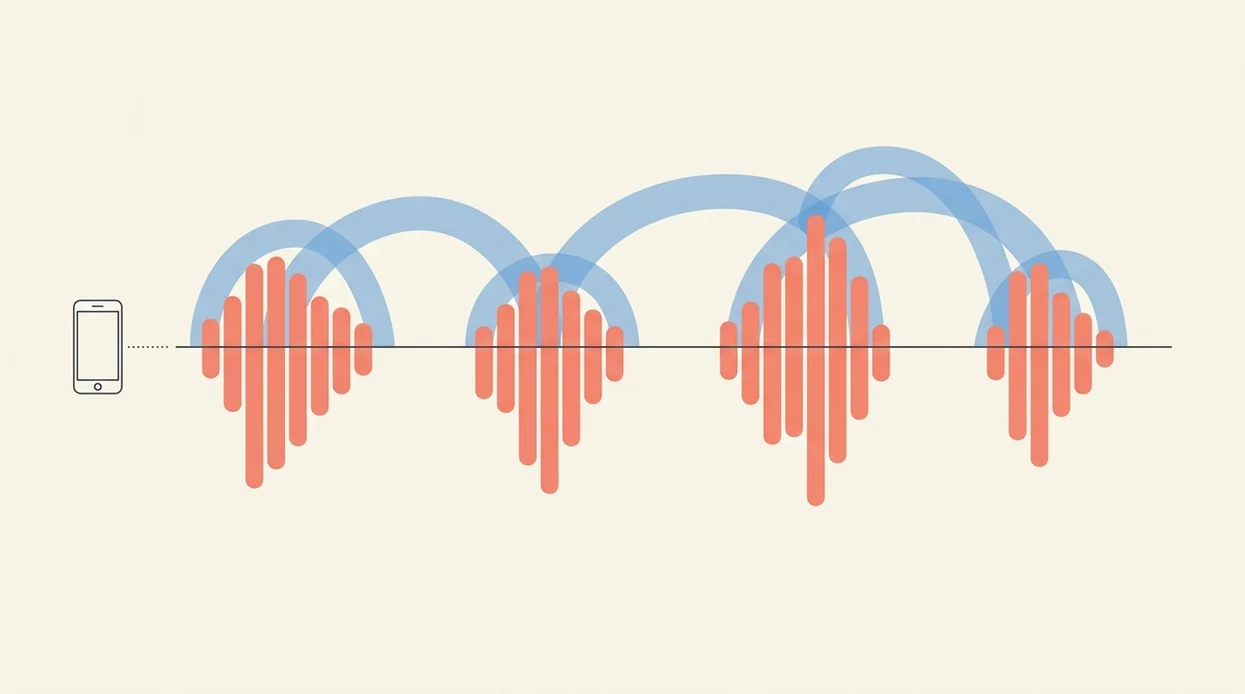
Early labor tracking usually depends more on pattern direction than on one exact interval because contractions often tighten, fade, and regroup before active labor.
How Early Labor Contraction Tracking Works
Early labor contraction tracking works by turning each tap into a timestamp, then calculating duration and frequency from those recorded points. A UNIX timestamp is just the exact digital time stored when you press start or stop.
Duration runs from start to stop. Frequency runs from one contraction start to the next contraction start. Rolling averages smooth the log, which helps when prodromal labor brings contractions strong enough to stop conversation, then nothing after lying down for 40 minutes.
Alert algorithms compare recent averages with rules like 5-1-1, but they only evaluate entered data. Apps cannot distinguish Braxton Hicks, prodromal labor, or true labor. In the U.S., 98.4% of births occur in hospitals, per CDC birth data, where contraction assessment is routine CDC National Vital Statistics Report.
The most useful contraction timer app gives organized timing data, not a diagnosis.
6 Steps to Use a Contraction Timer App in Early Labor
Use a contraction timer app when a repeatable tightening pattern starts, then step away from the screen between clear waves. The goal is to notice the rhythm, save your energy, and communicate clearly if you need to call.
- Open the app and tap start when the tightening begins.
- Tap stop when the contraction fully releases.
- Rest between contractions and don't time every twinge; log only clear contractions.
- Review the rolling average after 4 to 6 contractions, not after only one.
- Share the session log with your partner, doula, midwife, or provider if needed.
- Call your care team if patterns meet your provider's threshold or if symptoms concern you.
For a full timing walkthrough, use the how to time contractions guide before labor starts. A warm shower on the lower back can help you stop staring at numbers for a while.
When to Call Your Care Team During Early Labor
Call your care team whenever their instructions say to call, even if an app alert or common timing rule says to wait. Your provider’s plan is the one that fits your pregnancy, your history, and your birth setting.
Before contractions get hard to talk through, save the office, after-hours, triage, or midwife number in your phone and share it with your support person. A timing log can help you describe duration, frequency, and whether the pattern is changing, but it cannot diagnose your labor stage.
- Call immediately for heavy bleeding, severe or constant abdominal pain, fever, fainting, chest pain, trouble breathing, or a sudden severe headache.
- Seek guidance right away if your water breaks, fluid is green or foul-smelling, contractions feel unusually intense, or you feel something is not right.
- Report reduced fetal movement promptly, especially if the baby’s usual pattern has changed.
- Use lower thresholds if you have a high-risk pregnancy, are planning a VBAC, are preterm, or have provider-specific monitoring instructions.
- Read the log aloud when you call: average spacing, average length, how long the pattern has continued, and any symptoms.
Limitations of Contraction Timer Apps for Early Labor
Contraction timer apps are useful organization tools, but they are not medical decision-makers. Clinicians typically suggest using timing patterns alongside symptoms, pregnancy history, fetal movement, and direct care-team guidance.
- They cannot differentiate Braxton Hicks, prodromal labor, or true active labor.
- Hospital-alert algorithms use generalized rules that may not apply to high-risk pregnancies, VBACs, or provider-specific plans.
- User error skews averages, especially if you forget to tap, tap late, or time only some contractions.
- Most apps have not been rigorously validated in clinical trials.
- Over-focusing on the screen can increase anxiety and pull attention away from body cues.
- Data privacy varies widely, especially in apps with accounts, syncing, or partner sharing.
- About 32.1% of U.S. births are cesarean, per CDC data, which underscores that labor decisions need medical judgment beyond any app source.
Use the log as a communication aid. Not the final word.
8 Early Labor Contraction Timer App FAQs
Does an early labor contraction tracker replace medical advice? No. It records timing patterns so you can explain what is happening more clearly.
Do contraction timer apps really work?
Contraction timer apps work for recording start times, stop times, duration, and frequency. They cannot diagnose labor stage or determine whether birth is near.
What is the best free contraction timer app?
Full Term is a strong free option because it has simple timing and no ads. Free tiers from ContractionTimer.io contraction timer app and other shortlisted apps may also work depending on needed features.
When should I start timing contractions?
Start timing when you notice a repeatable tightening pattern, even if the contractions are still far apart. Stop if the sensations fade and restart later if a clearer rhythm returns.
Can a contraction timer app tell real labor from false labor?
No contraction timer app can tell real labor from false labor. It can only log the contractions you enter and show pattern changes.
What is the 5-1-1 rule for contractions?
The 5-1-1 rule means contractions are about 5 minutes apart, last about 1 minute, and continue for 1 hour. Some providers use different thresholds.
Do contraction timer apps work offline?
ContractionTimer.io, Full Term, and many basic timers can log contractions without Wi-Fi or mobile data. Syncing and sharing may require an internet connection.
Can my partner use the contraction timer app too?
Yes, several apps support partner sharing, session export, or dual-device syncing. This is helpful when the laboring person wants to keep eyes closed and focus on breathing.
Are contraction timer apps medically validated?
Most contraction timer apps are not medically validated through clinical trials. They should be used as organizational tools, not diagnostic devices.
What to Record Alongside Contraction Times in Early Labor
Timing shows how long contractions last and how far apart they begin, but a few brief notes can make the history more useful when speaking with your care team. Keep entries simple so tracking does not become stressful. For example, add “walking,” “resting,” or “water broke at 8:15 p.m.” rather than writing a detailed journal during every contraction.
- Intensity: Use a consistent label such as mild, moderate, or strong. Intensity is subjective, so compare contractions with your own earlier entries rather than someone else’s labor.
- Activity or position: Note whether you were resting, walking, showering, or changing position when the pattern shifted.
- Fluid or bleeding: Record the time, color, odor, and approximate amount of any fluid release or bleeding, then follow your care team’s instructions.
- Other symptoms: Note persistent pain between contractions, fever, dizziness, reduced fetal movement, or pressure. Contact your maternity unit or clinician promptly if you are concerned; do not wait for an app alert.
Timing patterns in early labor
Contraction Timer IO can help record duration and frequency, but early labor may remain mild and irregular for hours or days.
Established labor commonly brings stronger, regular contractions lasting 40-60 seconds and occurring every 3-5 minutes.
Timing is not a diagnosis: follow your care team’s advice and contact maternity care for bleeding, waters breaking, reduced fetal movement, labor before 37 weeks, or patterns flagged by NHS labor guidance.
| Pattern | Sourced benchmark |
|---|---|
| Established labor | 40-60 sec; every 3-5 min |
| Urgent advice | Any contraction over 2 min |
| Urgent advice | 6+ contractions in 10 min |