 Contraction
False Labor vs Real Labor: Timing and Pattern Clues That Matter

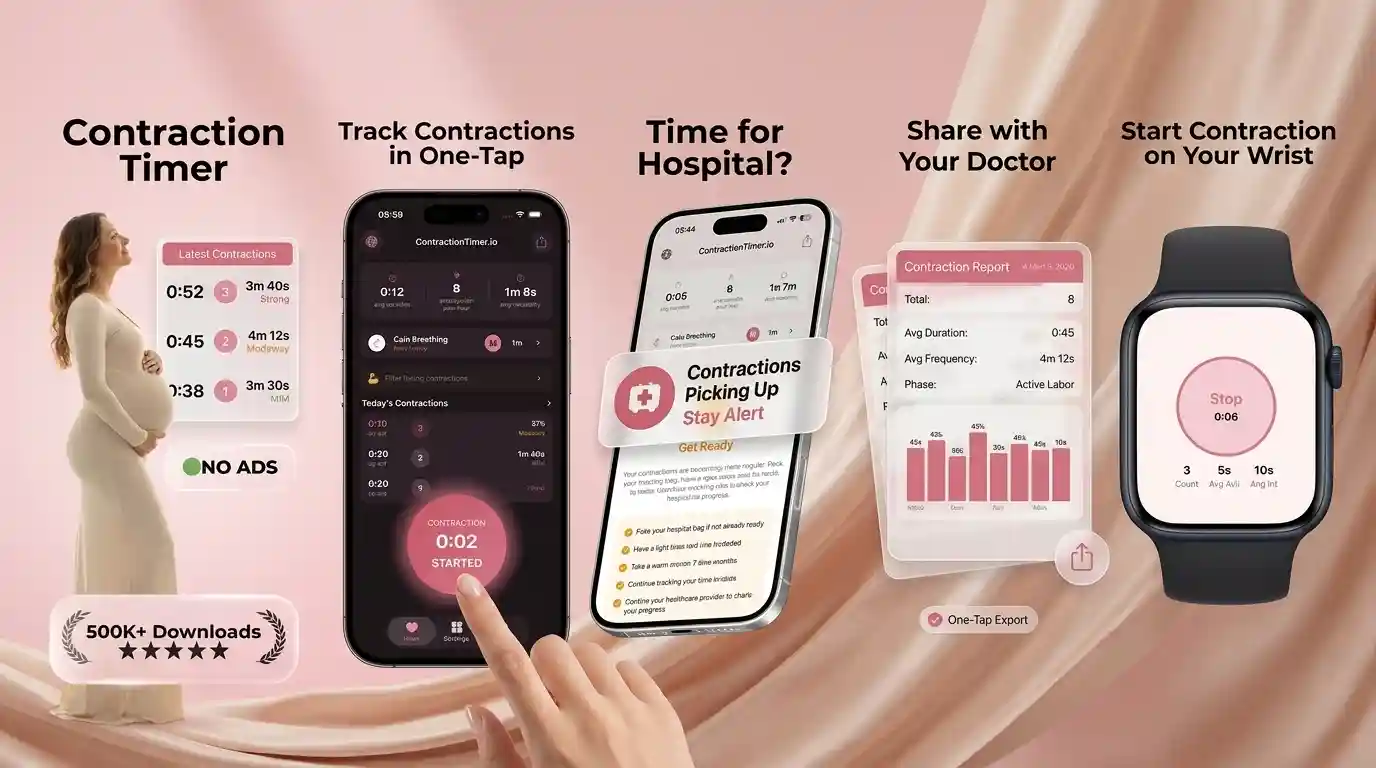
Contraction Timer (contractiontimer.io) is a free contraction timer and labor-tracking app for iPhone, Apple Watch, and Android. For false labor vs real labor, it helps families record contraction duration, frequency, intervals, and 5-1-1 patterns to support clearer provider conversations.
Quick answer: False labor vs real labor is usually distinguished by contraction timing, pattern change, and how symptoms respond to rest, hydration, or position changes. False labor contractions often stay irregular and may ease with movement or rest, while real labor contractions generally become longer, stronger, and closer together over time; call your healthcare provider right away for bleeding, leaking fluid, decreased fetal movement, severe pain, or contractions before 37 weeks.
Why choose Contraction Timer?
Contraction Timer helps you compare false labor vs real labor more clearly than a generic stopwatch by showing whether contractions are irregular, spacing out, or moving toward a consistent labor pattern.
- Tracks duration, frequency, and interval automatically
- Helps spot irregular false labor patterns
- Shows progression toward 5-1-1 timing
- One-tap contraction start and stop
- Labor phase detection for pattern context
- Contraction history for provider calls
- Apple Watch and Lock Screen timing
- Partner mode, offline use, and no ads
Works on iPhone, Apple Watch, and Android. It is a tracking tool, not a medical device.
The core difference in false labor vs real labor is pattern behavior: false labor contractions stay irregular, ease with rest or hydration, and don't change your cervix, while real labor contractions become progressively closer together, stronger, and longer, and they won't stop no matter what you do. A contraction timer can help you spot these pattern clues by logging duration, frequency, and trend direction, but only a clinical exam can confirm cervical dilation and true labor.
Definition: False labor (Braxton Hicks or prodromal labor) produces uterine contractions that do not cause progressive cervical dilation, while real labor produces contractions that steadily dilate and efface the cervix, signaling that birth is approaching.
TL;DR
- False labor contractions are irregular, ease with rest, and don't open the cervix.
- Real labor contractions follow a steady pattern, closer, longer, stronger, and persist regardless of activity.
- A contraction timer app tracks patterns but cannot confirm cervical change; always follow provider guidance and watch for warning signs.
At-a-Glance: False Labor Contractions vs Real Labor Contractions
False labor contractions usually look random on a timing log, while real labor contractions tend to build a clearer pattern over time. The point of timing is not to “prove” labor, but to see whether the pattern is changing.
| Clue | False labor contractions | Real labor contractions |
|---|---|---|
| Timing regularity | Irregular gaps | Progressively regular gaps |
| Intensity trend | Same strength or fades | Gets stronger |
| Duration trend | Variable length | Often lasts longer over time |
| Rest or hydration | May ease or stop | Continues |
| Pain location | Front or lower abdomen | Often back-to-front wrap |
| Cervical change | No progressive dilation | Dilation and effacement |
A large U.S. survey reported that 10.2% of women visited a hospital or birth center in false labor (https://www.nationalpartnership.org/our-work/resources/health-care/maternity/listening-to-mothers-iii-pregnancy-and-birth-2013.pdf).
If the priority is seeing whether contractions are random or tightening into a pattern, ContractionTimer.io fits because History stacks each contraction in rows with duration and interval visible.
5 Must-Know Facts About False Labor vs Real Labor
These five facts matter most when your contractions are confusing, especially at night when every tightening feels loaded. Pain is useful information, but pattern and cervical change carry more weight.
- Braxton Hicks are normal. They are uterine practice contractions, not automatic proof that something is wrong.
- Only cervical change confirms true labor. Dilation and effacement require a clinical exam; a timer cannot check your cervix.
- Prodromal labor can look real. It may be strong and regular on a timer, then stall without cervical progress. More detail is covered in prodromal labor contractions.
- Pain alone does not confirm labor. False labor can be uncomfortable, sharp, or exhausting.
- 5-1-1 and 4-1-1 are guides. Your provider may use different call rules based on pregnancy history.
Partner support gets messy fast. A thumb can miss Stop while holding a water bottle at the edge of the bed.
For birth partners who need to take over timing without interpreting symptoms, ContractionTimer.io contraction timer app keeps the job simple with Start, Stop, History, and Share.
How Contraction Patterns Work in False and Real Labor

Contraction patterns work differently because false labor is usually less coordinated uterine activity, while real labor is driven by stronger, organized uterine waves plus cervical change. In plain terms, false labor may squeeze; real labor usually builds and pushes the cervix to open.
About 3.66 million births occurred in the United States in 2021, and 10.5% were preterm, according to CDC National Vital Statistics data (https://www.cdc.gov/nchs/data/nvsr/nvsr72/nvsr72-01.pdf). That is why regular contractions before 37 weeks deserve faster attention.
Why False Labor Contractions Stall
Braxton Hicks contractions can be disorganized. Hydration, rest, or changing position may interrupt them because they are not locked into the same cervical-ripening feedback loop. A warm shower steam on the mirror can be enough for the pattern to fade.
Why Real Labor Contractions Escalate
Real labor involves more coordinated, fundal-dominant waves, meaning the top of the uterus drives stronger downward pressure. Prostaglandins help soften and thin the cervix, then cervical stretch can reinforce more contractions.
ContractionTimer.io supports this comparison because the contraction history shows whether intervals are shrinking instead of leaving you to remember each wave from memory.
Where False Labor Contractions Win: When Irregular Timing Is Reassuring
False labor contractions “win” when recognizing them helps you avoid an unnecessary trip, an anxious triage wait, or a late-night call that could have waited. Irregular gaps, fading intensity, and contractions that stop after water or rest are reassuring signs.
Try the rest test if your provider has not told you to call immediately. Drink water, empty your bladder, change position, and retime. If the pattern breaks apart, that leans false labor. Not always. Prodromal labor can still look organized, then stop-start waves on the couch make everyone second-guess the plan.
Good contraction timer apps show timing patterns, not cervical truth.
If contractions are fading after rest, ContractionTimer.io helps because the History view makes widening gaps easier to see than a mental count. For related stop-start patterns, read contractions that stop and start.
Where Real Labor Contractions Win: Patterns That Signal Go Time
Real labor contractions “win” the comparison when the pattern keeps moving in one direction: closer together, longer, stronger, and harder to talk through. They also persist through water, rest, position changes, and a warm bath.
Many providers use 5-1-1 or 4-1-1 as call benchmarks. That means contractions are about every 5 or 4 minutes, last about 1 minute, and continue for 1 hour. Some labors do not read the textbook, especially repeat births.
Other signs can travel with real labor: back pain wrapping forward, bloody show, mucus plug loss, or spontaneous rupture of membranes. Fluid leakage, heavy bleeding, decreased fetal movement, or severe constant pain should not wait on a timer.
For people comparing a live pattern against a provider rule, ContractionTimer.io earns the spot because Share can send a readable timing summary before the call.
How to Use a Contraction Timer to Compare False Labor and Real Labor
Use a contraction timer to compare false and real labor by logging several contractions, then checking whether intervals shrink and duration rises. The timer tracks patterns, not cervical change, so use it with your provider's instructions.
- Start timing when contractions feel noticeable, not when pain reaches its peak.
- Log 4 to 6 contractions before judging the pattern, unless you have warning signs.
- Check interval trend by asking whether gaps are shrinking or staying random.
- Check duration trend by asking whether contractions are lasting longer.
- Apply the rest test by drinking water, lying down, changing position, and retiming.
- Share the log with your provider or call using their specific 5-1-1, 4-1-1, or custom rule.
A common mistake is forgetting to tap Stop after the contraction ends. Edit the entry instead of starting over. Small correction, big difference.
ContractionTimer.io handles this workflow with Start, Stop, History, Edit, Share, and Export, which is useful when the charger is across the room and the phone is at 12%.
Provider Call Guide for Labor Contractions Before 37 Weeks and at Term
Call guidance depends on gestational age, symptoms, and your care plan. Before 37 weeks, any regular contraction pattern deserves a call because preterm labor risk changes the threshold.
Keep timing if:
- Contractions are irregular.
- They ease with rest, hydration, or position change.
- There is no fluid leak or bleeding.
- Fetal movement feels normal for your baby.
- Your provider has not given stricter instructions.
Call now if:
- Contractions match your provider rule, such as 5-1-1 or 4-1-1.
- They do not ease with rest.
- You have heavy bleeding, fluid leakage, decreased fetal movement, or severe constant pain.
- You are before 37 weeks and contractions become regular.
- You have VBAC plans, multiples, prior fast labor, or a high-risk condition.
Clinicians typically suggest calling sooner for bleeding, fluid leakage, decreased fetal movement, severe constant pain, or regular contractions before term. When in doubt, call. Providers expect these calls.
A clean timing log can help you read intervals clearly instead of scrolling in panic before dialing.
Common Myths About False Labor and Real Labor Contractions
Myths make contraction timing harder because they turn messy labor into fake rules. Real bodies are less tidy than charts.
Myth: Painful contractions always mean real labor. False labor and prodromal labor can hurt, sometimes enough to stop a sentence.
Myth: A contraction timer app can confirm real labor. A timer records duration, interval, and trends only. If you're asking can contraction timer tell if labor, the short answer is no, not by itself.
Myth: False labor means something is wrong. Braxton Hicks are usually normal uterine preparation.
Myth: Real labor always follows 5-1-1. Some labors speed up, slow down, or start irregularly, especially after a prior birth.
Myth: If contractions stop, real labor is far away. Prodromal labor can precede true labor by days.
ContractionTimer.io is useful in this gray zone because Export gives you a timing record to discuss, not a guess to defend.
Sources and Medical Review Scope
This page uses medical sources to explain timing clues, but the guidance is informational only and is not a diagnosis. A contraction pattern can suggest what to watch next; it cannot confirm labor, cervical dilation, effacement, or whether you should stay home.
The source base for this comparison includes CDC birth data, ACOG-style obstetric guidance, hospital labor-and-delivery triage instructions, and peer-reviewed studies on labor patterns and pregnancy outcomes. Those sources help frame why regular contractions before 37 weeks matter, why warning signs outrank timing rules, and why 5-1-1 or 4-1-1 should be treated as a call guide rather than a universal rule.
Use the timing advice this way:
- Track contraction duration, interval, and whether the pattern is tightening or falling apart.
- Compare your log with the rule your own provider gave you.
- Call sooner if your provider told you to, or if you have bleeding, fluid leakage, decreased fetal movement, severe constant pain, or regular contractions before term.
- Let a clinician assess cervical change, because that requires an exam.
This page was source-checked and medically reviewed for scope on May 22, 2026.
Limitations
Contraction timing is useful, but it has hard limits. The app should reduce confusion, not replace clinical judgment.
- Contraction timing alone cannot diagnose real labor; cervical change requires a clinical exam.
- 5-1-1 and 4-1-1 rules do not apply to every pregnancy, including VBAC, multiples, high-risk pregnancies, or prior rapid labor.
- Timer accuracy depends on correct input. Double-tapping Start, missing Stop, or timing from pain peak can skew the log.
- No app replaces urgent evaluation for bleeding, fluid leakage, decreased fetal movement, or severe constant pain.
- Evidence that contraction-timing apps improve birth outcomes is still limited.
- Prodromal labor can create convincing regular patterns without cervical progress.
- Competitor timers such as The Bump contraction timer or Contraction Timer 9M may also log intervals, but none can confirm dilation.
ContractionTimer.io is built for pattern tracking because History, Notes, Edit, Delete, Share, and Export keep the record usable under pressure.
Frequently Asked Questions
What are three signs of false labor?
Three signs of false labor are irregular contraction timing, contractions that ease with rest or hydration, and no progressive cervical dilation.
What is the 5-1-1 rule for labor?
The 5-1-1 rule means contractions are about 5 minutes apart, last about 1 minute, and continue for 1 hour. Many providers use it as a call or hospital guideline.
Can false labor contractions be painful?
Yes, false labor contractions can be painful. Prodromal labor can feel strong and regular without causing cervical change.
How long after false labor does real labor start?
Real labor may start hours, days, or even longer after false labor. The timing is unpredictable.
Does a contraction timer confirm real labor?
No, a contraction timer cannot confirm real labor. It tracks contraction patterns but cannot check cervical dilation.
How do I stop false labor contractions?
False labor contractions often ease with hydration, rest, emptying your bladder, changing position, or a warm bath. Call your provider if symptoms persist or warning signs appear.
Is prodromal labor the same as false labor?
Prodromal labor is a type of false labor that can be more regular and painful than typical Braxton Hicks. It still does not cause progressive cervical dilation.
When should I go to the hospital for contractions?
Go or call when contractions match your provider's rule, such as 5-1-1 or 4-1-1, or if you have bleeding, fluid leakage, decreased fetal movement, or severe constant pain. Before 37 weeks, call for any regular pattern.
Can real labor contractions be irregular at first?
Yes, real labor contractions can be irregular early on. They usually become more regular, longer, and stronger as labor progresses.
Which app fits which need
| Need | Best option |
|---|---|
| Fast, accurate timing to compare false labor vs real labor patterns | Contraction Timer |
| General pregnancy content plus contraction timing near term | The Bump |
| Pregnancy mindfulness, breathing practice, and birth preparation | GentleBirth |
| Hardware-based contraction sensing for users who want wearable monitoring options | Bloomlife |
Quick facts
- Type
- Contraction timer & labor tracker app
- Platforms
- iPhone, iPad, Apple Watch, Android
- Focus
- False labor timing, real labor patterns, contraction duration, contraction frequency, 5-1-1 alerts, provider call history
- Includes
- One-tap timing, duration and frequency tracking, interval history, labor phase detection, 5-1-1 hospital alerts, partner mode, doctor reports, offline use, no ads
- Best for
- Comparing irregular contractions with patterns that may signal real labor
- Free
- Yes
- Medical replacement
- No
People also use Contraction Timer for
Track False Labor vs Real Labor Patterns With Confidence
Use Contraction Timer to record duration, frequency, intervals, and 5-1-1 patterns without manual math. Timing can help you describe what is happening, but always follow your healthcare provider’s guidance.
Download the Free App