 Contraction
Early Labor Contraction Patterns: What They Look Like And How To Track Them

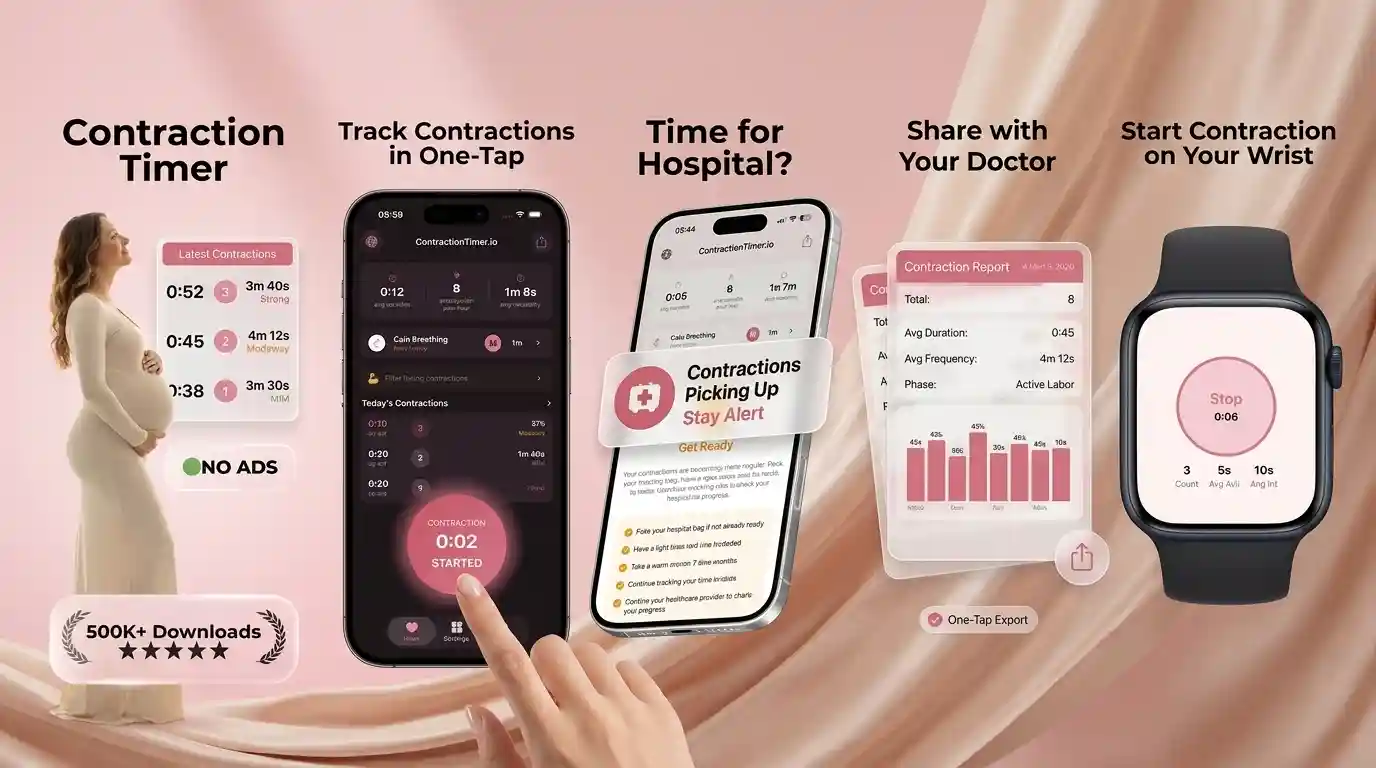
Contraction Timer (contractiontimer.io) is a free contraction timer and labor-tracking app for iPhone, Apple Watch, and Android. For early labor contraction patterns, it helps parents log irregular contractions over time and see whether duration, frequency, and intervals are becoming more consistent.
Quick answer: Early labor contraction patterns are often irregular at first, with contractions that may vary in length, spacing, and intensity before gradually becoming longer, stronger, and closer together. Tracking early labor contraction patterns over time helps reveal whether the pattern is changing toward active labor, but timing alone cannot confirm dilation or when you should go to the hospital.
Why choose Contraction Timer?
Contraction Timer is built for early labor patterns, so it records each contraction and shows timing trends more clearly than a generic stopwatch or notes app.
- One-tap contraction start and stop
- Automatic duration, frequency, and interval calculations
- Long contraction history to spot early labor changes
- 5-1-1 hospital alerts when patterns become consistent
- Labor phase detection for pattern context
- Apple Watch and Lock Screen timing support
- Partner mode for shared tracking
- Offline use with no ads
Works on iPhone, Apple Watch, and Android. It is a tracking tool, not a medical device.
Early labor contraction patterns are typically irregular, with contractions lasting 30–45 seconds and spaced 10–20 minutes apart, gradually becoming closer, longer, and stronger over hours. This stop-start rhythm is normal and can persist for six or more hours before active labor begins. A contraction timer helps you spot the trend toward regularity rather than expecting a perfectly even pattern from the start.
> Definition: Early labor contraction patterns describe the timing, duration, and intensity rhythm of uterine contractions during the latent phase of the first stage of labor, before active dilation begins around 5–6 cm.
- Irregular timing in early labor is normal. Contractions can speed up, slow down, or pause entirely.
- Track trends, closer, longer, stronger, over hours instead of expecting a clock-like pattern.
- Call your provider when contractions reach the 4-1-1 or 5-1-1 rule, or immediately for red-flag symptoms like bleeding or reduced fetal movement.
This guide is educational and cannot tell whether your cervix is dilating or whether you should stay home. Follow your clinician’s instructions first, especially if you are preterm, high-risk, or have been given individualized triage rules.
What Early Labor Contraction Patterns Actually Look Like
Early labor contraction patterns usually look uneven at first: 30–45 seconds long, often 10–20 minutes apart, and mild to moderate in strength. They may feel like period cramps, a low back ache, or a tightening across the belly that builds and then fades.
A normal early log might show 18 minutes, then 11 minutes, then 22 minutes, then two contractions close together. That can feel confusing when you’re staring at a notebook page with scribbled intervals, but it is still a common early labor rhythm.
The World Health Organization notes that the latent phase can last more than six hours without being abnormal, and contractions may be irregular during that time source. For a broader stage-by-stage view, compare this with labor contraction patterns.
Five Must-Know Facts About Early Labor Timing
- Irregular timing is normal in early labor. Uneven spacing does not automatically mean something is wrong, especially when contractions are still mild or moderate.
- True early labor usually trends forward. Braxton Hicks contractions often stay erratic, while early labor contractions tend to become closer, longer, and stronger over time.
- Active labor may begin later than older rules suggested. Updated labor curves show many people do not enter active labor until about 5–6 cm dilation, according to ACOG guidance source.
- First labors vary widely. Among first-time parents, the median first stage of labor has been reported around 7–8 hours, but real timelines can be shorter or much longer. In the Consortium on Safe Labor analysis, median first-stage duration for nulliparous patients admitted at 4 cm was 7.7 hours source.
- Most U.S. births involve labor contractions. Per the CDC, 68.7% of U.S. births in 2022 were vaginal deliveries, so many people experience early contractions before active labor or delivery decisions. source
How Early Labor Contraction Patterns Work Physiologically
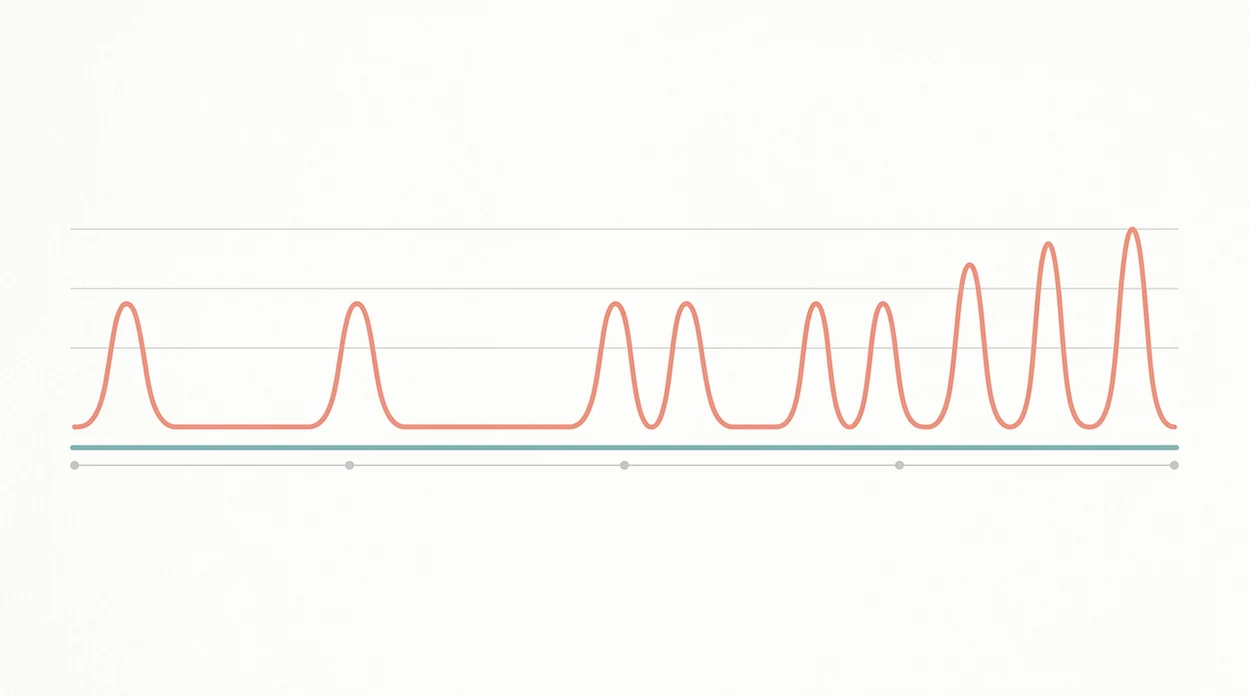
Early labor contractions work by gradually coordinating the uterine muscle while the cervix softens, thins, and begins to open. The technical term is effacement, which means the cervix is shortening and thinning before faster dilation starts.
The body does not always coordinate this process neatly. Baby’s position, pelvic alignment, hydration, rest, and oxytocin signaling can all affect the rhythm. Oxytocin works through a feedback loop: contractions create pressure, pressure supports more oxytocin release, and that can make contractions stronger and more regular.
Sometimes the pattern is odd. Two tightenings may come close together, then nothing happens for 20 minutes. A low moan into a pillow can be the whole plan for that round.
Updated labor curves support what many logs show in real life: slower progress below 5–6 cm can be physiologically normal. The trend matters more than one strange interval.
What You Need Before Tracking Early Labor Contractions
Before early labor starts, set up the boring parts. Install a contraction timer app, test Start and Stop, check History, and make sure your partner knows where Share or Export lives.
Keep your provider’s preferred timing rule written down. Some teams use 4-1-1, meaning contractions 4 minutes apart, lasting 1 minute, for 1 hour. Others use 5-1-1. If you have a planned birth location, ask which rule they want you to follow before contractions begin.
Charge the phone. Really.
At 12% battery, with Face ID failing in a dark room and the charger across the room, timing gets annoying fast. Tools like ContractionTimer.io, GentleBirth, and The Bump can help, but the setup matters more than the logo.
How To Track Early Labor Contraction Patterns Step By Step
Use early labor timing to record what happened, not to force the pattern to behave. Good contraction timer apps show duration, frequency, and trend, not a medical verdict about when the baby is coming.
Start and Stop Each Contraction in the App
- Tap Start when the first tightening begins, not when the pain peaks.
- Tap Stop when the tightening fades and your body releases.
- Save the entry even if the interval looks strange.
A large Start button under a thumb helps when the room is dark and nobody wants to unlock three menus.
Log Intensity After Every Contraction
- Mark intensity as mild, moderate, or strong after each contraction ends.
- Add Notes for back pressure, nausea, water breaking, or anything your provider asked you to watch.
Review Trends Over Hours Not Minutes
- Review the log every 30–60 minutes instead of after every single contraction.
Compare Sessions for Closer-Longer-Stronger Shifts
- Compare sessions for contractions getting closer, lasting longer, and feeling stronger.
Share Your Contraction Log With Your Provider
- Share the summary with your provider or birth team when the pattern shifts. For early labor timing, a saved log is often clearer than memory because nobody recalls exact intervals well during contractions.
Early Labor Contractions vs Braxton Hicks vs Active Labor
Early labor contractions sit between practice tightening and active labor: they may be irregular, but they usually start trending toward a clearer pattern. Timing helps compare patterns, but timing alone cannot confirm cervical dilation.
| Pattern | Typical timing | Typical feel | What usually changes |
|---|---|---|---|
| --- | ---: | --- | --- |
| Braxton Hicks | Irregular, no steady pattern | Tightening, often mild | May ease with rest, hydration, or position change |
| Early labor | Often 10–20 minutes apart at first | Period-like cramps, back ache, belly tightening | Gradually closer, longer, stronger |
| Active labor | Often about 3–5 minutes apart | Strong, focused, harder to talk through | More consistent and intense |
If your log starts moving toward active labor, compare it with active labor contraction patterns. Still, dilation needs clinical assessment. A phone can show a pattern; it cannot check your cervix.
Common Mistakes When Timing Early Labor Contractions
The most common mistake is expecting early labor to act like active labor. Early contractions may cluster, fade, restart, or stretch out again after a bath, nap, or change in position.
Another mistake is timing from the pain peak instead of the first tightening. That shortens the recorded duration and makes the log less useful. Double-tapping Start can also create fake contractions in History. Delete or Edit the entry instead of leaving a messy record.
Don’t time every contraction for hours if it is wearing you out. Rest is data too, especially when contractions stay mild and far apart.
There is one bigger safety mistake: ignoring symptoms because the timer looks “not ready.” Heavy bleeding, decreased fetal movement, preterm contractions, or water breaking should override the clock. A contraction tracker records trends; it does not diagnose labor or complications.
When Early Labor Contraction Patterns Mean Call Your Provider
“When should I call my provider for early labor contractions?” Call when your contractions match your care team’s rule, or sooner if you have red-flag symptoms.
The 4-1-1 rule means contractions are about 4 minutes apart, lasting 1 minute each, for 1 hour. The 5-1-1 rule uses 5 minutes apart, 1 minute long, for 1 hour. Your provider may choose one based on distance, birth history, risk factors, or hospital policy.
Call immediately if your water breaks, bleeding is heavy, baby’s movement decreases, pain suddenly changes, or you are preterm. ACOG’s patient guidance also advises contacting a clinician for leaking fluid, bleeding, decreased fetal movement, contractions before 37 weeks, or any symptoms your care team told you to treat as urgent source. Standard rules may not fit people who have given birth before, because some move from irregular contractions to advanced labor quickly.
Before the call, export the timing record if you can. It is easier for a partner to read clear times than scroll in panic with an overnight bag zipped by the stairs.
Limitations
Contraction timing is useful, but it has hard limits. Treat it as a trend record, not a diagnosis.
- Timing patterns alone cannot confirm cervical dilation or actual labor progress.
- Some multiparous people move from irregular contractions to advanced labor very quickly.
- Pain perception is highly individual; “moderate” for one person may feel overwhelming for another.
- Apps can create a false sense of precision if you focus only on numbers.
- Research on exact normal early labor patterns is limited and based on population averages.
- Baby position and pelvic alignment can produce unusual patterns that are still normal.
- A timer cannot evaluate bleeding, fetal movement, infection signs, or whether your water has broken.
The most common medically supported way to use contraction timing is to combine frequency, duration, and intensity trends with your provider’s instructions. ContractionTimer.io contraction timer app can help organize that record, but your care team decides what the pattern means for you.
Frequently Asked Questions
Do early labor contractions have a pattern?
Early labor contractions often start irregular and gradually trend toward a pattern. The main shift to watch is closer spacing, longer duration, and stronger intensity over time.
How far apart are early labor contractions?
Early labor contractions are often about 10–20 minutes apart at first. Wide variation is normal, including pauses or clusters.
What do early labor contractions feel like?
They may feel like period cramps, lower back ache, pelvic pressure, or tightening across the abdomen. Intensity is often mild to moderate early on.
How long does early labor usually last?
The WHO notes that the latent phase can exceed six hours without being abnormal. First-time parents have a reported median first stage around 7–8 hours, with wide variation.
Can early contractions stop and restart?
Yes, early contractions can slow down, stop, and restart. A stop-start pattern does not mean labor has failed.
What are double-peak contractions in early labor?
Double-peak contractions are two tightening waves close together, sometimes called coupling. They may relate to baby position or pelvic alignment.
When should I go to the hospital for early labor contractions?
Follow your provider’s 4-1-1 or 5-1-1 rule unless you were told otherwise. Go in or call sooner for water breaking, heavy bleeding, decreased fetal movement, preterm labor, or rapid changes.
Does a contraction timer replace medical advice?
No. A timer, including ContractionTimer.io, tracks frequency, duration, and trends but cannot diagnose labor progress or complications.
Which app fits which need
| Need | Best option |
|---|---|
| fast, accurate early labor timing with automatic duration, frequency, interval, and 5-1-1 alerts | Contraction Timer |
| simple contraction counting inside a broader pregnancy content app | The Bump |
| wearable uterine activity monitoring with a dedicated sensor experience | Bloomlife |
| birth preparation, relaxation, and hypnobirthing support alongside timing | GentleBirth |
Quick facts
- Type
- Contraction timer & labor tracker app
- Platforms
- iPhone, iPad, Apple Watch, Android
- Focus
- Early labor patterns, contraction timing, duration, frequency, intervals, 5-1-1 alerts
- Includes
- One-tap timing, contraction history, labor phase detection, 5-1-1 hospital alerts, partner mode, doctor reports, offline use
- Best for
- Tracking irregular early labor contractions and seeing whether they become longer, stronger, and closer together
- Free
- Yes
- Medical replacement
- No
People also use Contraction Timer for
Track Early Labor Contraction Patterns With Confidence
Use Contraction Timer to log each contraction, see duration and frequency automatically, and watch for patterns like 5-1-1. Always follow your healthcare provider’s guidance for when to call or go in.
Download the Free App