 Contraction
Contractions Every 5 Minutes: What To Track, What To Ask, and When To Call

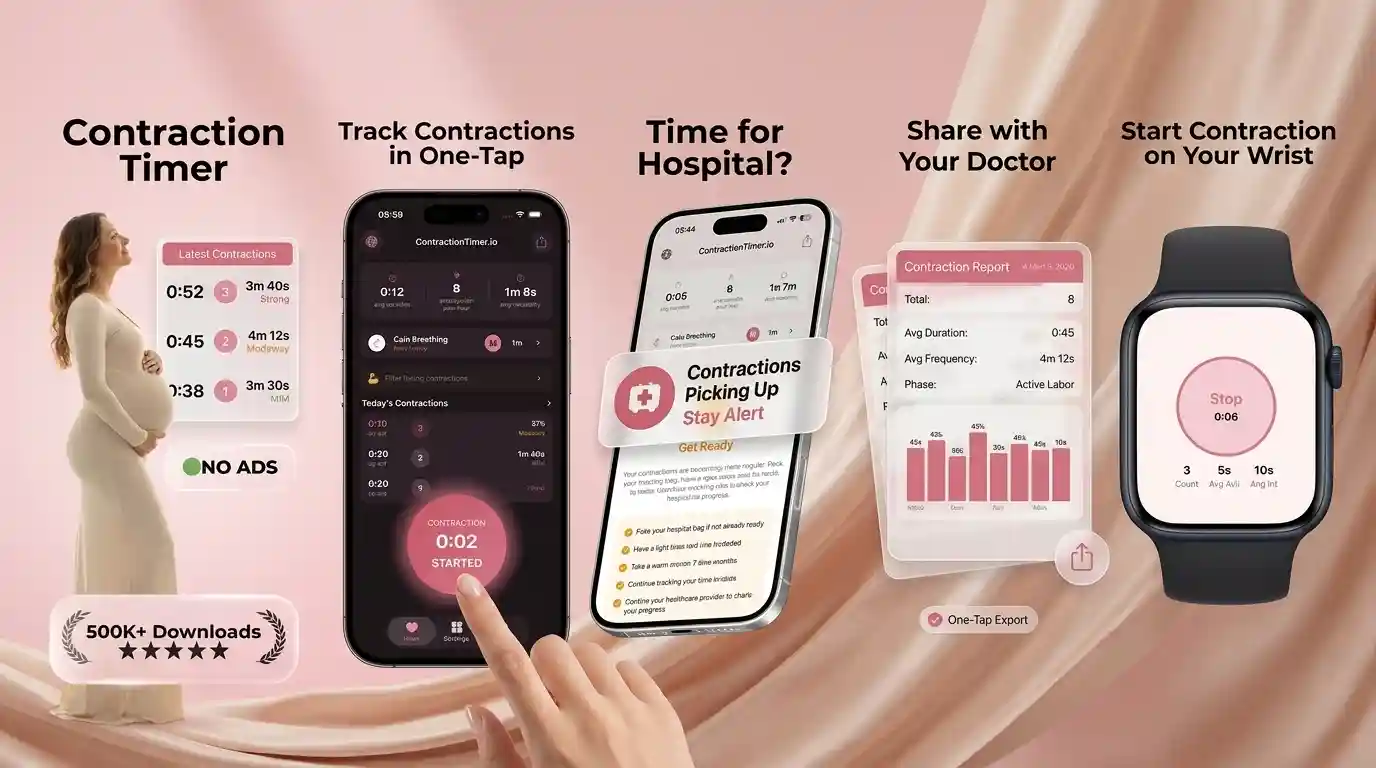
Contraction Timer (contractiontimer.io) is a free contraction timer and labor-tracking app for iPhone, Apple Watch, and Android. For contractions every 5 minutes, it helps record duration, frequency, intervals, and 5-1-1 patterns so the timing history is easier to review before calling care.
Quick answer: Contractions every 5 minutes can be a sign that labor is becoming more regular, especially if each contraction lasts about 60 seconds and the pattern continues for a full hour. Timing the start of one contraction to the start of the next helps you track frequency, duration, and whether the pattern meets your provider’s call or hospital guidance.
Why choose Contraction Timer?
Contraction Timer is built for tracking contractions every 5 minutes more clearly than a generic stopwatch because it calculates the full pattern for you.
- Automatic 5-minute frequency tracking
- Duration and interval calculations
- 5-1-1 hospital alerts
- Labor phase detection
- One-tap start and stop timing
- Contraction history for pattern review
- Apple Watch and Lock Screen support
- Doctor reports, offline use, and no ads
Works on iPhone, Apple Watch, and Android. It is a tracking tool, not a medical device.
Contractions every 5 minutes that last 45–60 seconds for at least one hour are a common signal to call your provider, but the pattern alone does not confirm active labor. A contraction timer app can log frequency and duration accurately, yet only a clinician can assess cervical change and decide next steps. Track the full picture, then share it with your care team.
Definition: Contractions every 5 minutes means the interval from the start of one contraction to the start of the next measures approximately five minutes, typically tracked alongside each contraction's duration and intensity to assess labor progress.
TL;DR
- Five-minute contractions are a triage guideline, not an automatic hospital trigger.
- Duration, intensity, and the full hour of consistency matter as much as the 5-minute interval.
- A contraction timer app tracks the numbers, your provider interprets what they mean.
- Prodromal labor can produce regular 5-minute contractions for hours or days without rapid progression.
- Warning signs like heavy bleeding, decreased fetal movement, or discolored fluid override any timing rule.
What Contractions Every 5 Minutes Actually Means
Contractions every 5 minutes means you measure about five minutes from the start of one contraction to the start of the next. That start-to-start interval is the standard way to count frequency.
This pattern is often associated with the move from early labor toward active labor, especially when contractions last 45–60 seconds and keep coming for a full hour. Still, 5 minute contractions do not prove active labor by themselves. The cervix has to change, and that cannot be seen from a timer screen.
ACOG’s labor-management guidance describes active labor as beginning around 6 cm dilation with regular, strong contractions: https://www.acog.org/clinical/clinical-guidance/clinical-practice-guideline/articles/2024/01/first-and-second-stage-labor-management. In plain terms, the clock gives useful evidence, not the diagnosis. The phone balanced on a belly pillow can show a clean five-minute rhythm, but your care team still needs the clinical picture.
For most people, the safest read is simple: five minutes apart means “call and report,” not “self-diagnose.”
Five Must-Know Facts About 5-Minute Contractions
- The 5-1-1 rule is a rough triage guide. It usually means contractions are 5 minutes apart, 1 minute long, for 1 hour. Your provider may use 4-1-1 or different instructions.
- A timer cannot tell Braxton Hicks from true labor. It can record contractions 5 minutes apart, but it cannot check cervical dilation, fetal position, or whether labor is progressing.
- Prodromal labor can look very regular. Some people have 5-minute contractions for hours, or on and off for days, without moving quickly into active labor.
- Intensity and function matter. If you cannot talk through contractions, need to stop walking, or feel a clear rise in intensity, that context belongs in the Notes field.
- Warning symptoms override timing. Heavy bleeding, decreased fetal movement, fever, severe pain between contractions, or green or brown fluid need immediate medical advice.
Numbers help. They are not the whole story. A steady log is most useful when it captures timing, symptoms, and how your body is actually responding.
How Contraction Timing Works at 5 Minutes Apart
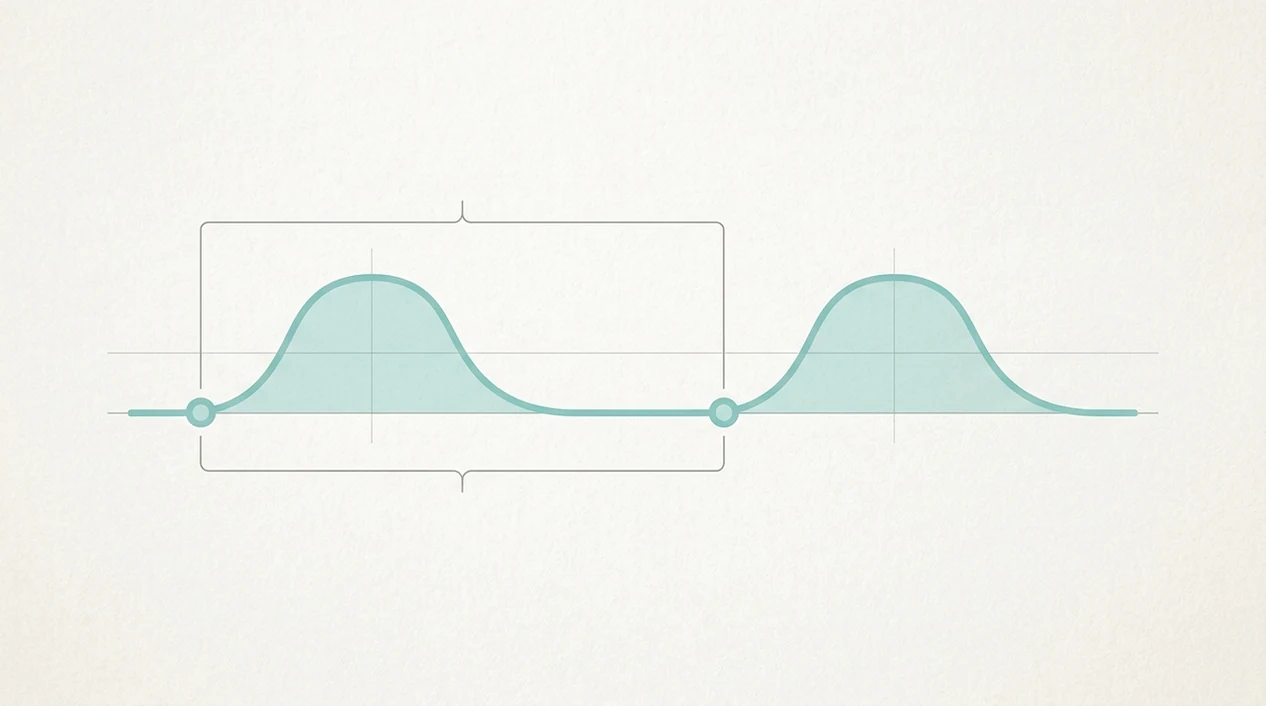
Contraction timing works by measuring two separate values: duration and frequency. Duration is how long one contraction lasts. Frequency is the start-to-start interval between contractions, not the time from the end of one contraction to the start of the next.
A contraction timer app records tap events. You tap Start when tightening begins, tap Stop when it fully releases, and the app calculates duration, frequency, and trend from those timestamps. Apps such as ContractionTimer.io, The Bump, and 9M focus on logging those numbers, not judging labor status.
Good contraction timer apps deliver clear timing records, not a clinical prediction of when the baby will arrive.
User error still matters. Late taps, missed contractions, double-tapping Start, or timing from the pain peak can skew the pattern. One 5-minute gap is also not enough. The full hour matters because labor patterns can tighten, loosen, or pause.
CDC final birth data reported that 98.4% of U.S. singleton births in 2020 were attended by a physician or certified nurse-midwife, so clinical assessment remains central: https://www.cdc.gov/nchs/data/nvsr/nvsr70/nvsr70-17.pdf.
Before You Start Timing 5-Minute Contractions
Before you start timing, make the setup calm enough that the log will be useful. A few small choices can prevent missed taps, battery panic, and confusion when it is time to call.
- Confirm your provider’s rule before relying on 5-1-1, especially if your office gave custom instructions for your pregnancy, distance from the birth place, or previous labor history.
- Charge your phone or hand it over to a birth partner so someone can keep the timer running while you breathe, move, sip water, or rest between contractions.
- Settle into a position where you can feel both the first tightening and the full release, whether that is side-lying, standing at the counter, leaning over a ball, or sitting upright.
- Know the symptoms that skip the timer, including heavy bleeding, decreased fetal movement, fever, severe pain between contractions, or green or brown fluid.
- Decide how you will share the log during the call, such as reading the average frequency and duration aloud, sending a screenshot, or using the app’s Share or Export option.
How To Track Contractions Every 5 Minutes With a Timer App
Use a timer app to create a clean record before you call, especially if your brain is loud and the room feels too busy. The goal is not perfect data. It is a readable summary your provider can use.
- Open a contraction timer and tap Start when the tightening begins, not when the pain peaks.
- Tap Stop when the contraction fully releases and your belly softens.
- Log intensity and notes such as water breaking, bleeding, fetal movement, pressure, or fever.
- Continue for at least one uninterrupted hour to see whether contractions 5 minutes apart are consistent.
- Review the session summary for frequency, duration, and whether the trend is getting closer or stronger.
- Share the log with your provider before or during your call, so nobody has to scroll in panic.
Tools like the ContractionTimer.io contraction timer app can keep the screen simple with Start, Stop, History, Notes, Share, and Export. If you want a rule-based reminder, an app that alerts 5-1-1 contractions may help.
Why Duration and the Full Hour Matter as Much as 5-Minute Frequency
Five-minute frequency matters most when each contraction also lasts about 45–60 seconds and the pattern holds for a full hour. Shorter contractions may still be early labor, prodromal labor, or a pattern that is not ready for hospital assessment.
The 5-1-1 rule and 4-1-1 rule both use a one-hour window because a single cluster can mislead you. Contractions may line up neatly for 20 minutes, then space back out after rest, hydration, a warm bath, or a position change. Stop-start waves on the couch are frustrating, but they happen.
Clinicians typically recommend looking at contraction strength, duration, consistency, and cervical change together. ACOG describes active labor as regular strong contractions with cervical dilation around 6 cm, not frequency alone.
The most common medically supported way to judge active labor is contraction timing combined with clinical assessment of cervical change.
When Contractions 5 Minutes Apart Need a Provider Call
Do contractions 5 minutes apart mean you should call your provider? Yes, if they are lasting about a minute, have continued for about an hour, or match the call instructions your care team gave you.
Many offices use the 5-1-1 rule. Some use 4-1-1, meaning contractions are 4 minutes apart, 1 minute long, for 1 hour. The difference is covered in more detail in 4-1-1 vs 5-1-1 contractions, but your own instructions win.
Call earlier if you have had a previous fast labor, live far from your birth place, have a high-risk pregnancy, or were told not to wait. Also call immediately for heavy bleeding, decreased fetal movement, fever, severe pain between contractions, or green or brown amniotic fluid.
If you are unsure whether a symptom counts as urgent, call anyway. Triage staff would rather sort out a false alarm than miss bleeding, infection signs, reduced fetal movement, or abnormal fluid color.
A Cochrane review found that continuous labor support was associated with a 25% reduction in cesarean birth and fewer requests for pain medication: https://www.cochranelibrary.com/cdsr/doi/10.1002/14651858.CD003766.pub6/full. Calling early enough to organize support can matter, not just for timing but for coping.
Common Mistakes When Timing Contractions at 5-Minute Intervals
The most common timing mistakes are late taps, missed contractions, stopping too soon, and treating the numbers as more certain than they are. A clean-looking log can still be wrong if the inputs were rushed.
One partner may try to hit Stop with a thumb while holding a water bottle at the edge of the bed. That is real life, but it can add extra seconds. A cracked screen protector, Face ID failing in a dark room, or 12% battery can also interrupt timing.
Other errors are more subtle. Round ligament pain, gas pain, or constant back pain can be counted as contractions when they do not come in waves. Some people stop timing after three regular entries and miss the fact that contractions later spread to eight minutes apart.
For first-time timing, a plain check contractions 5-1-1 rule workflow can reduce mistakes. But if watching the screen makes you spiral, hand the phone over and breathe.
How To Verify Your 5-Minute Contraction Pattern Before Heading In
Before heading in, verify that the log shows at least one full hour of consistent 5-minute frequency and 45–60+ second duration. Then add context before you call.
Open History and scan the last hour. Look for a steady start-to-start rhythm, not one isolated 5-minute interval. Check whether intensity is rising, staying mild, or fading. Add notes about fetal movement, bleeding, fluid color, pressure, fever, and whether you can talk through contractions.
The midwife number taped to the fridge is useful here. Call with the summary first: average frequency, average duration, how long it has lasted, and any red flags. Follow their instructions, even if the app summary looks neat.
For birth partners, reading a shared summary is often easier than scrolling through individual timestamps because the call stays focused.
Limitations
Contraction data is useful, but it has clear limits. Treat it as a record for your provider, not a medical decision engine.
- App-recorded intervals are approximate because late taps, missed taps, and tap latency change the numbers.
- Regular 5-minute contractions do not guarantee cervical dilation or imminent birth.
- Timing alone cannot distinguish normal labor from urgent complications.
- The 5-1-1 rule is based on averages and expert triage practice, not precise predictive science.
- Prodromal labor can create convincing patterns that slow, stop, or restart later.
- Over-focusing on the app can increase anxiety and interfere with rest, breathing, hydration, and coping.
- Standard timing rules may not fit every pregnancy, birth setting, distance from hospital, or risk profile.
- A timer cannot assess fetal position, maternal blood pressure, infection signs, or cervical change.
ContractionTimer.io can help organize the timing record, but your clinician decides what the record means. If your provider gives different instructions, use those.
Frequently Asked Questions
Are you in labor at 5-minute contractions?
You may be in labor, especially if contractions are strong, regular, and lasting about a minute. Active labor still requires clinical confirmation, usually including cervical change.
What is the 5-1-1 rule for labor?
The 5-1-1 rule means contractions are 5 minutes apart, 1 minute long, for 1 hour. It is a triage shorthand, not a universal medical rule.
How long after 5-minute contractions is birth?
Birth may happen within hours, but it can also take a full day or longer. No timer app or timing rule can predict the exact delivery time.
Can contractions be 5 minutes apart and stop?
Yes. Prodromal labor can produce regular 5-minute contractions that later slow down or stop completely.
What if contractions are 5 minutes apart but mild?
Mild 5-minute contractions may be early labor or prodromal labor. Track them, note changes, and follow your provider’s call instructions.
Should I go to the hospital if my water hasn't broken?
Water breaking is not required for active labor. Follow your provider’s timing guidance and call if contractions meet their threshold.
Do second labors skip the 5-minute stage?
Second or later labors can progress faster than first labors. Many providers advise calling or coming in earlier if you have a history of fast labor.
Can a contraction timer replace a nurse assessment?
No. A contraction timer records frequency and duration, but it cannot assess cervical dilation, fetal position, or complications.
Which app fits which need
| Need | Best option |
|---|---|
| Fast, accurate timing when contractions are about 5 minutes apart | Contraction Timer |
| Pregnancy articles and broad week-by-week education alongside basic tools | The Bump |
| Mindfulness, breathing, and birth preparation support | GentleBirth |
| Clinical-style contraction monitoring hardware for selected users | Bloomlife |
Quick facts
- Type
- Contraction timer & labor tracker app
- Platforms
- iPhone, iPad, Apple Watch, Android
- Focus
- Contractions every 5 minutes, 5-1-1 alerts, duration tracking, frequency tracking, labor patterns
- Includes
- one-tap timing, duration, frequency, intervals, 5-1-1 alerts, labor phase detection, contraction history, partner mode, doctor reports, offline use
- Best for
- Parents timing contractions that may be settling into a 5-minute pattern
- Free
- Yes
- Medical replacement
- No
People also use Contraction Timer for
Track Contractions Every 5 Minutes With Less Guesswork
Use Contraction Timer to record each contraction, see duration and frequency automatically, and spot whether a 5-1-1 pattern is forming. Always call your provider or go in if they advise it or if you have urgent symptoms.
Download the Free App