 Contraction
Check Contractions 5-1-1 Rule With a Timing Log

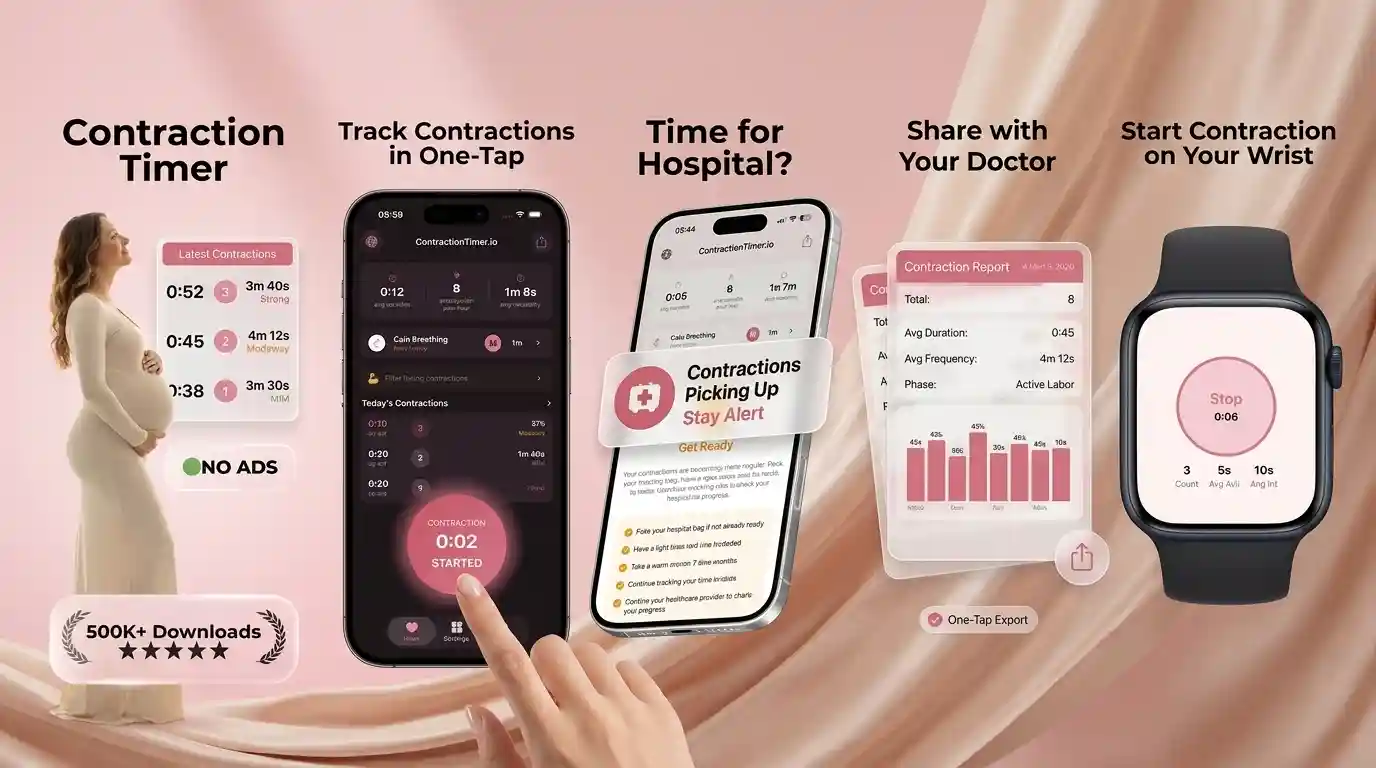
Contraction Timer (contractiontimer.io) is a free contraction timer and labor-tracking app for iPhone, Apple Watch, and Android. For this page, it helps parents check 5-1-1 contraction rule patterns with a structured timing log showing duration, frequency, intervals, and recent history.
Quick answer: The 5-1-1 contraction rule checks whether contractions are about 5 minutes apart, last about 1 minute each, and continue for 1 hour. A timing log helps you check contractions 5-1-1 rule patterns more reliably by showing duration, frequency, intervals, and recent history while you follow your provider’s instructions.
Why choose Contraction Timer?
Contraction Timer is built for checking 5-1-1 labor patterns, so it gives clearer timing data than a generic stopwatch or notes app.
- Auto-calculates contraction duration and frequency
- 5-1-1 hospital alerts based on timing patterns
- One-tap start and stop for each contraction
- One-hour contraction history for pattern review
- Labor phase detection to help organize timing trends
- Apple Watch and Lock Screen support for quick logging
- Partner mode for shared contraction tracking
- Doctor reports, offline use, no ads
Works on iPhone, Apple Watch, and Android. It is a tracking tool, not a medical device.
To check contractions 5-1-1 rule timing, log each contraction's start time and end time, then verify three conditions: contractions arrive roughly every 5 minutes measured start-to-start, each lasts about 1 minute, and this pattern holds for at least 1 hour straight. A contraction rule checker can automate these calculations so you can focus on how you feel and follow your provider's guidance.
Definition: The 5-1-1 rule is a labor-timing guideline stating that contractions spaced about 5 minutes apart, each lasting approximately 1 minute, sustained for at least 1 hour, may signal the onset of active labor in term pregnancies.
This page is an educational timing aid for term or near-term labor questions; it is not medical advice and should not override your obstetrician, midwife, triage nurse, or local emergency instructions.
TL;DR
- The 5-1-1 rule checks three things: 5-minute spacing, 1-minute duration, 1-hour consistency.
- A 5-1-1 checker calculates intervals from start-to-start times in your log, not from contraction end to next start.
- Matching 5-1-1 is a prompt to call your provider, not an automatic hospital admission or a diagnosis.
- Red-flag symptoms, including bleeding, water breaking, or reduced movement, override any timing pattern.
- The rule applies mainly to low-risk, term pregnancies; your provider may give you different thresholds.
At a Glance: What the 5-1-1 Contraction Rule Checks
The 5-1-1 rule checks whether contractions are close enough, long enough, and consistent enough to suggest active labor may be starting. All three parts need to happen together, not just once or twice in a messy log.
- 5 minutes apart: contractions begin about 5 minutes apart, measured from the start of one contraction to the start of the next.
- 1 minute long: each contraction lasts about 60 seconds from first tightening to full release.
- 1 hour sustained: the pattern keeps going for roughly 60 minutes, not just during one short cluster.
- All three matter: contractions every 5 minutes but lasting 25 seconds do not meet the full 5-1-1 pattern.
- Term guideline: 5-1-1 is mainly used for low-risk pregnancies at 37 weeks or later.
The start-to-start detail matters. A hallway lap during early labor can make timing feel blurry, so write down the start time first.
How the 5-1-1 Contraction Rule Checker Works
A 5-1-1 checker works by turning each contraction entry into interval, duration, and one-hour pattern data. It checks the rhythm across the log, instead of judging one contraction by itself.
Interval, Duration, and Window Calculations
The interval is calculated from the start timestamp of one contraction to the start timestamp of the next contraction. That is different from the resting gap between one contraction ending and the next one beginning. Duration comes from tap-on to tap-off timestamps, so a late stop tap can make a contraction look longer than it felt.
A rolling one-hour window looks across the log and asks: did the spacing stay near 5 minutes, did contractions last near 1 minute, and did both hold together? Most labor contractions do not land at exactly 5:00 or exactly 1:00. Good contraction timer apps deliver pattern math, not a diagnosis.
Tools like ContractionTimer.io can reduce the mental math when the room is dim and someone is whispering “start” and “stop” while you keep your eyes closed.
How to Check Contractions With a 5-1-1 Timing Log
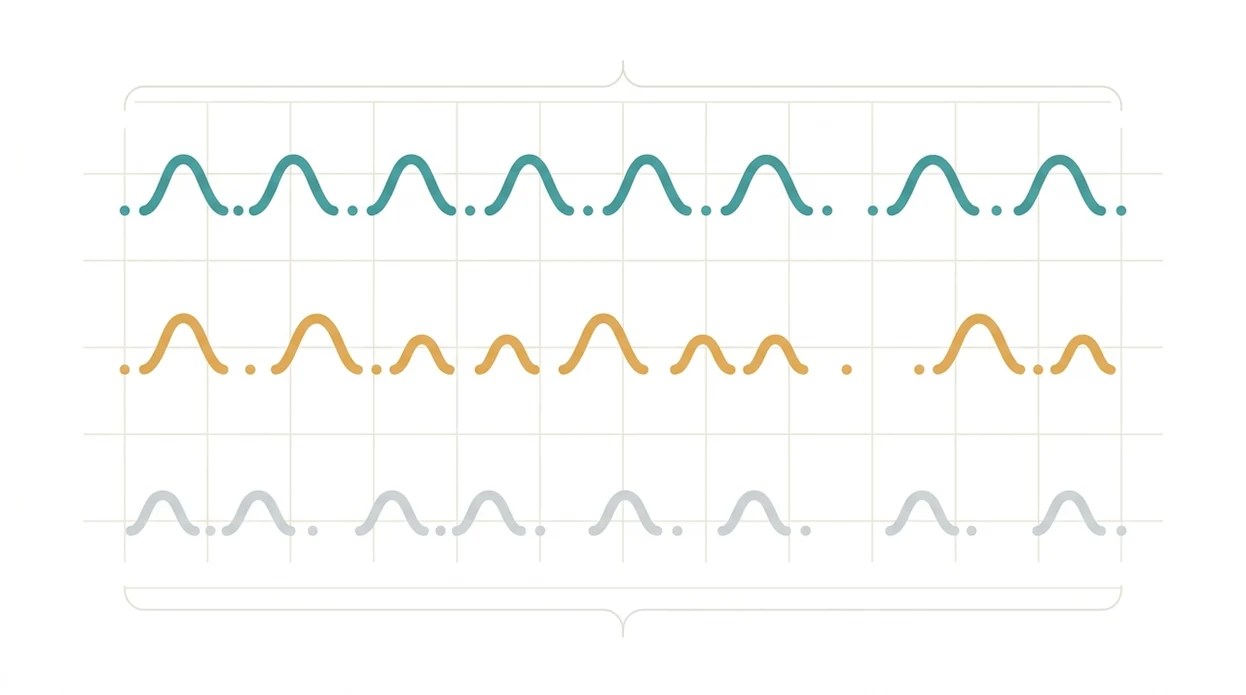
To check contractions with a 5-1-1 timing log, record every contraction the same way for at least one hour. The most common medically supported way to use the 5-1-1 rule is timing plus a provider check-in, not timing alone.
- Open Contraction Timer and tap Start when a contraction begins, ideally at the first clear tightening.
- Tap Stop when the contraction fully ends, so the log records duration.
- Repeat each time and let the app calculate start-to-start intervals.
- Review the log after one hour to see whether spacing, duration, and consistency meet 5-1-1.
- Call your provider or go to your birth location if the pattern holds and no red-flag symptom changes the plan.
If you are comparing timing rules before labor starts, the full 5-1-1 rule contractions guide gives more background. In the moment, keep it simple: sip, pee, change positions, then check the pattern again.
Contraction Log Patterns That Match and Miss 5-1-1
Different labor logs can tell very different stories. Not fitting 5-1-1 does not mean “not in labor,” and matching it does not prove cervical dilation.
Steady Build to 5-1-1 in a First Labor
A first-time parent might log contractions every 8 minutes at 1:10 a.m., then 7 minutes, then 6 minutes, then close to 5 minutes by 3:00 a.m. If each wave lasts about a minute and the pattern holds, that log matches 5-1-1.
Fast Progression That Skips 5-1-1
A second-time parent may jump from mild cramping to contractions 3 minutes apart. That person has bypassed 5-1-1 entirely and may need earlier evaluation, especially with a history of fast labor.
Irregular Braxton Hicks That Mimic 5-1-1
Braxton Hicks can cluster near 5 minutes, then fade after water, rest, or lying down. I have seen contractions strong enough to stop conversation disappear after 40 minutes.
For pattern examples beyond 5-1-1, compare broader labor contraction patterns.
Common 5-1-1 Rule Myths a Contraction Checker Can't Fix
A contraction checker can calculate timing, but it cannot correct every assumption people bring into early labor. The charger cable stretched across the sofa, the half-packed bag, the “should we go?” loop, it all makes simple rules feel bigger than they are.
| Myth | Fact |
|---|---|
| You must rush to the hospital the instant you hit 5-1-1. | 5-1-1 is usually a prompt to call your provider and follow the plan you were given. |
| Meeting 5-1-1 guarantees dilation and admission. | Cervical change can only be assessed by clinical evaluation, not a contraction log. |
| Contractions outside 5-1-1 mean you are not in true labor. | Some labors are faster, slower, shorter, longer, or more irregular than the rule. |
| An app can replace emergency evaluation. | A timer cannot assess bleeding, fetal movement, blood pressure symptoms, or infection signs. |
Clinicians typically recommend using contraction timing alongside symptoms, pregnancy history, and direct care-team instructions.
Red-Flag Symptoms That Override the 5-1-1 Rule
Red-flag symptoms override the 5-1-1 rule because safety concerns matter more than a neat timing pattern. Call your provider, triage line, or emergency service as instructed if these happen.
- Water breaks, especially if fluid is green, brown, foul-smelling, or you are unsure what you are seeing.
- Heavy vaginal bleeding occurs, beyond bloody show or light spotting you were told to expect.
- Fetal movement is significantly reduced compared with your baby’s usual pattern.
- Severe headache, vision changes, or upper abdominal pain appear, which can be warning signs of preeclampsia.
- Fever or chills happen during labor symptoms.
- Contractions begin before 37 weeks, because preterm labor needs different guidance.
Per CDC/NCHS final natality data, about 8.3% of U.S. births in 2022 were preterm, before 37 completed weeks (https://www.cdc.gov/nchs/data/nvsr/nvsr73/nvsr73-02.pdf). That is why “just wait for 5-1-1” can be the wrong advice before term.
When the 5-1-1 Contraction Rule Does Not Apply
The 5-1-1 rule does not apply cleanly to every pregnancy or every birth plan. A contraction rule checker is most useful when your provider has said timing at home is appropriate.
| Situation | Why 5-1-1 may not fit |
|---|---|
| Preterm labor before 37 weeks | Earlier assessment may be needed, even if contractions are not regular. |
| Induced labor | Progress is monitored directly, and instructions come from the care team. |
| VBAC pregnancy | Providers may want earlier evaluation because uterine scar history changes the risk picture. |
| Long drive to birth location | Waiting for a full hour at 5-1-1 may leave too little travel time. |
| Prior fast labor | Second or later labors can move quickly and skip common timing milestones. |
Per CDC/NCHS final natality data, induction occurred in roughly 31.2% of U.S. singleton births in 2021, and cesarean birth was about 32.1% of deliveries that year (https://www.cdc.gov/nchs/data/nvsr/nvsr72/nvsr72-01.pdf). Birth decisions often involve more than contraction spacing.
If your provider gave you a different threshold, that instruction wins. Reset the plan.
Medical Sources and Review Scope
This timing guidance is educational, not a diagnosis or a substitute for labor triage. It is meant to help you organize contraction data so your clinician has a clearer log.
The review scope uses broad clinical categories commonly relied on for U.S. pregnancy guidance, including ACOG-style obstetric guidance, CDC and NCHS public health data, hospital triage instructions, and standard midwifery labor education. This page was last reviewed and updated in May 2026. If your obstetrician, midwife, nurse line, or written birth plan gives a different calling threshold, that personalized instruction overrides any general 5-1-1 rule.
Evidence limits for contraction timing apps are specific and important:
- Treat app output as time math, not proof of dilation, fetal status, or active labor.
- Expect missed taps, delayed stop times, and duplicate entries to distort intervals.
- Remember that pain intensity, fluid color, bleeding, fever, and fetal movement are not measured by a timer.
- Use the log to support a provider call, especially when symptoms or pregnancy risks do not fit a low-risk term pattern.
Limitations
The 5-1-1 rule is useful, but it is narrow. It measures time, not the whole clinical picture.
- Timing only: it cannot assess cervical change, fetal status, membrane status, or complication risk.
- Input errors happen: missed taps, delayed stops, and pain during a contraction can skew the log.
- Irregular contractions distort averages: prodromal labor may look convincing, then fade after rest.
- High-risk situations need different plans: preterm labor, inductions, planned cesareans, VBACs, and some medical conditions are not standard 5-1-1 scenarios.
- Warning signs are invisible to an app: bleeding, abnormal fluid, fever, high blood pressure symptoms, and decreased movement require human evaluation.
- Over-focusing can backfire: some people wait too long with fast labor, while others spiral over variable early-labor numbers.
The car seat can already be clipped in back and the log can still be unclear. According to CDC data, 98.4% of U.S. births occurred in hospitals in 2018, where admission decisions usually include more than contraction timing.
For people comparing hospital timing guidance, 4-1-1 vs 5-1-1 contractions explains why some care teams use a tighter rule.
Frequently Asked Questions
What is the 3-1-2 rule for contractions?
The 3-1-2 rule usually means contractions are about 3 minutes apart, lasting 1 minute, for 2 hours. It is stricter than 5-1-1 and may be used by some providers or birth settings.
How is 5-1-1 different from Braxton Hicks?
5-1-1 contractions are regular, sustained, and usually build over time. Braxton Hicks are often irregular, change with rest or hydration, and do not hold a one-hour pattern.
Do 5-1-1 contractions have to be painful?
They do not have to feel equally painful for everyone. Timing can count, but your provider should interpret painless or unusual contractions in context.
Does the 5-1-1 rule change for second babies?
It often can. Second or later labors may progress faster, so providers may suggest calling before a full 5-1-1 hour.
What if contractions are 5-1-1 but water hasn't broken?
Intact membranes do not cancel a 5-1-1 pattern. Call your provider if contractions meet the rule or follow your written labor instructions.
Is there an app that checks the 5-1-1 rule?
Yes. The ContractionTimer.io contraction timer app can calculate spacing, duration, and one-hour consistency from logged contractions.
Can I check 5-1-1 at 37 weeks?
Yes, 37 weeks is considered term for using general labor-timing guidance. Call earlier if symptoms feel concerning or your provider gave stricter instructions.
Should I go to the hospital at exactly 5-1-1?
Not automatically. Use 5-1-1 as a prompt to call your provider, confirm next steps, and consider travel time and symptoms.
Which app fits which need
| Need | Best option |
|---|---|
| Fast, accurate 5-1-1 contraction timing with duration, frequency, alerts, and history | Contraction Timer |
| A simple, pregnancy-focused contraction timer with basic tracking | Full Term |
| Broad pregnancy content, community, and general milestone information | The Bump |
| Contraction tracking alongside mindfulness, breathing, or birth preparation content | GentleBirth |
Quick facts
- Type
- Contraction timer & labor tracker app
- Platforms
- iPhone, iPad, Apple Watch, Android
- Focus
- Contraction timing, 5-1-1 alerts, duration, frequency, intervals, one-hour history
- Includes
- One-tap timing, duration and frequency calculation, 5-1-1 hospital alerts, labor phase detection, contraction history, partner mode, doctor reports, offline use
- Best for
- Checking whether contraction patterns match the 5-1-1 rule before contacting or going to labor and delivery as instructed
- Free
- Yes
- Medical replacement
- No
People also use Contraction Timer for
Check Contractions Against the 5-1-1 Rule
Use Contraction Timer to log duration, frequency, intervals, and one-hour history without manual math. Follow your provider’s instructions, and use the app as a clear timing record—not a medical diagnosis.
Download the Free App