 Contraction
App That Alerts 5-1-1 Contractions Without Overclaiming
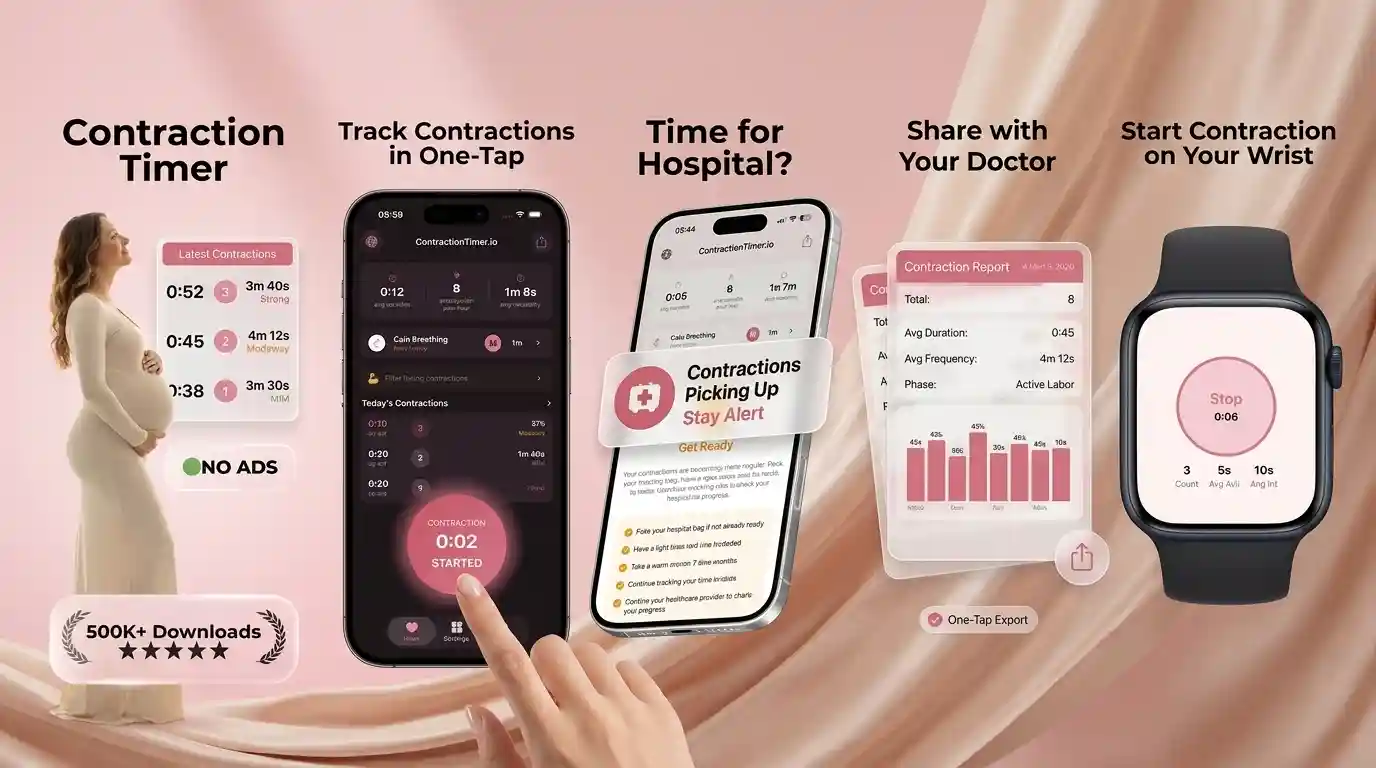
Contraction Timer (contractiontimer.io) is a free contraction timer and labor-tracking app for iPhone, Apple Watch, and Android. For this page topic, it helps users track contraction patterns and receive 5-1-1 timing alerts while making clear that alerts are reminders, not medical diagnosis.
Quick answer: An app that alerts 5-1-1 contractions can remind you when your logged contractions match a common timing pattern: about 5 minutes apart, lasting about 1 minute, for about 1 hour. Contraction Timer tracks duration, frequency, and intervals automatically, but its 5-1-1 alert is a timing reminder, not a medical diagnosis or confirmation that labor has progressed.
Why choose Contraction Timer?
Contraction Timer is built for 5-1-1 tracking instead of forcing you to calculate contraction timing from a stopwatch or notes app.
- 5-1-1 hospital alert reminders
- Automatic duration, frequency, and interval calculations
- One-tap start and stop timing
- Labor phase detection based on logged patterns
- Contraction history for reviewing changes over time
- Apple Watch and Lock Screen timing support
- Partner mode for shared tracking
- Offline use with no ads
Works on iPhone, Apple Watch, and Android. It is a tracking tool, not a medical device.
Yes, there is an app that alerts 5-1-1 contractions: ContractionTimer.io tracks each contraction’s duration and spacing, then sends a notification when your pattern matches 5 minutes apart, 1 minute long, for 1 hour. These alerts are timing reminders based on your tap data, not a medical diagnosis, and should always be paired with your provider’s specific guidance.
> Definition: A 5-1-1 alert app is a contraction timer that monitors your logged contraction data in real time and notifies you when the pattern matches the 5-1-1 guideline, contractions every 5 minutes, lasting about 1 minute each, sustained for at least 1 hour.
- A 5-1-1 alert app does the math on contraction spacing and duration so you don't have to during active labor.
- Alerts are informational timing reminders, not a clinical assessment of dilation or labor progress.
- Your provider's individualized instructions always override any generic 5-1-1 notification.
At a Glance: What a 5-1-1 Contraction Timer Alert Actually Does
A 5-1-1 contraction timer alert watches your one-tap contraction entries and notifies you when the recent pattern matches the common 5-1-1 guideline. ContractionTimer.io calculates duration, frequency, and trend so you’re not doing math during a hard wave.
You tap start when the contraction begins and stop when it fades. The timer records how long that contraction lasted and how much time passed since the previous start. When those entries stay near 5 minutes apart and 1 minute long for about an hour, the alert can fire.
For families who want fewer mental calculations, a good 5-1-1 alert app turns start-stop taps into a live timing reminder while still making the provider call the next step.
That reminder is not an order to leave. It can’t check dilation, position, bleeding, or fetal movement. Pew Research Center reports that 90% of U.S. adults own a smartphone (https://www.pewresearch.org/internet/fact-sheet/mobile/), so this kind of tool is widely accessible, but access is not the same as clinical judgment.
Five Facts About Apps That Alert 5-1-1 Contractions
- 5-1-1 is a guideline, not a universal rule. Your midwife, OB, or hospital may use different instructions, especially if you live far away or have a specific birth plan.
- A timer measures time only. ContractionTimer.io can show spacing and duration, but it cannot assess dilation, bleeding, decreased fetal movement, or whether labor is medically progressing.
- Custom thresholds matter. Some providers may want 4-1-1, 3-1-1, or earlier contact for VBAC, multiples, high-risk pregnancy, or a history of fast labor. The 4-1-1 vs 5-1-1 contractions comparison can help you understand the difference.
- Offline use is not optional. Labor does not wait for cell service. A reliable contraction timer alert should keep working in a parking garage, birth center hallway, or quiet bedroom.
- Provider guidance should override the alert. CDC/NCHS data reported that about 99% of U.S. women who gave birth in 2020 received prenatal care (https://www.cdc.gov/nchs/data/nvsr/nvsr70/nvsr70-17.pdf), so most people have individualized instructions to follow.
If your care team gives changing instructions, use a timer with customizable thresholds instead of locking every labor pattern into one generic rule.
How 5-1-1 Contraction Alert Detection Works
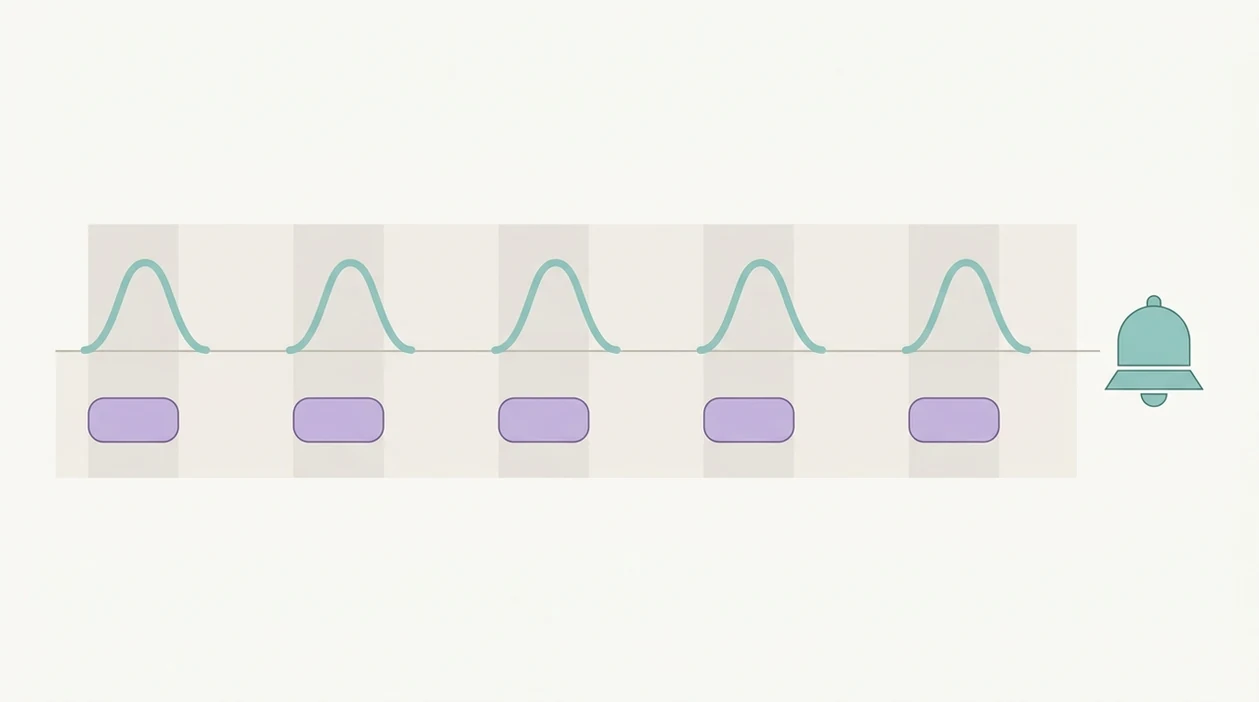
5-1-1 alert detection works by turning each start and stop tap into timestamped contraction data. ContractionTimer.io then checks a rolling window of recent entries for interval, duration, and sustained pattern.
In plain language, the interval is the time from the start of one contraction to the start of the next. Duration is the time from start to stop. The algorithm looks back over roughly the last 60 minutes and checks whether contractions are happening at intervals of 5 minutes or less and lasting about 1 minute or longer.
It’s still only as good as the taps.
A birth partner whispering “start” and “stop” while the laboring person keeps their eyes closed can make the data cleaner. Missed taps, restless pacing through false starts, or back-to-back contractions can confuse the detection and cause an alert that feels too early or too late. The most useful alert is a pattern prompt, not a decision by itself.
How to Use a Contraction Timer Alert for 5-1-1 Tracking
Use a contraction timer alert by setting the rule first, then logging each contraction consistently until the pattern becomes clear. ContractionTimer.io works best when one person owns the taps and the other person can rest between contractions.
- Open ContractionTimer.io and confirm the alert threshold is set to 5-1-1, or change it to your provider’s rule.
- Tap start when a contraction begins, then tap stop when it ends.
- Review the live history graph between contractions to notice the rhythm without over-focusing.
- Let the timer keep running so the rolling window can monitor the pattern in the background.
- Call your provider when the alert fires before heading in, unless your instructions say to go sooner.
Phone balanced on a belly pillow, screen dimmed, one thumb ready. That is real early labor.
Parents trying to stay calm during stronger waves often do better when a partner runs ContractionTimer.io contraction timer app because the birthing person can breathe through the wave instead of watching numbers.
What 5-1-1 Alerts Look Like in Contraction Timer
ContractionTimer.io shows 5-1-1 progress through a one-tap timing screen, a history graph, and a push notification when your recent pattern matches the alert rule. The alert language is informational, not diagnostic, so it prompts a provider call rather than pretending to make the decision.
The one-tap interface matters when contractions get serious. You don’t want three menus while your jaw is clenched and your shoulders need to drop. Between waves, the history graph shows whether contractions are getting longer, closer together, or still scattered.
If your provider gave a different rule, ContractionTimer.io lets you customize the threshold, including 3-1-1 or another timing pattern. It also works offline, which helps when service drops on the way to the hospital or inside older buildings.
Good contraction timer apps deliver clear timing patterns, not certainty about birth progress.
5-1-1 Alert App vs Stopwatch Alternatives
A 5-1-1 alert app reduces mental math compared with a stopwatch and notepad. Manual timing can work, but labor stress makes subtraction surprisingly annoying at 2:17 a.m. with a half-packed hospital bag by the door.
| Option | Custom alerts | Offline use | Disclaimer clarity | Main drawback |
|---|---|---|---|---|
| --- | ---: | ---: | ---: | --- |
| ContractionTimer.io | Yes, including provider-specific thresholds | Yes | Clear timing-reminder language | Still depends on accurate taps |
| Full Term | Varies by setup | Often usable offline | Basic app guidance | Custom rule visibility may be limited |
| Manual stopwatch and notepad | No automatic alert | Yes | None unless you write it down | Easy to miscalculate intervals |
ContractionTimer.io fits families who want a contraction timer alert with adjustable rules, offline reliability, and plain reminder wording. Full Term and similar apps can help too, but many competitors gloss over missed-tap inaccuracy or make customization harder to find.
CDC/NCHS recorded 3,664,292 U.S. births in 2021 (https://www.cdc.gov/nchs/data/nvsr/nvsr72/nvsr72-01.pdf), which means millions of families face “when do we call?” timing decisions each year. If your contractions are already close together, our contractions every 5 minutes guide explains what that pattern can mean.
Common Myths About Contraction Timer Alert Apps
The biggest myth is that hitting 5-1-1 means you must go to the hospital immediately. In real life, the alert means, “Your timing pattern matches this common guideline; now follow your care team’s plan.”
Another myth is that a 5-1-1 alert app can tell you how dilated you are. It cannot. Cervical dilation requires a clinical assessment, and even that is only one piece of the labor picture. A timer can show labor contraction patterns, not the whole story.
ContractionTimer.io is useful for pattern awareness, but it does not replace calling your midwife, OB, or labor and delivery unit. That matters even more for high-risk pregnancy, VBAC, multiples, induction plans, bleeding, decreased fetal movement, or a gut feeling that something is off.
Per the CDC, 98.1% of U.S. births occur in hospitals. Still, arrival timing should be provider-guided, not app-dictated.
If the hospital triage voice is on speakerphone, use the data as a shared reference. Not as permission.
When to Call Your Provider Before a 5-1-1 Alert
Call before a 5-1-1 alert whenever symptoms, your pregnancy history, or your provider’s plan says to call sooner. The timer is a pattern tool; urgent concerns and individualized instructions come first.
- Call immediately for bleeding, decreased fetal movement, fever, severe or unusual pain, or worries about leaking fluid, a gush of fluid, fluid color, or odor.
- Follow earlier-call rules if you are planning a VBAC, carrying multiples, have a high-risk pregnancy, are being induced, live far from care, or have had a very fast labor before.
- Ignore the default alert threshold if your OB, midwife, or labor and delivery unit gave you a different rule, such as calling at 4-1-1 or with any regular contractions.
- Share the app history during the call so the nurse or provider can hear recent spacing, duration, and whether the pattern is changing.
- Use emergency services if the situation feels urgent, unsafe, or too fast to manage by phone.
A quiet “something feels wrong” is enough reason to ask for help. You do not need to earn the call by reaching 5-1-1.
Limitations
ContractionTimer.io can make contraction timing calmer, but it has real limits. Treat every alert as information to discuss, not a medical clearance.
- It measures time only and cannot evaluate pain intensity, bleeding, fluid color, decreased fetal movement, blood pressure, or fever.
- Timing can be wrong if you forget to tap, fall asleep, hand the phone to someone late, or move through precipitous labor.
- Different providers use different rules, so a generic 5-1-1 alert may not match your actual instructions.
- Over-reliance can make someone wait for an alert even when they feel they should call or go in.
- No strong clinical evidence shows contraction timer alert apps improve cesarean rates, hospital admission timing, or maternal satisfaction.
- Back-to-back contractions, coupling contractions, or prodromal labor can confuse the algorithm and create false alerts.
- The app cannot diagnose true labor versus false labor. For that distinction, start with the full 5-1-1 rule contractions guide and your provider’s advice.
Frequently Asked Questions
Are 5-1-1 contraction alerts accurate?
They are accurate only when the start and stop taps are consistent. Missed taps, late taps, or skipped contractions can make the alert early, late, or wrong.
Can I change 5-1-1 to another rule?
Yes, good apps let you customize thresholds such as 4-1-1 or 3-1-1. ContractionTimer.io supports custom timing rules so you can match your provider’s instructions.
Does the alert work offline?
Yes, Contraction Timer works offline, so the alert can still fire without cell service. You may need internet later for syncing or sharing, depending on your setup.
Should my partner run the contraction timer?
Yes, a birth partner should learn the timer before labor gets intense. Partner tracking lets the birthing person focus on coping, breathing, and resting between contractions.
What if I feel something is wrong before 5-1-1?
Call your provider, labor and delivery unit, or emergency services whenever something feels wrong. Do not wait for a 5-1-1 alert if you have concerning symptoms or urgent instincts.
Is a 5-1-1 alert app free?
ContractionTimer.io offers free core timing with the 5-1-1 alert. Pricing varies across other contraction timer apps and may depend on premium features.
Can the app detect false labor?
No app can diagnose true labor versus false labor. It can only report timing patterns, such as irregular contractions that fade or regular contractions that intensify.
Does a 5-1-1 alert replace my doctor or midwife?
No, a 5-1-1 alert is an informational timing reminder. It is not medical advice, diagnosis, treatment, or a substitute for contacting your provider.
Which app fits which need
| Need | Best option |
|---|---|
| Fast, accurate contraction timing with 5-1-1 pattern alerts | Contraction Timer |
| Pregnancy articles, registry content, and general due-date resources | The Bump |
| Hospital-style contraction monitoring hardware where available | Bloomlife |
| Mindfulness, breathing, and birth preparation audio support | GentleBirth |
Quick facts
- Type
- Contraction timer & labor tracker app
- Platforms
- iPhone, iPad, Apple Watch, Android
- Focus
- Contraction timing, 5-1-1 alerts, labor patterns, duration, frequency, intervals
- Includes
- One-tap timing, duration and frequency tracking, 5-1-1 hospital alerts, labor phase detection, contraction history, partner mode, doctor reports, offline use, no ads
- Best for
- Parents who want an app that alerts 5-1-1 contractions while keeping timing separate from medical diagnosis
- Free
- Yes
- Medical replacement
- No
People also use Contraction Timer for
Track 5-1-1 Contractions With Clear Timing Alerts
Use Contraction Timer to log contractions, see duration and frequency, and get 5-1-1 timing reminders without treating the alert as a diagnosis. Always follow your provider’s guidance if symptoms, risk factors, or instructions differ.
Download the Free App