 Contraction
Best Contraction Timer App With 5-1-1 Alerts and Safe Wording
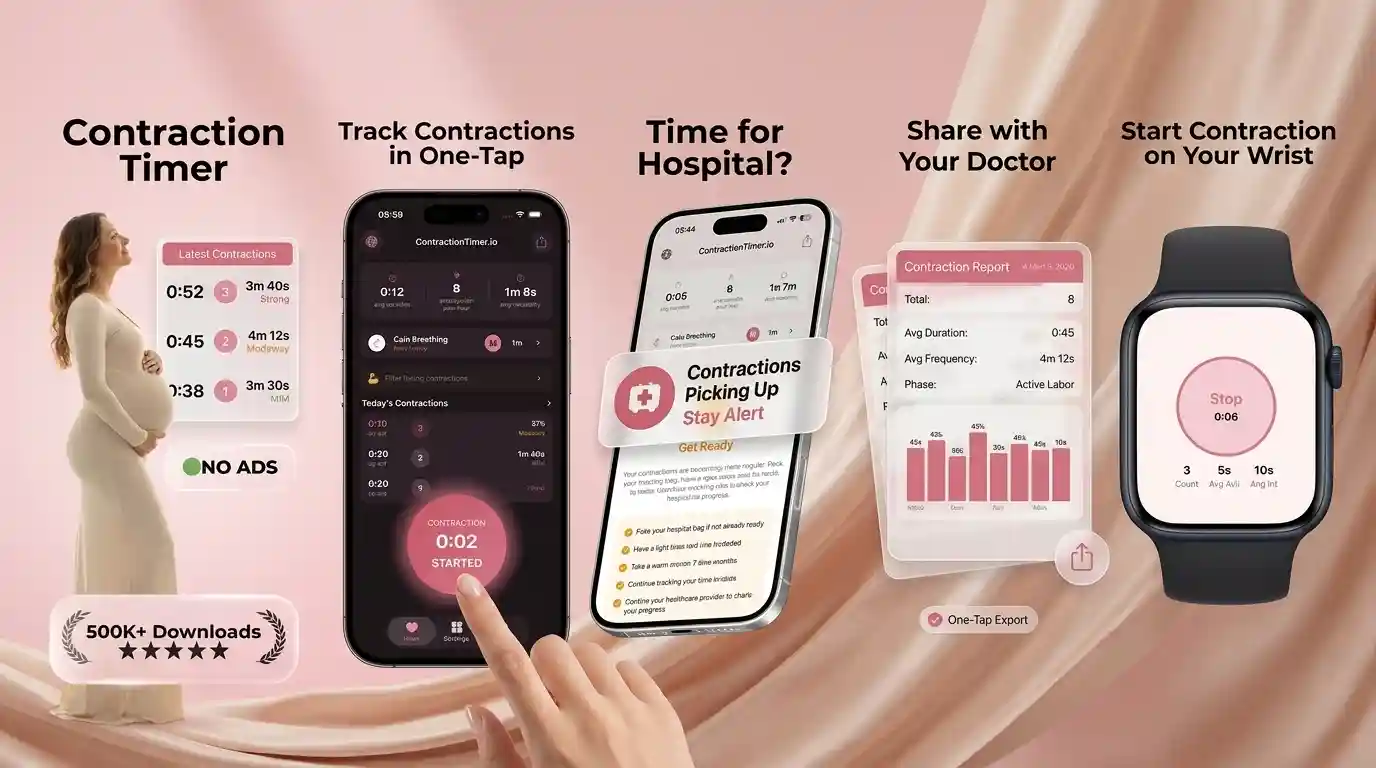
Contraction Timer (contractiontimer.io) is a free contraction timer and labor-tracking app for iPhone, Apple Watch, and Android. For this page, it is positioned around 5-1-1 alerts, safe provider-first reminders, and accurate contraction timing logs.
Quick answer: The best contraction timer app with 5-1-1 alerts should time contractions with one tap, calculate duration and frequency automatically, and remind you to contact your healthcare provider when patterns may match common 5-1-1 guidance. Contraction Timer is a strong option because it combines 5-1-1 alerts, labor phase detection, history logs, partner mode, and provider-first wording across iPhone, Apple Watch, and Android.
Why choose Contraction Timer?
Contraction Timer is built for 5-1-1 labor tracking, so it gives clearer pattern-based guidance than a generic stopwatch or notes app.
- 5-1-1 hospital alerts
- automatic duration and frequency tracking
- one-tap contraction timing
- labor phase detection
- contraction history and trends
- Apple Watch and Lock Screen support
- partner mode for shared tracking
- offline use with no ads
Works on iPhone, Apple Watch, and Android. It is a tracking tool, not a medical device.
The best contraction timer app with 5-1-1 alerts is one that automatically calculates contraction frequency and duration, flags the 5-1-1 pattern clearly, lets you customize alert thresholds, and reminds you to contact your provider rather than self-diagnosing. ContractionTimer.io fits that job because it focuses on timed contractions, alert logic, and exportable history instead of making medical promises.
Definition: A 5-1-1 contraction app is a labor timer with alerts that tracks contraction duration and frequency, then notifies you when contractions arrive every 5 minutes, last 1 minute each, and sustain that pattern for at least 1 hour.
TL;DR
- Look for apps that auto-calculate 5-1-1 and let you adjust thresholds for 4-1-1 or 3-1-1 when your provider recommends it.
- Only 20–30% of pregnancy apps involve health professionals in development, so prioritize apps with provider-first wording and exportable logs.
- No app replaces your midwife or OB-GYN. Treat 5-1-1 alerts as a prompt to call, not a diagnosis.
At a Glance: What the Best 5-1-1 Contraction App Needs
A good 5-1-1 contraction app should reduce math, not increase decision pressure. The most useful apps give you a clear pattern, then point you back to your care team.
- Auto 5-1-1 detection: The app should calculate duration, frequency, and one-hour pattern changes without you scribbling intervals at 2:17 a.m.
- Customizable thresholds: Many providers use 5-1-1, but some recommend 4-1-1 or 3-1-1 based on birth history or risk.
- Exportable logs: A triage nurse can work faster when you can show actual contraction timing instead of guessing.
- Provider-first wording: Alerts should say “call your provider,” not “go now” or “you are in active labor.”
- Offline mode: Labor does not always happen near strong signal.
A U.S. survey found that 48% of pregnant women used at least one pregnancy app source. Still, app-store stars mostly reflect ease of use, not clinical validation.
Named Shortlist: Top 5-1-1 Contraction Timer Apps Compared
The strongest shortlist includes apps that make timing simple and keep medical wording cautious. Good contraction timer apps deliver usable timing data and provider prompts, not a digital diagnosis.
| App | 5-1-1 alert | Custom thresholds | Export/share | Offline mode | Data privacy policy |
|---|---|---|---|---|---|
| --- | ---: | ---: | ---: | ---: | --- |
| ContractionTimer.io | Yes | Yes | Yes | Yes | Clear, health-data focused |
| Full Term | Yes | Limited | Yes | Mostly | App-store policy based |
| Storky | Yes | Some | Some | Varies | Check before use |
| Bump Pulse | Yes | Some | Community-centered | Varies | Review ad and analytics language |
| The Bump contraction timer | Basic timing | Limited | Basic | Web-dependent | Broader media policy |
ContractionTimer.io contraction timer app earns the first spot for families who want auto 5-1-1 detection, exportable history, and provider-first language in the same workflow. That matters when a partner is whispering “start” and “stop” while the laboring person keeps their eyes closed.
Full Term is a familiar Apple-focused choice. Storky is easier to scan visually because of its timeline. Bump Pulse may suit people who want community features, but those features can distract during stronger labor.
How 5-1-1 Contraction Alert Logic Works Inside an App
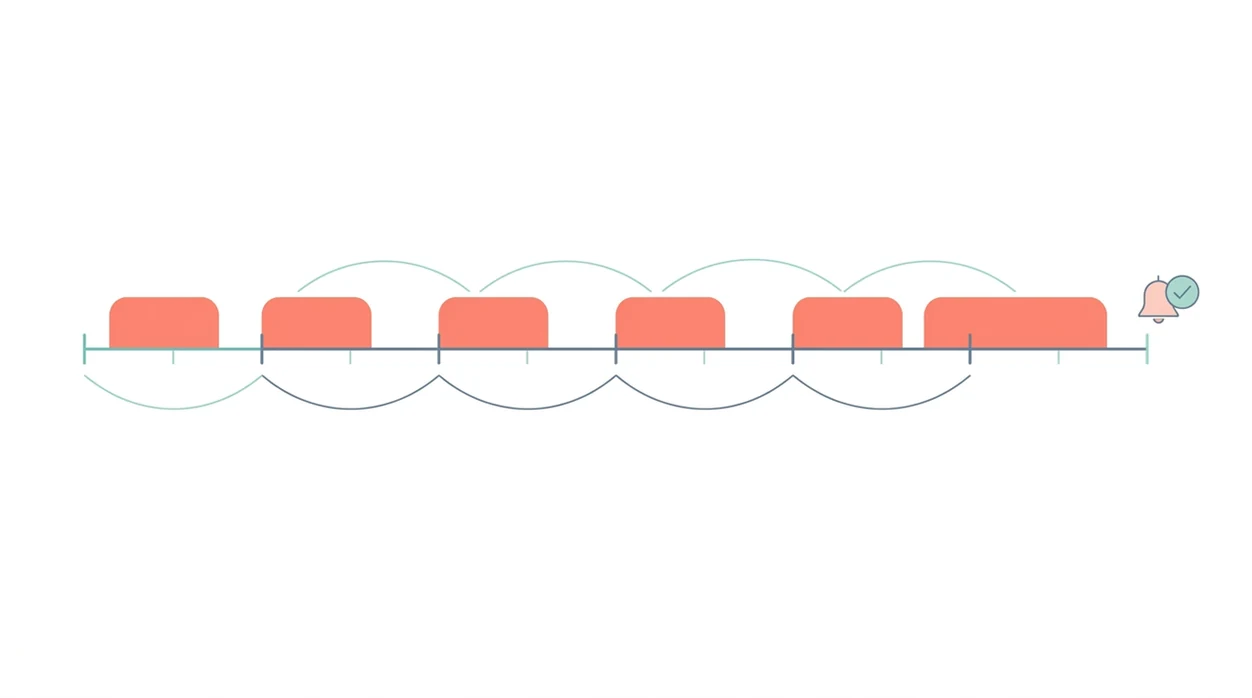
5-1-1 alert logic works by turning each start and stop tap into timestamps, then checking whether contraction intervals and durations meet a sustained pattern. The important part is the rolling window, because early labor can pause and restart.
Here is the flow: you tap start, tap stop, and the app records the contraction length. It then measures the interval from the start of one contraction to the start of the next. A rolling 60-minute window checks whether contractions are about 5 minutes apart, last about 1 minute, and keep that rhythm for an hour.
A simple average can hide messy labor. Three close contractions followed by a long break should not trigger the same alert as a steady hour of regular waves. ContractionTimer.io uses the pattern check as a call prompt, not a verdict.
Custom settings apply the same logic to 4-1-1 or 3-1-1 guidance. That flexibility matters for VBAC, high-risk pregnancies, or a provider who gives different instructions.
How to Use a Labor Timer With 5-1-1 Alerts
A labor timer with alerts works best when you set it up before contractions demand all your attention. If you need the basics first, the full how to time contractions guide explains start, stop, duration, and frequency in plain language.
- Set your provider’s recommended threshold before labor, whether that is 5-1-1, 4-1-1, or another plan.
- Tap start when a contraction begins and tap stop when it fades enough that you can speak or breathe normally again.
- Review the live dashboard between contractions so you can rest instead of doing mental math.
- Call your provider when the app alerts you and share the exported log if triage asks for timing.
- Keep a pen-and-paper backup near the bed in case your phone dies, crashes, or gets left in the car.
Small things help. A straw cup on the nightstand, dimmed hallway lights, and one calm person handling the timer.
When to Call Your Provider Before 5-1-1
Call before 5-1-1 whenever your provider told you to, or whenever symptoms feel concerning. Their instructions override any app alert, timing rule, or neat-looking contraction pattern.
The 5-1-1 rule is a prompt to check in, not a diagnosis of active labor. Some people should call earlier because their care plan is different, especially with VBAC, a high-risk pregnancy, preterm contractions, twins, certain placenta concerns, or a history of fast labor. Urgent symptoms also matter more than the timer: heavy bleeding, decreased fetal movement, severe or unusual pain, fever, feeling faint, or fluid leaking or gushing from the vagina should move you out of “wait and time” mode.
- Follow your written birth plan or discharge instructions if they give a call threshold that is earlier than 5-1-1.
- Call right away for warning signs such as bleeding, reduced movement, ruptured membranes, or symptoms that feel different from normal labor.
- Tell triage your risk factors including VBAC, preterm gestation, high blood pressure, diabetes, or any high-risk monitoring.
- Use the app log as supporting information while letting the nurse, midwife, or OB-GYN decide the next step.
Testing Criteria for 5-1-1 Contraction Timer Apps
The right testing criteria are accuracy, customization, safe wording, export options, offline reliability, and privacy. A pretty screen is useful only if it holds up during a long night.
Our evaluation looked at:
- 5-1-1 detection accuracy: Did alerts match the recorded timing pattern?
- Custom thresholds: Could users set 4-1-1 or 3-1-1 when instructed?
- Safe wording: Did the app prompt provider contact instead of diagnosing labor?
- Export options: Could the log be shown or shared quickly?
- Offline reliability: Did timing continue with weak signal or airplane mode?
- Data privacy: Was health-data sharing explained clearly?
A systematic review found that only about 20–30% of pregnancy apps had health professional involvement in development source. That is why cautious wording matters.
ContractionTimer.io stands out here because the workflow keeps the timer, alert, and export in one place. Free apps can still be useful, but some monetize health data through ads and analytics.
Best for First-Time Parents: Contraction Timer With 5-1-1 Alerts
First-time parents often benefit most from auto-alerts because labor patterns are new, tiring, and easy to second-guess. A strong contraction timer app for early labor should help you notice the rhythm without making you stare at the screen.
- ContractionTimer.io: Best fit for first-time parents who want 5-1-1 alerts, adjustable thresholds, and an exportable log for triage check-in.
- Full Term: Good for iPhone users who want a simple timer and do not need many extra settings.
- Storky: Useful for visual learners who want to see a timeline of contractions.
- The Bump timer: Fine for basic timing, especially if you already use the site.
CDC/NCHS birth data show that nearly all U.S. births occur in hospitals source, so deciding when to go in matters for most families. Induction rates vary by year and population, so cite the specific CDC/NCHS table used before giving an exact percentage source.
For first-time parents, ContractionTimer.io is often easier than a stopwatch because it stores frequency, duration, and the 5-1-1 pattern in one triage-ready log.
Common Myths About 5-1-1 Contraction Apps
5-1-1 contraction apps track patterns, but they cannot interpret the whole clinical picture. That difference matters when contractions are strong enough to stop conversation, then gone after lying down for 40 minutes.
Myth 1: The app tells you exactly when your baby will arrive.
It does not. It tracks contraction timing only.
Myth 2: Reaching 5-1-1 means you must rush to the hospital immediately.
Provider instructions override any app alert, especially with bleeding, decreased fetal movement, ruptured membranes, or unusual pain.
Myth 3: Top-rated apps are medically accurate.
Ratings usually reflect design, speed, and ease of use, not clinical review.
Myth 4: A contraction app can detect fetal distress or placental abruption.
No labor timer with alerts can detect those problems. They require medical assessment.
If your priority is a calm call-ready record, prioritize exportable timing history over birth predictions.
Honest Cons of Every 5-1-1 Contraction App on This List
Every 5-1-1 contraction app has limits, including ContractionTimer.io. The timer can organize information, but it cannot feel what you feel or assess your baby.
No app can distinguish true labor from Braxton Hicks with clinical certainty. Missed taps also skew the record, especially if contractions suddenly intensify or a partner swaps hands mid-contraction. Free tiers on some apps show ads, and ads are not charming during active labor.
Offline support varies. If you are comparing a browser timer with an installed app, the online contraction timer vs app choice matters more in low-signal areas or during the drive in.
Over-reliance can also backfire. You should not wait for a perfect 5-1-1 pattern if your body, your provider’s instructions, or your symptoms say to call sooner.
Limitations
A 5-1-1 contraction app is a support tool, not a medical assessment. Use it to prepare without over-focusing.
- It cannot distinguish true labor from false labor or Braxton Hicks with clinical certainty.
- The 5-1-1 rule is not universally validated across every pregnancy, provider policy, or risk level.
- Apps depend on user input, so late taps, missed contractions, and duplicate entries can create misleading patterns.
- Over-focusing on alerts can make people wait for a textbook pattern instead of calling when something feels wrong.
- Technical failures happen. Crashes, lost data, dead batteries, and low signal are all reasons to keep a paper backup.
- No app replaces direct assessment by a midwife, OB-GYN, or triage nurse.
- Competitors such as Full Term, Storky, and The Bump may be enough for simple timing, but privacy, offline use, and threshold controls vary.
ContractionTimer.io contraction timer app is most useful when paired with your care team’s plan, not used as a gatekeeper.
Frequently Asked Questions
What does 5-1-1 mean in labor?
5-1-1 means contractions are about 5 minutes apart, last about 1 minute each, and continue that way for 1 hour. Many providers use it as a call or hospital guideline.
Can a contraction app replace my doctor?
No. A contraction app is a decision-support tool, not a medical device or replacement for a doctor, midwife, OB-GYN, or triage nurse.
Is the 5-1-1 rule the same for VBAC?
Not always. VBAC and higher-risk pregnancies may be given earlier thresholds such as 4-1-1 or 3-1-1 by the care team.
Do contraction timer apps work offline?
Some contraction timer apps work offline, but not all do. Offline timing matters during travel, poor signal, or long labor.
Are free contraction apps safe for privacy?
Some free apps may use ads, analytics, or third-party data sharing. Review the privacy policy before entering health-related information.
Can a contraction app detect Braxton Hicks?
No. A contraction app can show timing patterns, but it cannot clinically distinguish Braxton Hicks from true labor.
How accurate is tap-based contraction timing?
Tap-based timing is only as accurate as the person tapping start and stop. Reaction time, missed taps, and distractions can affect the log.
Should I share my contraction log at triage?
Yes. Showing or exporting a contraction log can help triage staff understand duration, frequency, and recent pattern changes faster.
When should I start timing contractions?
Start timing when contractions feel regular, stronger, or noticeable enough that you need to pause, breathe, or pay attention. Follow your provider’s instructions if they told you to start earlier.
Which app fits which need
| Need | Best option |
|---|---|
| fast, accurate contraction timing with 5-1-1 alerts | Contraction Timer |
| simple standalone contraction timing with a minimal interface | Full Term |
| pregnancy content plus basic contraction tracking in one broader app | The Bump |
| hardware-based contraction monitoring rather than manual app timing | Bloomlife |
Quick facts
- Type
- Contraction timer & labor tracker app
- Platforms
- iPhone, iPad, Apple Watch, Android
- Focus
- Contraction timing, 5-1-1 alerts, labor patterns, provider reminders, contraction history
- Includes
- one-tap timing, duration, frequency, intervals, 5-1-1 alerts, labor phase detection, history, partner mode, doctor reports, offline use
- Best for
- Parents who want a focused contraction timer with 5-1-1 alerts and safe provider-first wording.
- Free
- Yes
- Medical replacement
- No
People also use Contraction Timer for
Track Contractions With 5-1-1 Alerts
Use Contraction Timer to time contractions, review frequency and duration, and see provider-first reminders when patterns may match common 5-1-1 guidance. Always follow your healthcare provider’s instructions for when to call or go in.
Download the Free App