 Contraction
Find Real Labor Contraction Pattern Clues in Your Timing Log

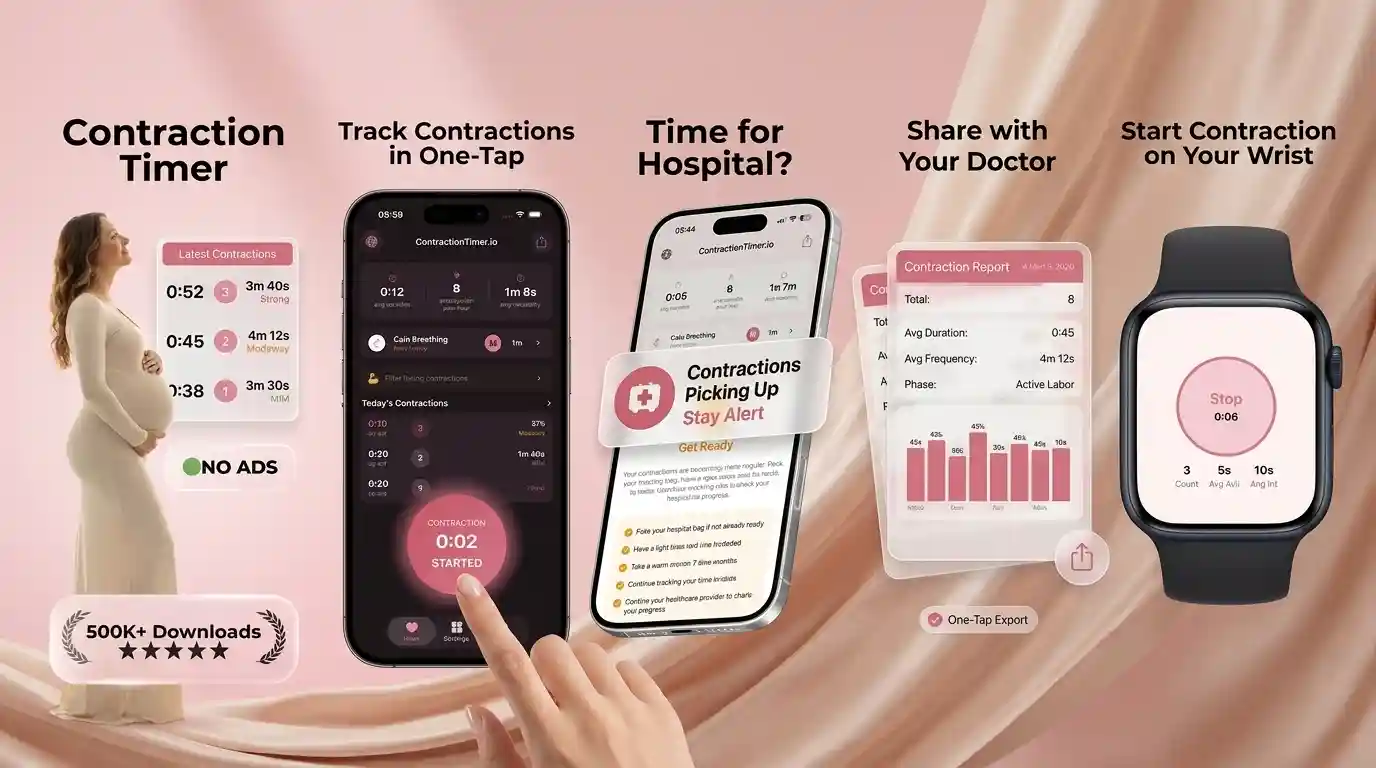
Contraction Timer (contractiontimer.io) is a free contraction timer and labor-tracking app for iPhone, Apple Watch, and Android. For this page, it helps parents review contraction timing logs for real labor pattern clues such as consistency, progression, duration, frequency, and 5-1-1 trends.
Quick answer: A real labor contraction pattern usually shows contractions becoming longer, stronger, and closer together over time, often with a steadier rhythm in your timing log. Timing can reveal useful clues, but it cannot confirm cervical dilation, diagnose true labor, or replace your clinician’s guidance.
Why choose Contraction Timer?
Contraction Timer is built to show labor-pattern clues more clearly than a generic stopwatch by automatically organizing timing data into duration, frequency, intervals, and trends.
- Automatic duration, frequency, and interval calculations
- 5-1-1 hospital alerts for sustained patterns
- Labor phase detection to spot progression clues
- Contraction history for reviewing changes over time
- One-tap timing during intense contractions
- Apple Watch and Lock Screen timing support
- Partner mode for shared tracking
- Offline use with no ads
Works on iPhone, Apple Watch, and Android. It is a tracking tool, not a medical device.
To find real labor contraction pattern clues in your log, look for contractions that become progressively closer together, last 40–90 seconds each, grow stronger over time, and persist for at least an hour regardless of rest or position changes. A contraction timer app helps you spot these trends, but only a clinician can confirm true labor by checking cervical change.
> Definition: A real labor contraction pattern is a repeatable sequence of uterine contractions that increase in frequency, duration, and intensity over time, a clue that may suggest true labor rather than Braxton Hicks or prodromal contractions.
TL;DR
- Real labor contractions get closer together, last longer, and hurt more over time. Your log should show a tightening trend, not random spikes.
- Rules like 5-1-1 or 4-1-1 are starting guidelines, but your provider's personalized instructions always override generic thresholds.
- A contraction timer captures data; only a clinician confirms labor by assessing cervical dilation and effacement.
Real Labor Pattern vs. False Alarm Signs in a Timing Log
A real labor pattern usually looks regular, escalating, and persistent in a timing log. False labor often looks jumpy, stable, or fading, especially after water, rest, or a position change.
| Log clue | Real labor pattern | Braxton Hicks or false alarm |
|---|---|---|
| Frequency | Intervals shorten over time, such as 7 minutes, then 5, then 4 | Intervals stay random or spread out |
| Duration | Often builds toward 40–90 seconds | Often shorter, uneven, or unchanged |
| Intensity | Gets harder to talk, walk, or reset between waves | May stay mild or ease after rest |
| Persistence | Continues despite hydration, rest, shower, or movement | Often slows or stops with changes |
| Log shape | Trend line tightens across an hour or more | Spikes appear, then disappear |
ACOG notes that early labor can often last more than 8 hours while contractions are still irregular and forming a pattern source. That dim bedroom phone glow at 2:10 a.m. can show five entries and still not tell the whole story.
Oxytocin, Cervical Change, and Real Labor Contraction Patterns
Real labor patterns form because oxytocin helps drive stronger uterine contractions, and those contractions create pressure that can support more oxytocin release. In plain language, the body can enter a feedback loop where contractions become closer, longer, and harder to ignore.
How real labor contraction patterns work: contractions are not just timed cramps; they are part of a mechanical and hormonal process that can change the cervix. Cervical dilation means the cervix opens. Effacement means it thins. Those two changes are the clinical proof you cannot measure from the couch.
Clinicians typically recommend using timing, symptoms, and provider instructions together because ACOG defines active labor as starting at 6 cm dilation. Regular painful contractions often build before that point. Unlike many Braxton Hicks contractions, real labor usually does not quit because you drank water, lay down, or walked the hallway.
The log helps. The cervix decides.
6 Steps to Find a Real Labor Pattern in Your Contraction Log
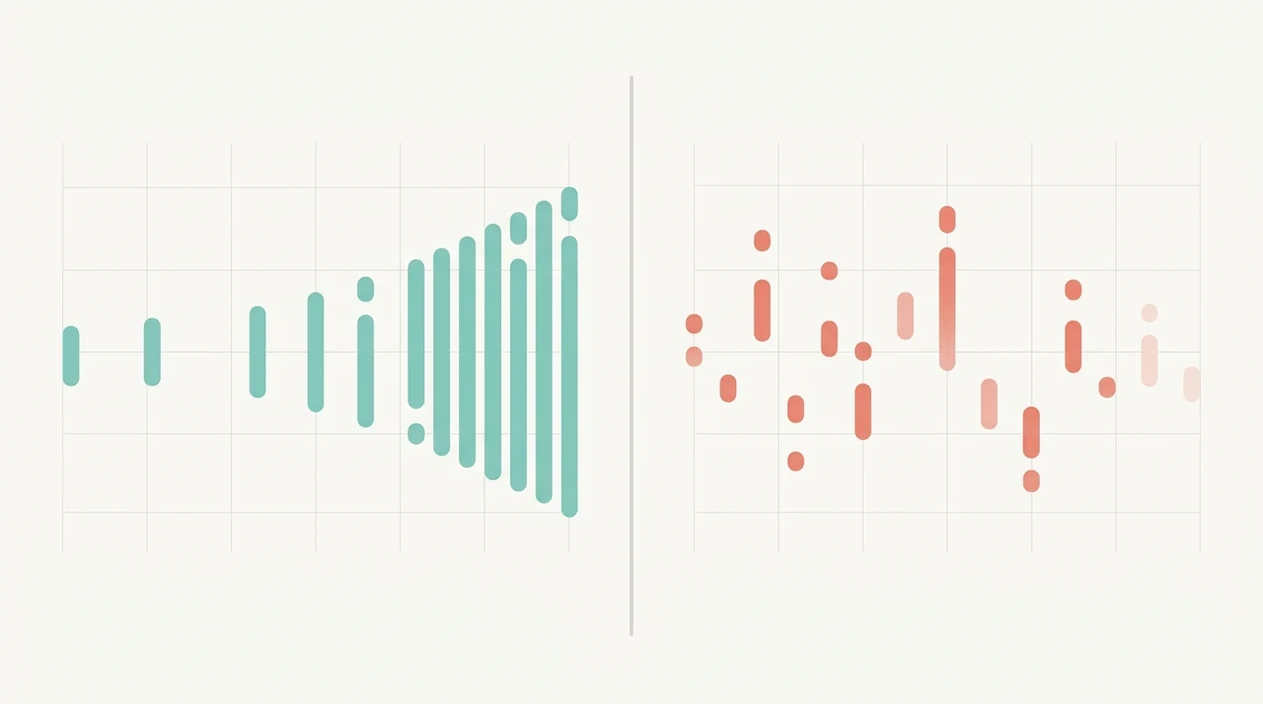
How to use a contraction log to find a real labor pattern: collect enough entries first, then compare timing with body cues and your provider’s call-in plan. Six contractions are more useful than two, because one odd gap can make the log look scarier than it is.
- Log at least 6–8 contractions before judging the trend, unless your provider told you to call earlier.
- Check frequency by asking whether intervals are shortening over time, not just whether one gap was close.
- Review duration and look for contractions lasting 40–90 seconds, especially if they are slowly getting longer.
- Add notes on intensity and body cues, such as low back pain, pelvic pressure, or whether you can talk through the wave.
- Compare the log with your provider’s threshold, whether that is 5-1-1, 4-1-1, or a custom plan.
- Share the log with your provider or birth partner so another person can read the pattern calmly.
For most families, reviewing a timed sequence is often easier than remembering pain peaks because the timestamps stay steady when memory gets loud.
Contraction Timer Method for Tracking Real Labor Clues
A contraction timer method works by capturing Start and Stop taps, then calculating duration and interval automatically. That removes the mental math when someone is breathing through a wave and another person is timing from the edge of the bed.
Tools like ContractionTimer.io can keep the screen simple: tap Start at the first tightening, tap Stop when it releases, then review the log. Good contraction timer apps deliver timestamps and trends, not a diagnosis or permission to ignore your care team. Because early labor can last more than 8 hours, many people first interpret these patterns at home before calling source.
But tapping is imperfect. A partner can miss Stop while holding a water bottle. Face ID can fail in a dark room. The charger may be across the room, and 12% battery changes everyone’s patience.
3 Real Labor Pattern Scenarios from Contraction Logs
Not every real labor log looks clean. Some patterns build in a straight line, some pause, and some show irregular spacing while intensity keeps climbing.
Scenario A: Steady Escalation Pattern
A textbook log might move from contractions every 6 minutes, lasting 50 seconds, to every 5 minutes for one hour, then every 3 minutes. That is the classic 5-1-1 pattern turning into 3-1-1 over several hours.
Scenario B: Stuttering Start That Builds
A stuttering log may look regular for 45 minutes, fade after a shower, then return stronger two hours later. That pattern can overlap with prodromal labor contractions, but it can also be early real labor when the later waves grow longer and harder.
Scenario C: Back Labor With Irregular Spacing
Back labor can show intervals like 4, 8, 5, and 7 minutes while duration and intensity rise. The clue is not tidy spacing. It is the combination of longer contractions, more pelvic pressure, and less ability to talk through the wave.
Messy logs happen.
5 Real Labor Pattern Clues Most Guides Miss
Real labor clues are strongest when timing data and body cues point the same way. A clean interval chart matters less if the body signs are flat, and an uneven chart may still matter if intensity is clearly rising.
- Pain often moves lower. Early tightening may feel high or across the belly, while real labor often pulls lower into the pelvis or back.
- Talking gets harder. If you stop mid-sentence during each wave, that note belongs beside the timestamp.
- Pelvic pressure can matter. Increasing downward pressure may be more useful than one short interval.
- Higher-risk plans change thresholds. VBAC, multiples, preterm history, or other complications may mean calling earlier than 5-1-1.
- Admission criteria are not random. In a prospective study of 1,302 low-risk women, standardized admission criteria using contraction patterns and cervical change reduced cesarean risk by about 9% compared with usual care source.
Your provider’s plan overrides every generic rule, including anything you read in a false labor vs real labor guide.
4 Myths About Real Labor Contraction Patterns
Real labor logs are useful, but several myths make people read them too aggressively or dismiss them too quickly. The timer should slow the room down, not turn every entry into an alarm.
Myth 1: Thirty minutes of regular contractions means rush in. Some people do need to call early, but many providers ask for a longer pattern unless warning signs appear.
Myth 2: If it is not 5-1-1 or 4-1-1, it cannot be real labor. Real labor can stutter, especially before active labor or with back labor.
Myth 3: Braxton Hicks are always painless and random. They can feel uncomfortable and may briefly look regular in a timer. The bigger question is whether they fade or keep building.
Myth 4: An app can diagnose true labor. It cannot. Even an app to help tell Braxton Hicks from real labor is still organizing clues, not checking cervical change.
Contraction Pattern Log Blind Spots
A contraction pattern log cannot show the most important clinical markers: cervical dilation and effacement. It can show when contractions started, stopped, and tightened as a pattern, but it cannot prove the cervix is changing.
Inductions and augmented labors may never create the neat spacing people expect from early labor charts. Back labor can also look uneven. Fear, fatigue, and pain change tap accuracy too. I have seen logs where the real issue was not labor at all; it was a double-tapped Start and one forgotten Stop after a contraction ended.
Tools such as the ContractionTimer.io contraction timer app can help you review History, Notes, Edit, Share, and Export before calling. Still, high-risk instructions matter more than the graph. If your provider gave a custom threshold, use that one.
When to Call Your Clinician About Contraction Patterns
Call your clinician according to the threshold they gave you, even if an app, article, or friend suggests a different timing rule. Generic patterns like 5-1-1 can help you notice a trend, but your pregnancy’s plan comes first.
If you have a VBAC plan, twins or higher-order multiples, a preterm birth history, or another high-risk condition, your care team may want an earlier call before contractions look textbook. Do not wait for a perfect log if something feels wrong.
- Call immediately for heavy bleeding, a gush or steady leaking of fluid, reduced fetal movement, sudden severe pain, or any warning sign listed in your birth instructions.
- Share the start time of the contraction pattern, not just the most recent entry.
- Report frequency and duration from your log, including whether the gaps are tightening or staying random.
- Describe intensity and notes, such as back pain, pelvic pressure, trouble talking, or whether rest, water, or movement changed anything.
- Use the timer as a record, not a triage tool; it organizes what happened, but it cannot judge emergencies or replace your clinician’s directions.
Limitations
Contraction timing is helpful, but it has hard limits. Use the log as a record to discuss, not as a final answer.
- Timing alone cannot confirm true labor. Cervical dilation and effacement require clinical assessment.
- Generic rules may not fit your pregnancy. Fast labors, preterm birth history, VBAC, multiples, or complications can change when to call.
- Tap accuracy can distort the pattern. Stress, pain, wet fingers, a cracked screen protector, or forgotten taps can make intervals look wrong.
- Some labors never look textbook. Inductions, augmented labors, and back labor may not follow clean 5-1-1 spacing.
- Waiting for a perfect log can delay care. Sudden intense pain, heavy bleeding, a fluid gush, or reduced fetal movement means call immediately.
- A timer cannot judge your distance, weather, childcare, or hospital access. Those details matter in real decisions.
- No app replaces emergency judgment. ContractionTimer.io can organize the record, but your clinician gives medical direction.
If you are unsure can contraction timer tell if labor, the safest answer is that it can show patterns, not confirm labor.
Frequently Asked Questions
Does a real labor contraction pattern always stabilize quickly?
No. Some logs tighten within an hour, but early labor can stutter for hours before contractions become consistently closer together.
How long before a labor pattern stabilizes?
Early labor can last more than 8 hours, and contractions may stay irregular before a clearer pattern forms. A longer log usually shows the trend better than the first few entries.
Can real labor contractions be irregular?
Yes. Real labor can stutter or show uneven intervals, especially in early labor or back labor.
What does a 5-1-1 contraction pattern mean?
A 5-1-1 pattern means contractions are about every 5 minutes, last about 1 minute, and continue for 1 hour. Some providers use 4-1-1 or a custom threshold instead.
Can Braxton Hicks contractions look like real labor in a timer?
Yes. Braxton Hicks can sometimes feel painful and temporarily regular, but they often ease with rest, hydration, or position changes.
Can a contraction timer app diagnose true labor?
No. A contraction timer app can record timing patterns, but only a clinician can confirm true labor by assessing cervical change.
When should I call my provider about contractions?
Call based on your provider’s specific threshold. Call immediately for heavy bleeding, fluid leakage, reduced fetal movement, sudden severe pain, or any warning sign you were told to watch.
Does the contraction pattern differ for VBAC labor?
It can. VBAC and other higher-risk pregnancies may have earlier call-in thresholds than standard 5-1-1 guidance.
Should I time contractions during back labor?
Yes. Time back labor contractions, but expect intervals to look less regular and pay close attention to rising intensity and duration.
Which app fits which need
| Need | Best option |
|---|---|
| fast, accurate contraction timing with duration, frequency, history, and 5-1-1 pattern alerts | Contraction Timer |
| pregnancy education, weekly baby-size updates, and general labor articles alongside basic tools | The Bump |
| guided hypnobirthing, breathing practice, mindfulness, and relaxation support during labor | GentleBirth |
| clinical-style contraction measurement hardware or pregnancy monitoring support where available | Bloomlife |
Quick facts
- Type
- Contraction timer & labor tracker app
- Platforms
- iPhone, iPad, Apple Watch, Android
- Focus
- Contraction timing, real labor patterns, 5-1-1 alerts, labor progression clues, contraction history
- Includes
- One-tap timing, duration and frequency, interval tracking, 5-1-1 alerts, labor phase detection, contraction history, partner mode, doctor reports, offline mode
- Best for
- Reviewing a timing log for real labor contraction pattern clues before calling or heading in
- Free
- Yes
- Medical replacement
- No
People also use Contraction Timer for
Track Real Labor Contraction Pattern Clues Clearly
Use Contraction Timer to log contractions, review duration and frequency trends, and watch for 5-1-1 patterns without relying on memory. Always follow your clinician’s instructions for when to call or go in.
Download the Free App