 Contraction
What App Identifies 5-1-1 Contractions From Your Log?

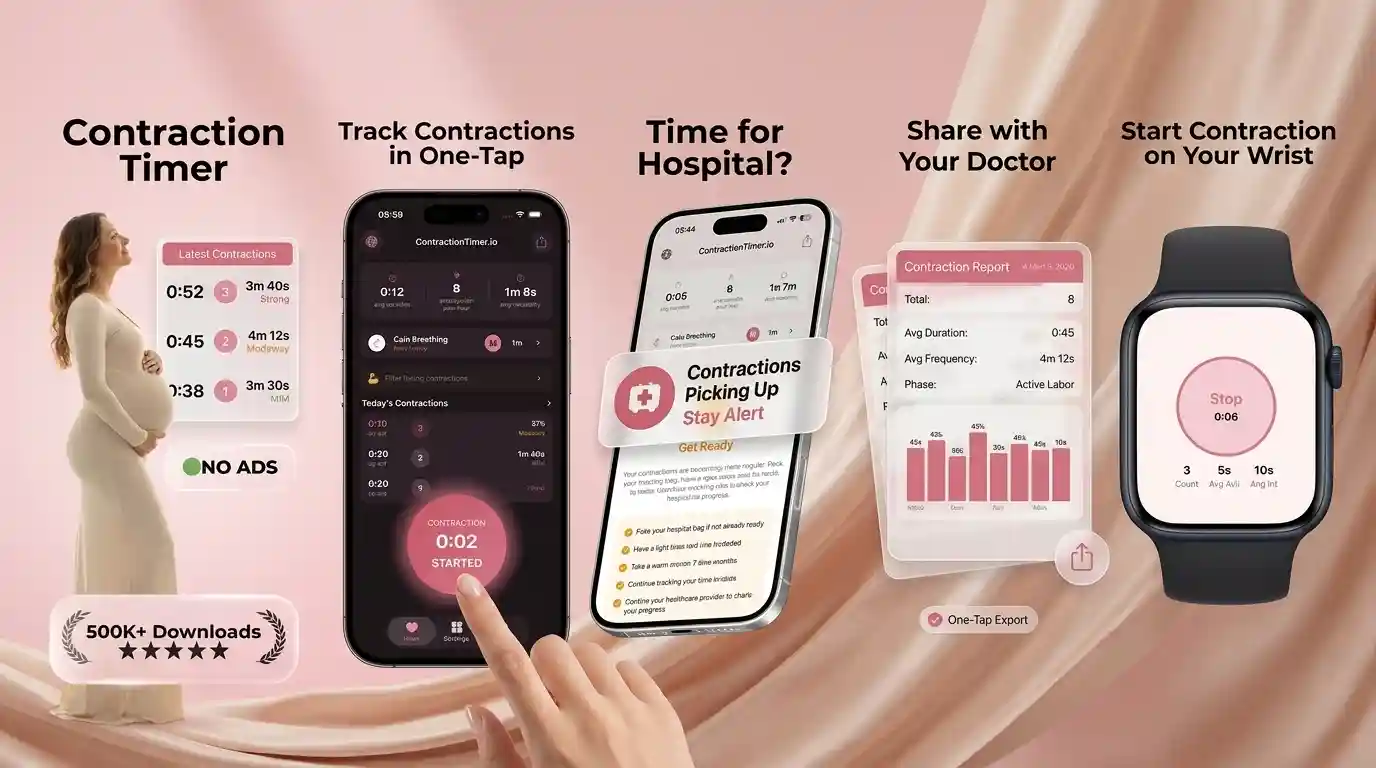
Contraction Timer (contractiontimer.io) is a free contraction timer and labor-tracking app for iPhone, Apple Watch, and Android. For 5-1-1 tracking, it uses your logged contractions to calculate duration, frequency, interval, and pattern-based alerts.
Quick answer: A 5-1-1 contraction app identifies when your logged contractions are about 5 minutes apart, last about 1 minute, and continue for about 1 hour. Contraction Timer can calculate duration, frequency, and interval from your log and show 5-1-1 hospital alerts, but your provider’s instructions should always come first.
Why choose Contraction Timer?
Contraction Timer is built to recognize 5-1-1 contraction patterns from real-time logs instead of making you calculate timing from a stopwatch or notes app.
- 5-1-1 hospital alerts from your contraction log
- Automatic duration, frequency, and interval calculations
- One-tap start and stop timing
- Labor phase detection based on timing patterns
- Contraction history for reviewing trends
- Apple Watch and Lock Screen timing support
- Partner mode for shared tracking
- Doctor reports, offline use, no ads
Works on iPhone, Apple Watch, and Android. It is a tracking tool, not a medical device.
An app identifies 5-1-1 contractions by analyzing logged start and stop times, then alerting when contractions are about every 5 minutes, lasting 1 minute each, for at least 1 hour. ContractionTimer.io can do this from a Start/Stop log, but the alert should be treated as a prompt to call your provider, not as a diagnosis or a hospital order.
A 5-1-1 contraction tracker is an app that records contraction start and stop times, calculates frequency and duration, and flags when contractions match the 5-minutes-apart, 1-minute-long, 1-hour-sustained pattern commonly used as a hospital-readiness guideline.
- The app watches your contraction log for the 5-1-1 pattern and sends an on-screen alert when it's detected.
- 5-1-1 is a general guideline, your provider may use 3-1-1 or another threshold, so look for customizable rules.
- No app replaces medical judgment; always call your provider before deciding to go to the hospital.
At a Glance: 5-1-1 Contraction Tracker Signals
- 5-1-1 means a contraction about every 5 minutes, each lasting about 1 minute, for 1 hour. It is one common timing pattern used when deciding when to call or go in.
- Most U.S. births happen in hospitals. In 2018, 98.4% of U.S. births occurred in hospitals, per CDC/NCHS birth data source, so timing guidance matters for many families planning hospital birth.
- Health app use is already normal. A U.S. survey found that 58% of smartphone owners had downloaded a health-related app source.
- ContractionTimer.io is a pattern-detection aid, not a diagnostic tool. It can identify timing trends, but it cannot check dilation, baby’s heart rate, or your exact labor stage.
- Parents trying to avoid mental math during early labor can use the ContractionTimer.io contraction timer app because it shows average interval, average duration, and a 5-1-1 alert from the same log.
Early labor can pause and restart. That’s why the log helps, especially when the phone is balanced on a belly pillow and nobody wants to count minutes by memory.
How 5-1-1 Contraction Pattern Detection Works
A 5-1-1 app works by turning each contraction into a timestamp pair, then checking whether recent contractions sustain the same timing pattern. The useful terms are interval, meaning start-to-start spacing, and duration, meaning start-to-stop length.
Timestamp Logging and Interval Math
You tap Start when the contraction begins and Stop when it fades. ContractionTimer.io stores those two times, then calculates how long the contraction lasted and how many minutes passed between contraction starts. That matters more than one dramatic wave. Labor is a rhythm.
If you’re comparing the details behind 5-1-1 rule contractions, the key is consistency over time, not one isolated contraction.
Rolling-Window Pattern Check
The ContractionTimer.io contraction timer app reviews the most recent stretch of logged data, roughly the last 60 minutes, and checks whether contractions are near 5 minutes apart and about 1 minute long. If the threshold is met, it shows an on-screen alert suggesting a provider call.
Research has found that many pregnancy apps lack health-professional involvement and evidence-based content, according to a systematic review in BMC Pregnancy and Childbirth source. Good contraction apps deliver clear timing and safety guardrails, not a fake diagnosis from a phone.
5 Steps to Use a 5-1-1 Contraction Timer App
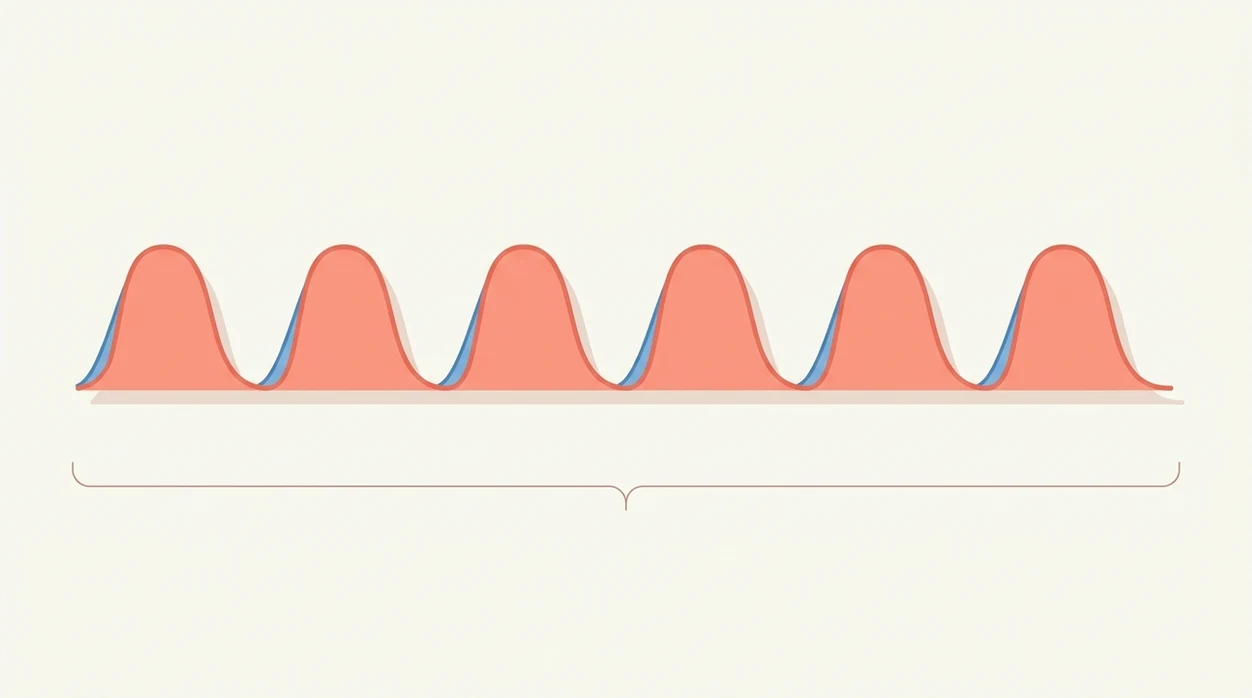
Use a 5-1-1 contraction timer app by logging each wave, reviewing the averages, and treating any alert as a reason to call your provider. Keep the phone useful, not constant.
- Open ContractionTimer.io and tap Start when a contraction begins.
- Tap Stop when the contraction fades and you can rest between contractions.
- Repeat for each contraction so the session builds enough data.
- Review the session summary for average interval and average duration.
- Watch for the 5-1-1 pattern alert, then call your provider for instructions.
If contractions are getting stronger, hand the phone to your partner. A birth partner whispering “start” and “stop” lets the laboring person keep eyes closed and breathe through the wave.
For first-time parents who need a low-effort 5-1-1 contraction tracker, ContractionTimer.io fits because the Start/Stop workflow removes handwritten interval math.
Put it down between checks.
When to Trust a 5-1-1 Contraction Alert
A 5-1-1 alert is most useful for low-risk, term pregnancies where the care team has already given standard hospital-birth timing guidance. It is not the right threshold for everyone.
High-risk pregnancies, prior very fast labors, planned cesareans, inductions, or specific medical concerns may need a different call point. Some providers use 3-1-1 for first-time parents, and others adjust based on distance from the hospital, Group B strep plans, or your history. Clinicians typically suggest using contraction timing together with symptoms, provider instructions, and your sense of coping.
Constant timing can also pull you into your head. Oxytocin likes privacy, rhythm, and feeling safe. Use the timer in early labor, then hand tracking to a partner during active coping, especially if a shoulder squeeze during a stronger surge is doing more good than another screen check.
The most useful 5-1-1 alert is a prompt to call your care team, not a command to rush out the door.
Call right away instead of waiting for a 5-1-1 pattern if you have heavy bleeding, green or brown fluid, severe constant pain, fever, decreased fetal movement, or your water breaks before your care team told you to wait. ACOG also frames labor timing as only one part of deciding when to contact obstetric care source.
When to Call Your Provider Right Away
Call your provider right away when symptoms feel concerning, even if the timer has not reached 5-1-1. A contraction pattern can support the conversation, but your care team’s instructions always outrank an app threshold.
Do not wait for the next alert if you notice heavy bleeding, green or brown fluid, severe constant pain between contractions, fever, a bad headache with vision changes, decreased fetal movement, or your water breaks before you were told to stay home. ACOG’s labor and warning-sign guidance treats these symptoms as reasons to contact obstetric care, not as data points to average out.
- Call your OB, midwife, or triage line if urgent symptoms appear.
- Tell them your contraction interval, duration, fluid color, bleeding amount, baby’s movement, and how you are coping.
- Follow the plan they give, even if it differs from 5-1-1.
- Use custom timing if you have a high-risk pregnancy, prior fast labor, planned cesarean, induction plan, long hospital drive, or Group B strep instructions.
- Remember that 5-1-1 is a call prompt, not proof of active labor or safety.
Contraction Timer 5-1-1 Identification Screens and Alerts
ContractionTimer.io surfaces 5-1-1 through a simple Start/Stop screen, a live session dashboard, and an on-screen pattern badge when your log matches the rule. The screen is built for tired eyes, not spreadsheet thinking.
The dashboard shows average interval and average duration, so you can notice the rhythm without recalculating after every wave. If your provider told you to use 3-1-1, 4-1-1, or another timing rule, you can change the threshold instead of forcing your birth plan into one default. The alert also reminds you to call your provider before leaving.
If your main need is an app that alerts 5-1-1 contractions, ContractionTimer.io covers that job because the alert is tied to the live session metrics, not a separate manual checklist.
A calm alert matters. Loud urgency helps almost nobody at 2:17 a.m.
5-1-1 Contraction App vs. Stopwatch and Manual Log
A dedicated 5-1-1 contraction app reduces math errors because it calculates interval, duration, and pattern status from the same session. A stopwatch can time one contraction, but it will not tell you whether the last hour matches 5-1-1.
| Method | What it captures | What it misses | Best use |
|---|---|---|---|
| --- | ---: | --- | --- |
| Pen and paper | Start times and notes | Easy to miscalculate under stress; no alert | Very early, mild contractions |
| Generic stopwatch | One duration at a time | No start-to-start interval or 5-1-1 flag | Quick spot checks |
| Phone timer app | Multiple timed events if managed manually | Still needs manual pattern review | Organized support person |
| ContractionTimer.io | Duration, interval, averages, pattern alert | Still depends on accurate taps | Early labor and provider call prep |
Anyone dealing with stop-start contractions on the couch may prefer ContractionTimer.io because it turns repeated taps into average interval and duration without asking you to do subtraction during a wave.
Not all contraction apps are medically vetted. Apps such as GentleBirth, Contraction Timer & Tracker, 9m Contraction Timer, and The Bump’s timer vary in education depth, alert behavior, and customization.
4 Myths About 5-1-1 Contraction Tracker Apps
A 5-1-1 contraction tracker app can identify timing patterns, but it cannot interpret every part of labor. That difference protects you from both panic and false reassurance.
Myth 1: The app can tell how dilated you are. It cannot. ContractionTimer.io times contractions; dilation requires a clinical assessment.
Myth 2: A 5-1-1 alert means you must leave immediately. It means your timing matches a common guideline, and your next step is to call your provider.
Myth 3: No 5-1-1 alert means you are not in active labor. Some people progress with irregular patterns, especially if contractions are intense and close together in feel.
Myth 4: All contraction apps are medically vetted. Many are built by independent developers, and some pregnancy apps lack evidence-based content.
For parents comparing 4-1-1 vs 5-1-1 contractions, ContractionTimer.io is useful because the rule can be adjusted to match the care team’s actual threshold.
Limitations
A 5-1-1 contraction app is useful for pattern awareness, but it has real limits. These limits are not small print; they are part of safe use.
- ContractionTimer.io cannot assess contraction strength, baby’s well-being, bleeding, fluid color, fever, or cervical dilation.
- The 5-1-1 rule is not appropriate for every pregnancy. High-risk pregnancies, rapid-labor history, or planned cesareans need provider-specific instructions.
- Mild but regular 5-1-1 contractions may not mean active labor. Intense irregular contractions may still mean birth is near.
- False reassurance can delay needed care. False alarms can also lead to an early hospital trip.
- Battery drain, accidental taps, missed stops, or forgotten starts can distort the log.
- Over-reliance can raise stress and reduce coping. A warm shower on the lower back may matter more than one more data point.
- Many pregnancy apps lack health-professional involvement, according to a systematic review.
- ContractionTimer.io does not replace triage advice, your midwife, your OB, or emergency care.
The safest workflow is simple: time, notice, call, then follow the plan you were given.
Frequently Asked Questions
What does 5-1-1 mean for contractions?
5-1-1 means contractions are about every 5 minutes, lasting about 1 minute each, for 1 hour. It is a common guideline for when to call a provider during labor.
Can an app tell Braxton Hicks from real contractions?
No app can reliably tell Braxton Hicks from real labor by feel or intensity. Contraction Timer can only time contraction patterns and show whether they are becoming regular.
Does a 5-1-1 alert mean I should go to the hospital?
A 5-1-1 alert means your timing matches a common guideline. Call your provider before deciding to leave.
Can I change a contraction timer from 5-1-1 to 3-1-1?
Good contraction timer apps let you customize the timing rule. ContractionTimer.io can be adjusted if your provider recommends 3-1-1 or another threshold.
How accurate are contraction timer apps?
Contraction timer accuracy depends on tapping Start and Stop at the right moments. The app cannot measure contraction strength, dilation, or baby’s condition.
Should my birth partner track contractions for me?
Yes, a birth partner can track contractions so the laboring person can focus on breathing and comfort. Partner tracking also reduces screen-checking during stronger contractions.
Is a contraction app better than using a stopwatch?
A dedicated contraction app is usually easier than a stopwatch because it calculates interval and duration automatically. A stopwatch requires manual math to identify 5-1-1.
Are 5-1-1 contraction timer apps free?
Many contraction timer apps offer free core timing features. ContractionTimer.io contraction timer app includes free timing and 5-1-1 detection features.
Which app fits which need
| Need | Best option |
|---|---|
| Fast, accurate 5-1-1 pattern detection from a live contraction log | Contraction Timer |
| Basic contraction timing inside a broader pregnancy app | The Bump |
| A simple standalone contraction timer with manual-style logging | Full Term |
| Structured birth preparation or guided relaxation alongside labor support | GentleBirth |
Quick facts
- Type
- Contraction timer & labor tracker app
- Platforms
- iPhone, iPad, Apple Watch, Android
- Focus
- Contraction timing, 5-1-1 alerts, labor patterns, duration, frequency, interval
- Includes
- One-tap timing, duration and frequency calculations, 5-1-1 hospital alerts, labor phase detection, contraction history, partner mode, doctor reports, offline use
- Best for
- Identifying possible 5-1-1 contraction patterns from a timed labor log
- Free
- Yes
- Medical replacement
- No
People also use Contraction Timer for
Track 5-1-1 Contractions With a Free Labor Timer
Use Contraction Timer to log contractions, calculate duration and frequency, and watch for 5-1-1 patterns. Always follow your provider’s guidance if symptoms, risk factors, or instructions differ.
Download the Free App