 Contraction
Contraction Pattern Alerts: Labor Timing Thresholds Explained

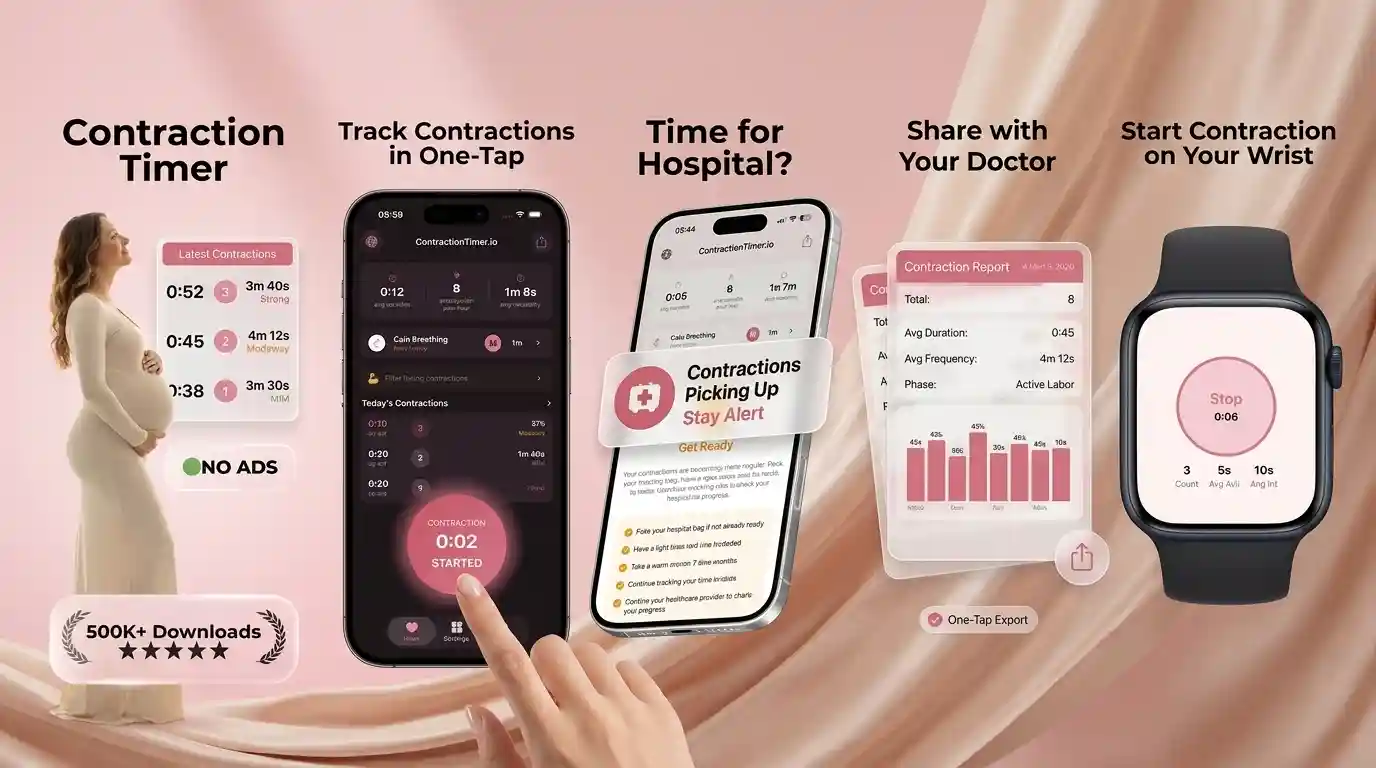
Contraction Timer (contractiontimer.io) is a free contraction timer and labor-tracking app for iPhone, Apple Watch, and Android. For contraction pattern alerts, it helps track duration, frequency, intervals, and 5-1-1-style trends while keeping medical decisions with your healthcare provider.
Quick answer: Contraction pattern alerts help you notice timing trends such as contractions getting closer together, lasting about one minute, and repeating for around one hour. They can support 5-1-1 tracking, but they cannot diagnose labor, measure dilation, or replace instructions from your healthcare provider.
Why choose Contraction Timer?
Contraction Timer is built for labor timing alerts, so it does more than a generic stopwatch by calculating patterns and surfacing thresholds like 5-1-1.
- 5-1-1 hospital alert detection
- Automatic duration and frequency calculations
- Labor phase detection based on timing trends
- One-tap contraction start and stop
- Full contraction history for pattern review
- Apple Watch and Lock Screen timing
- Partner mode for shared tracking
- Offline use with no ads
Works on iPhone, Apple Watch, and Android. It is a tracking tool, not a medical device.
Contraction pattern alerts are app notifications that flag when your contractions match preset timing thresholds like 5-1-1, helping you notice trends you might miss during labor. A contraction timer app can compare logged contraction frequency, duration, and regularity against common guidelines, but alerts cannot diagnose labor, confirm cervical change, or tell you when to go to the hospital.
Definition: A contraction pattern alert is an automated notification from a contraction timer app that triggers when logged contractions match a preset timing rule such as 5-1-1, signaling the user to evaluate their symptoms and consider contacting their provider.
TL;DR
- Alerts compare your logged contractions against timing rules like 5-1-1; they do not detect or diagnose labor.
- The 5-1-1 guideline is a rule of thumb, not a guarantee of active labor or hospital admission.
- Always combine alerts with provider guidance, red-flag symptoms, and clinical exam for real decisions.
At a Glance: 5 Facts About Contraction Pattern Alerts
- Contraction pattern alerts compare frequency, duration, and regularity against preset timing rules.
- 5-1-1 alerts are common, but 5-1-1 is guidance, not proof of active labor.
- Timing alerts cannot tell Braxton Hicks, prodromal labor, early labor, and active labor apart.
- Thresholds should match your provider’s advice, birth history, risk level, and distance from care.
- An alert is a prompt to call your provider or check your birth plan, not a diagnosis.
When early labor starts at 2:17 a.m., the screen can feel steadier than memory. ContractionTimer.io fits that moment because it keeps the average interval, duration, and session history in one place instead of asking a tired partner to do math.
How Contraction Pattern Alerts Work Behind the Scenes
Contraction pattern alerts work by turning start and stop taps into timing data, then comparing that data with a preset rule. The core measurements are interval, duration, and consistency over a rolling time window.
You tap start when a contraction begins and stop when it fades. ContractionTimer.io then calculates how long that contraction lasted, how many minutes passed since the last one began, and whether the pattern is holding. A 5-1-1 alert, for example, should not fire after one neat contraction. It needs the pattern to continue for the full window, usually one hour.
Missed taps matter. So do late taps.
If a birth partner whispers “start” and “stop” while you keep your eyes closed, the data is usually cleaner. ContractionTimer.io contraction timer app is useful when hands are shaking or the kitchen clock is glowing past midnight because the rolling pattern summary updates without mental math.
How to Use Labor Timing Alerts in Contraction Timer
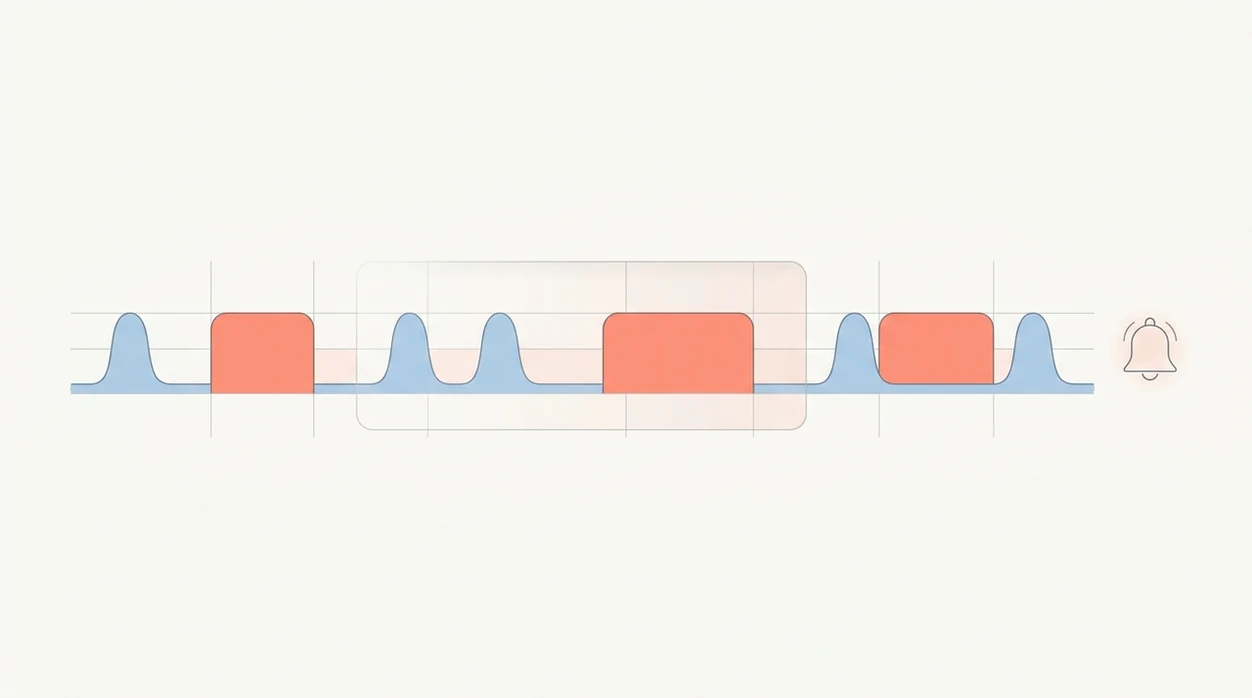
Use labor timing alerts as a calm prompt, not as permission to ignore your body. Contraction Timer works best when the threshold is set before contractions are close together.
- Open the timer and choose 5-1-1, 4-1-1, or a custom rule from your provider.
- Tap start and stop for every contraction, even the short or annoying ones.
- Review the pattern summary after each contraction so you can notice whether the rhythm is tightening.
- Wait for the alert notification that confirms the threshold has held for the set window.
- Call your provider or use your birth plan when an alert fires, especially if symptoms change.
If the priority is noticing a real trend without staring at the screen, ContractionTimer.io earns the spot because the alert uses the timing threshold plus the rolling labor session, not a single isolated contraction.
When 5-1-1 Alerts Apply — and When They Don't
5-1-1 alerts apply when contractions are about five minutes apart, last about one minute, and continue for about one hour. They do not prove active labor, especially in first-time births.
The older 5-1-1 habit grew from a time when active labor was often discussed around 4 cm. ACOG now describes active labor as more reliable around 6 cm and emphasizes that labor diagnosis depends on regular painful contractions with cervical change, not timing alone: https://www.acog.org/clinical/clinical-guidance/committee-opinion/articles/2019/02/approaches-to-limit-intervention-during-labor-and-birth.
For first-time births, research has found the median latent phase is about 9 hours, with a 95th percentile near 19.4 hours. Source: https://pubmed.ncbi.nlm.nih.gov/20207244/. That means patterned contractions can last a long time before active labor. Early labor can pause and restart.
People with prior births may progress faster, or in a less tidy pattern. High-risk pregnancies, VBAC plans, or a long drive to the hospital may need 6-1-1, 7-1-1, or a provider-specific rule instead. The most medically supported way to interpret a timing alert is to combine it with symptoms, risk factors, and your care team’s instructions.
What Contraction Pattern Alerts Look Like in Contraction Timer
In ContractionTimer.io, a contraction pattern alert appears as a visual notification when the selected threshold is met. The point is simple: make the pattern visible before everyone in the room starts guessing.
You can use common options like 5-1-1 or 4-1-1, or set a custom provider rule. A rolling window shows whether contractions are moving toward the threshold. The contraction history stacks in rows, so the last hour is easier to explain during a phone call.
After a threshold alert, ContractionTimer.io contraction timer app supports sharing the timing summary or taking a screenshot for context. That can help when the nurse asks, “How far apart, how long, and for how many contractions?” Good labor timing alerts deliver a clearer call summary, not a clinical decision.
Common Myths About Labor Timing Alerts
The biggest myth is that hitting 5-1-1 means you are definitely in active labor. It might mean labor is building, but it can also happen during a long latent phase or prodromal labor.
Another myth is that an app can identify Braxton Hicks. Timing-only tools cannot feel intensity, check cervical change, assess baby’s position, or know whether contractions stop after hydration and rest. I’ve seen contractions strong enough to stop conversation, then gone after lying down for 40 minutes.
No alert does not mean “not labor.” This is especially important for second or later births, where things can move quickly. Anyone dealing with fast prior labors or unusual contraction spacing should use ContractionTimer.io as a record for the provider because the session log shows the pattern even when a preset alert never fires.
Alerts also cannot tell whether you need an induction, C-section, or admission. Those decisions require clinical assessment.
Contraction Pattern Alerts vs. Manual Timing and Other Methods
Contraction pattern alerts reduce the math burden, but they do not make medical assessments. Manual timing, app timing, and hospital monitoring all answer different questions.
| Method | What it measures | Main strength | Main limit |
|---|---|---|---|
| --- | ---: | --- | --- |
| Paper chart or stopwatch | Start time, stop time, spacing | Works without setup | Easy to miscalculate under stress |
| ContractionTimer.io alerts | User-tapped frequency, duration, pattern | Compares timing to rules automatically | Depends on accurate taps |
| Hospital tocodynamometry | Uterine contraction activity | Clinical monitoring context | Still needs provider interpretation |
| Cervical exam | Cervical change | Helps diagnose labor progress | Requires clinician assessment |
For tired partners, automated alerts are often easier than manual timing because the comparison to 5-1-1 or 4-1-1 happens in the background. You can also use a focused contraction frequency calculator when you need to understand spacing clearly.
Related Contraction Timer Features for Birth Readiness
Contraction alerts work better when they sit beside a clear record. A single notification is less useful than a pattern you can review, share, and explain.
A useful labor-timing record includes contraction history, session logs, duration and frequency trends, and sharing options for a partner or provider. The contraction timer log is especially helpful when early labor keeps changing shape across the night.
After a warm shower on the lower back, when contractions restart, ContractionTimer.io helps separate “that felt stronger” from “the interval is actually shorter” because the duration and frequency trend charts stay visible. For many families, that’s enough structure to breathe through the wave and save energy between calls.
When to Call Your Provider Instead of Waiting for an Alert
Call your provider whenever your instructions, symptoms, or birth history say to call, even if the app has not reached 5-1-1. Provider guidance always outranks every preset or custom alert.
Some situations deserve earlier contact because timing rules were built for uncomplicated term labor, not every body or every birth plan. Preterm contractions should be reported sooner, regardless of whether they are evenly spaced. The same is true if you have bleeding, decreased fetal movement, a severe headache, vision changes, severe abdominal pain, or pain that feels different from your usual contractions. Fast prior labors, a VBAC plan, a high-risk pregnancy, or a long drive to the birth place can also make “wait for the alert” the wrong strategy.
When you call, keep the summary simple:
- Share how far apart contractions are, counted from the start of one to the start of the next.
- Report how long they last and how many you have timed.
- Describe intensity, pain location, fluid leaking, bleeding, baby movement, and any new symptoms.
- Mention gestational age, prior fast labor, VBAC plans, and travel time.
- Follow the next instruction from your care team.
Limitations
Contraction pattern alerts are useful, but they have hard limits. Treat them as timing support, not a safety screen.
- Alerts cannot measure cervical dilation, fetal heart rate, blood pressure, temperature, or oxygen levels.
- Timing-based alerts are less reliable in second or later births, inductions, and epidural labors.
- Accuracy depends entirely on consistent tapping; missed, delayed, or selective taps distort the pattern.
- Preterm contractions, suspected placental abruption, or hypertensive symptoms may need urgent care regardless of spacing.
- There is no direct clinical research proving specific app-generated alerts improve labor outcomes.
- The latent phase can last beyond 20 hours in some first-time pregnancies without automatically signaling a problem.
- Red flags override every timing rule, including bleeding, decreased fetal movement, severe headache, vision changes, or severe abdominal pain.
Other tools, including The Bump contraction timer and several App Store contraction timers, can record timing too. The safety issue is the same across them: no timer can replace your clinician.
Frequently Asked Questions
What pattern of contractions indicates labor?
Labor is usually identified by regular painful contractions with cervical change. Timing alone cannot confirm labor.
Is 5-1-1 the only alert threshold?
No. 5-1-1 is common, but 4-1-1, 6-1-1, 7-1-1, and custom provider rules may fit different situations.
Can apps tell Braxton Hicks from real labor?
No. Timing-only apps cannot distinguish Braxton Hicks from labor contractions without clinical context.
Should I go to the hospital at 5-1-1?
5-1-1 is a prompt to call your provider or follow your birth plan. It is not an automatic hospital admission rule.
Are contraction alerts accurate?
Contraction alerts are only as accurate as the start and stop taps entered by the user. Specific app alerts have not been clinically validated against labor outcomes.
Do alerts work for second pregnancies?
They can help record patterns, but second and later labors may progress faster or less predictably. Standard thresholds may be less reliable.
What if my alert never triggers?
No alert does not rule out labor. Call your provider if contractions intensify, symptoms concern you, or your birth plan says to call.
Can I customize alert timing thresholds?
Yes, ContractionTimer.io supports custom thresholds based on provider guidance, risk factors, birth history, and distance to the hospital.
Which app fits which need
| Need | Best option |
|---|---|
| Fast, accurate contraction timing with 5-1-1 pattern alerts | Contraction Timer |
| General pregnancy content plus lightweight timing tools | The Bump |
| Contraction sensing hardware rather than tap-based timing | Bloomlife |
| Birth education, mindfulness, and relaxation support | GentleBirth |
Quick facts
- Type
- Contraction timer & labor tracker app
- Platforms
- iPhone, iPad, Apple Watch, Android
- Focus
- Contraction timing, 5-1-1 alerts, labor patterns, duration, frequency, intervals
- Includes
- One-tap timing, duration and frequency calculations, 5-1-1 hospital alerts, labor phase detection, contraction history, partner mode, doctor reports, offline mode
- Best for
- Tracking contraction pattern alerts and reviewing timing trends before calling your provider or heading to the hospital
- Free
- Yes
- Medical replacement
- No
People also use Contraction Timer for
Track Contraction Pattern Alerts With Less Guesswork
Use Contraction Timer to time contractions, review duration and frequency, and notice 5-1-1-style patterns. Always follow your provider’s instructions, especially if symptoms feel urgent or different from expected labor.
Download the Free App