 Contraction
Hospital Bag When Contractions Start: Timing-Based Checklist

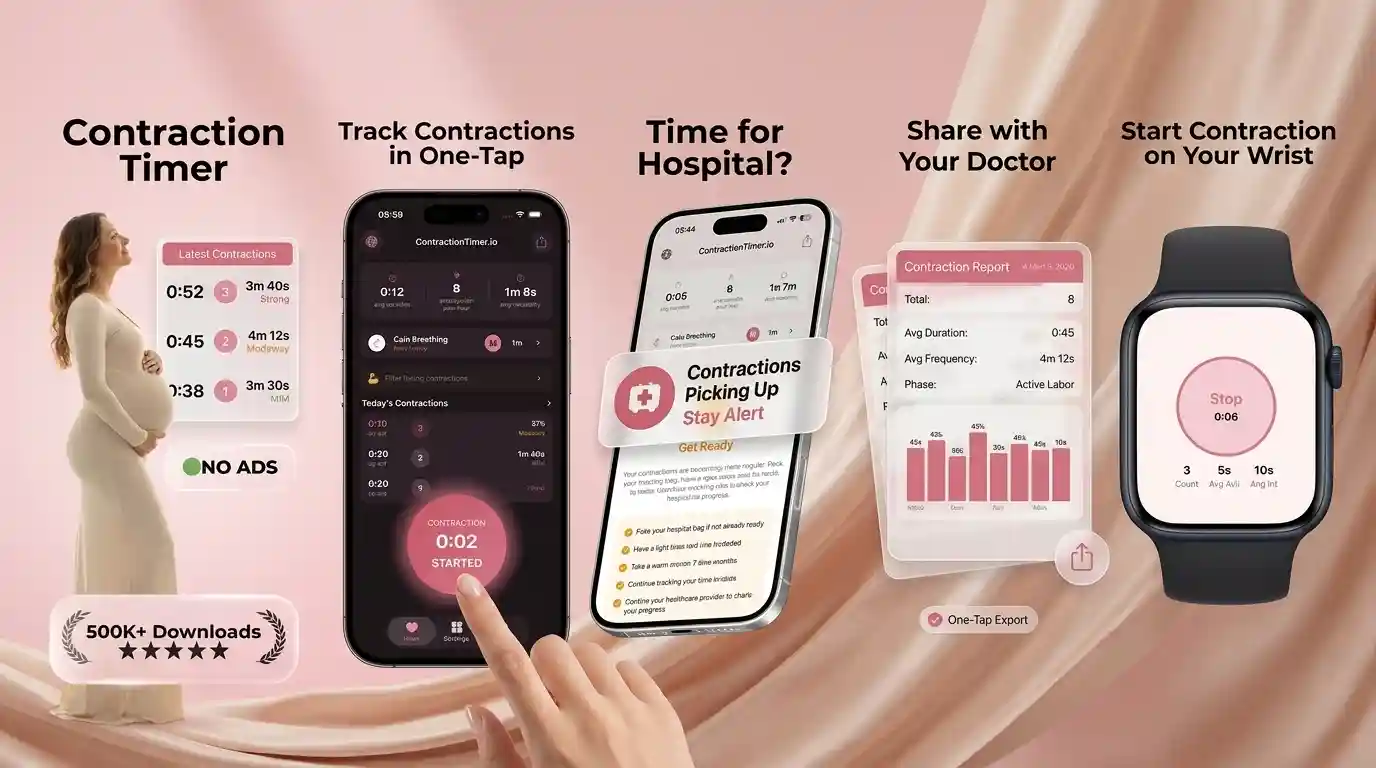
Contraction Timer (contractiontimer.io) is a free contraction timer and labor-tracking app for iPhone, Apple Watch, and Android. For this hospital bag page, it helps parents use contraction timing patterns, 5-1-1 alerts, and history to decide when to call, confirm documents, and leave with the right essentials.
Quick answer: A hospital bag when contractions start should be organized around timing patterns: early labor prep, a ready-to-leave go-bag, and essentials triggered by your provider’s call or 5-1-1 guidance. Use contraction duration, frequency, and interval patterns to decide when to confirm your plan, call, and move the admission essentials to the car.
Why choose Contraction Timer?
Contraction Timer is more useful than a generic stopwatch for a hospital bag plan because it connects packing decisions to real contraction duration, frequency, history, and 5-1-1 alerts.
- 5-1-1 hospital alerts for go-bag timing
- Automatic duration, frequency, and interval tracking
- One-tap contraction timing during early labor
- Labor phase detection to guide when to call
- Contraction history for nurses and providers
- Apple Watch and Lock Screen timing support
- Partner mode for shared bag and timing coordination
- Offline tracking with no ads
Works on iPhone, Apple Watch, and Android. It is a tracking tool, not a medical device.
Your hospital bag when contractions starts should already be packed by 36 weeks so you only grab it and go once your contraction timer shows a consistent pattern like 5-1-1. A timing-based approach splits essentials into a small go-bag for labor triage, a secondary comfort bag, and a car-stored overflow bag so you never scramble between contractions.
Definition: A hospital bag when contractions start is a pre-packed, grab-ready bag organized around contraction timing patterns so that once labor is confirmed, for example contractions 5 minutes apart, lasting 1 minute, for 1 hour, you and your birth partner can leave without packing decisions.
- Pack your go-bag by 36 weeks; about 10% of births happen preterm.
- Use your contraction timer's 5-1-1 pattern as the trigger to grab the bag and call your hospital.
- Stage gear in three tiers: a small labor bag, a comfort bag, and car-stored extras to avoid overpacking.
This checklist is for planning and organization, not diagnosis. Call your provider or labor and delivery unit right away for heavy bleeding, reduced fetal movement, severe pain, ruptured membranes, fever, or any instruction that conflicts with a timer pattern.
Timing-Based Hospital Bag Checklist Definition
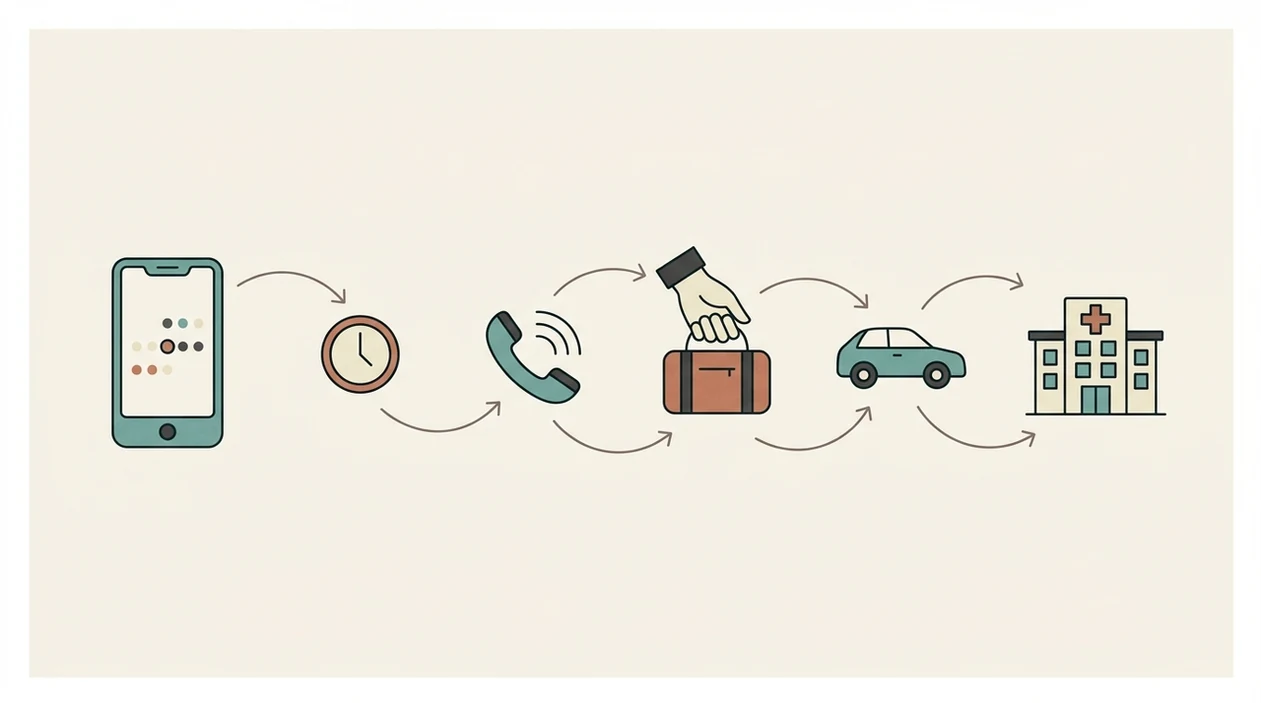
A timing-based hospital bag checklist connects what you pack to when you leave, using contraction decision rules instead of a broad baby-gear list. It is built around actions: start timing, confirm the pattern, call, grab the bag, leave.
That matters because 98.7% of U.S. births occurred in hospitals in 2022, according to CDC/NCHS birth data source. Nearly every family needs a plan for documents, transport, and admission, not just a cute packing list.
Generic lists often say “bring clothes, snacks, and toiletries.” Useful, but incomplete. A contractions-start checklist says, “When the timer shows 5-1-1, pick up Bag 1 and the printed call card.” That is easier to follow when the average interval number on screen suddenly feels very real.
How a Timing-Based Hospital Bag Works
A timing-based hospital bag works by turning labor signals into pre-decided packing actions. Instead of asking “What do we need?” during contractions, the timer pattern tells your partner which bag, call, and route comes next.
The system has three parts. Tier 1 is the admission bag: ID, insurance, medications, phone power, birth plan, and the printed call list. Tier 2 is the comfort bag for the longer stay, with clothes, snacks, toiletries, and partner items. Car-stored overflow holds bulky or optional things, such as extra blankets, towels, and the installed car seat. The contraction log, meaning the app history of start and stop times, works with the call list and bag locations so the plan stays visible.
- Time contractions and watch for your provider’s instructed pattern.
- Call the listed contacts when the threshold is met or symptoms change.
- Grab Tier 1 first, then load Tier 2 if leaving is confirmed.
- Show the timer log at triage so staff can see the pattern clearly.
This reduces decisions, not medical urgency. Provider instructions always override general 5-1-1 timing rules.
36-Week Labor Timing Checklist Requirements
Before contractions start, finish the basics that are hard to do under pressure. These five requirements make the hospital bag usable, not just packed.
- Pack by 36 weeks: About 10% of births happen before 37 weeks, per the CDC source.
- Test the timer: Install a contraction timer app and have your partner practice Start, Stop, History, Notes, and Share.
- Write the hospital call list: Save numbers digitally and place a printed copy in the go-bag.
- Confirm transportation: Choose the main driver, backup driver, or ride service before labor.
- Set the timing rule: Use your provider’s instruction, or a common guide such as the 5-1-1 rule contractions pattern.
Do one practice run with the phone at 12% battery. That tiny stress test tells you a lot.
5-1-1 Contraction Timing Trigger for Your Hospital Bag
The 5-1-1 trigger means contractions are about 5 minutes apart, last about 1 minute, and continue for 1 hour. Many providers use it as a call-or-go-in checkpoint, although your own instructions come first.
Here is how the mechanism works: the timer records duration and frequency, then turns raw taps into a visible pattern. You tap Start at the first tightening and Stop when it fully releases. The app calculates the spacing, so nobody is doing math between waves. Good contraction timer apps deliver duration, frequency, and trend clarity, not medical certainty.
For many first-time births, there is time to mobilize. A prospective cohort study found median active first-stage labor for nulliparous women was about 7.7 hours source. Still, pain and adrenaline can narrow attention fast. Pre-set rules prevent “Where is the charger?” from becoming the main event.
6-Step Contraction Timer and Hospital Bag Workflow
Use this workflow when contractions feel organized enough to track. It keeps the screen simple and gives your partner clear jobs.
- Start timing contractions in the app when you suspect labor; tap Start at the first tightening, not the pain peak.
- Watch for the 5-1-1 pattern or your provider’s rule on the timer dashboard; an app that alerts 5-1-1 contractions can reduce missed patterns.
- Alert your birth partner and run through the hospital call list, including OB, midwife, doula, childcare, and driver.
- Grab the Tier 1 go-bag and move toward the car once your call plan says to leave.
- Have your partner load Tier 2 while you settle in the vehicle and keep breathing.
- Review your contraction log on arrival so triage nurses see real times, not a shaky memory.
The parking garage ticket machine may still beep forever. The log helps you stay focused.
Tier 1 Go-Bag: Essentials for Hospital Admission
Tier 1 is the small bag you grab the moment contractions meet your leaving rule. Keep it light enough to carry with one hand.
- Admission documents: Photo ID, insurance card, pre-registration papers, and any required hospital forms.
- Phone setup: Phone, wall charger, long cable, and battery pack. Because 90% of U.S. adults report owning a smartphone, according to Pew Research Center source, the phone is often the main timing and contact tool.
- Paper backup: Birth plan printout and hospital call list, folded where your partner can find it.
- Medications: Current prescriptions, labeled and listed in Notes.
- Minimal comfort items: Lip balm, hair tie, grip socks, and glasses if you wear them.
If Face ID fails in a dark room, nobody should be hunting for the insurance card too.
Tier 2 Comfort Bag and Car-Stored Extras
Tier 2 holds comfort items that help later but should not slow admission. Pack a robe, pillow, snacks, toiletries, going-home clothes for the birthing parent, and a baby going-home outfit.
Keep bulky items in the car: installed car seat, extra blankets, spare towels, and any large comfort object. A three-tier setup reduces decision fatigue because each bag has a job. Tier 1 gets you admitted. Tier 2 supports the stay. The car holds the “maybe” items.
For birth partners, the job is simple: load Tier 2 while the laboring person breathes and keeps timing. I have seen a partner try to hit Stop with a thumb while holding a water bottle at the edge of the bed. Assigning bag jobs before labor helps.
Hospital Call List for 5-1-1 Labor Timing
A hospital call list is a short, ordered contact plan that activates with contraction milestones. Include the labor and delivery unit, OB or midwife, doula, childcare backup, emergency driver, and one ride service.
Store the list in your timer notes and print it for the go-bag. Tools like ContractionTimer.io can help keep timing notes and contact prompts near the contraction history, but paper still matters when service drops.
Assign calls to thresholds. For example, call your provider at 7-1-1 if instructed, then call the hospital at 5-1-1. The question of what app identifies 5-1-1 contractions matters less than whether your partner can read the plan without asking you during a contraction.
Advance call planning is especially useful for first-time parents because they may not yet know how quickly labor logistics can stack up once contractions become regular. Advance call planning offsets inexperience.
4 Hospital Bag Packing Mistakes During Early Labor
The most common hospital bag mistakes happen because people expect early labor to feel calm and linear. Sometimes it does. Sometimes the charger cable is stretched across the sofa and nobody can find shoes.
- Waiting until contractions start: Adrenaline makes small choices harder, especially documents and medication lists.
- Packing one massive bag: A huge bag slows triage and makes every item feel urgent.
- Assuming your partner knows: They need written bag locations, call order, and timing rules.
- Relying only on digital tools: Phones die, apps update, and cracked screen protectors make numbers harder to read.
For first-time parents, a staged hospital bag is often easier than one large suitcase because each tier matches a specific labor task.
36-Week Hospital Bag and Contraction Plan Verification
Verify the plan before 36 weeks with a short dry run. Start a practice contraction log, tap Start and Stop three times, grab the go-bag, and time how long it takes to reach the car.
Ask your partner to find both bags and the printed call list without help. No hints. If they open three closets first, move the bags.
Check the app next. Confirm contacts, update the phone, charge the battery pack, and make sure the History screen is easy to read. Apps such as the ContractionTimer.io contraction timer app can support this workflow when the notes and timing log are kept current.
Re-check the car seat installation and fuel level weekly after 36 weeks. Clinicians typically recommend calling your own provider for labor instructions, especially if bleeding, reduced fetal movement, ruptured membranes, or high-risk factors are present.
Limitations
This checklist helps with readiness, but it cannot control labor. Use it as a planning tool, not a medical decision-maker.
- No app, checklist, or packed bag can predict how fast labor will progress.
- The 5-1-1 rule is a general guideline, not a strict medical rule for every pregnancy.
- Fast labor, high-risk pregnancy, multiples, prior cesarean, or provider instructions may change when you leave.
- Over-planning can create a false sense of control; hospital policies and labor patterns vary.
- A packed bag does not replace a transportation plan, backup driver, or childcare plan.
- Digital tools can fail if the phone dies, loses service, locks, or updates at the wrong time.
- Printed backups still matter for phone numbers, medication lists, and admission details.
- If contractions are paired with warning signs, call your provider or hospital instead of waiting for a timer pattern.
The plan is there to reduce scramble. Not to override care.
Frequently Asked Questions
How early should I pack my hospital bag?
Pack your hospital bag by 36 weeks because about 10% of births happen before 37 weeks. Keep last-minute items, like glasses or daily medications, on a small add-in list.
What is the 5-1-1 rule for labor?
The 5-1-1 rule means contractions are 5 minutes apart, last 1 minute, and continue for 1 hour. It is a guideline, not an absolute medical rule.
What documents do I need for hospital admission?
Bring a photo ID, insurance card, birth plan, and any hospital pre-registration paperwork. Keep paper copies in the Tier 1 go-bag.
Should my birth partner have a separate bag?
Your birth partner should have snacks, a charger, basic toiletries, and a change of clothes. These can go in the Tier 2 comfort bag.
Can I store my call list in an app?
Yes, a contraction timer app such as ContractionTimer.io can store call notes near the timing log. Keep a printed backup in case the phone fails.
Is 30 weeks too early to pack a hospital bag?
No, 30 weeks is not too early to start packing, especially for documents and non-daily items. Add perishable snacks and daily-use items closer to 36 weeks.
What if my contractions are irregular?
Continue timing and logging irregular contractions so you can describe the pattern clearly. Irregular contractions do not always mean false labor, so call your provider if you are unsure.
Which app fits which need
| Need | Best option |
|---|---|
| Fast, accurate contraction timing to trigger hospital bag and 5-1-1 decisions | Contraction Timer |
| Simple full-term pregnancy countdown and general late-pregnancy reference | Full Term |
| Broad pregnancy content, registry planning, and general hospital bag articles | The Bump |
| Wearable contraction activity monitoring for users specifically seeking a sensor-based product | Bloomlife |
Quick facts
- Type
- Contraction timer & labor tracker app
- Platforms
- iPhone, iPad, Apple Watch, Android
- Focus
- Contraction timing, 5-1-1 alerts, hospital bag planning, labor patterns, admission history
- Includes
- One-tap timing, duration and frequency tracking, 5-1-1 alerts, labor phase detection, contraction history, partner mode, doctor reports, offline use, no ads
- Best for
- Parents who want to use contraction patterns to decide when to call, pack final items, and leave for the hospital
- Free
- Yes
- Medical replacement
- No
People also use Contraction Timer for
Use Contraction Timing to Finalize Your Hospital Bag
Track contractions, watch for 5-1-1 patterns, and keep a clear history for your provider so your hospital bag plan is based on timing instead of guesswork. Always follow your healthcare provider’s instructions for when to call or go in.
Download the Free App